Issue Nº 07 — October 2026
Verified — Audi
Audi’s Fastest Car Ever Has a Lamborghini Heart.
2027 Audi Nuvolari · October 14, 2026 · Preview
Full disclosure: The Torque Wrench hasn’t driven it — nobody outside Audi has. What exists today is a near-production prototype, a spec sheet, and a handful of Formula 1 drivers’ impressions. This is the verified breakdown, not a road test.
For twenty years, Audi’s answer to the supercar question was the R8: a V10 you could daily-drive, a car you could park at the shops. Production ended in 2024, and the assumption was that whatever came next would be electric, sensible, and quiet about it. Wrong. Audi’s next flagship is a 499-unit hybrid with a twin-turbo V8 that revs to 10,000 rpm, a drag-reduction button stolen from Formula 1, and a name borrowed from a man who raced for Auto Union in the 1930s. Audi didn’t ease back into the supercar game. It kicked the door in.
The twist is the engine. The Nuvolari shares its hybrid V8 architecture with the Lamborghini Temerario — then outguns it by roughly 60 kW. Audi, the company that spent decades insisting on quiet competence, just built a car designed to embarrass its own cousin. That takes nerve. It also takes some explaining.
01
The Engine Is Italian. The Nerve Is German.
Start with the hardware, because the hardware is the story. The Nuvolari’s 4.0-litre V8 biturbo makes 588 kW — 800 hp — and 730 Nm on its own, and it revs to 10,000 rpm, a ceiling Audi says was previously reserved for motorsport. Around it sit three axial-flux electric motors, each rated at 110 kW: two oil-cooled units on the front axle delivering up to 2,150 Nm, and a third sandwiched between the mid-mounted V8 and the transmission. Total system output: 736 kW, or 1,001 PS. Audi quotes 0–100 km/h in 2.6 seconds, 0–200 in 6.8, and a top speed over 350 km/h.
Now the family connection. That V8 architecture is shared with the Lamborghini Temerario — same flat-plane-crank, 10,000-rpm bloodline, same three-motor hybrid layout. But the Temerario makes 920 PS; the Audi makes 1,001. Audi also fits a bigger battery — 7.3 kWh against the Lambo’s 3.8. The student didn’t just graduate. It lapped the teacher.
And the marketing is doing something careful. Audi calls the Nuvolari its “first supercar with a high-performance hybrid powertrain” — a phrase with a lawyer’s fingerprints on it, because the R8 existed. Audi isn’t pretending otherwise; it just isn’t calling this car the R8’s replacement. It’s a limited flagship, a statement, a halo. The R8 was a car you could buy. The Nuvolari is a car you get invited to buy.
One more number that matters: 405 days. That’s how long the Nuvolari took from green light (March 2025) to the Antibes reveal — about 13 months, developed through close international collaboration — corporate speak for “Lamborghini did the heavy lifting and Ingolstadt moved fast.” Either way, 405 days from sketch to a running near-production prototype is an absurd pace for a company this size.
02
Four Drive Units, One Brain
The powertrain is the headline. The chassis is the argument. Audi’s big claim is the quattro predictive ride — a system that builds a precise model of the car’s state from steering angle, acceleration, yaw rate, and current grip level, then acts before grip disappears. The four drive units shuffle torque longitudinally and laterally; the brakes stabilize through targeted interventions; the aero adjusts downforce to the situation. It is quattro as a nervous system, not a drivetrain.
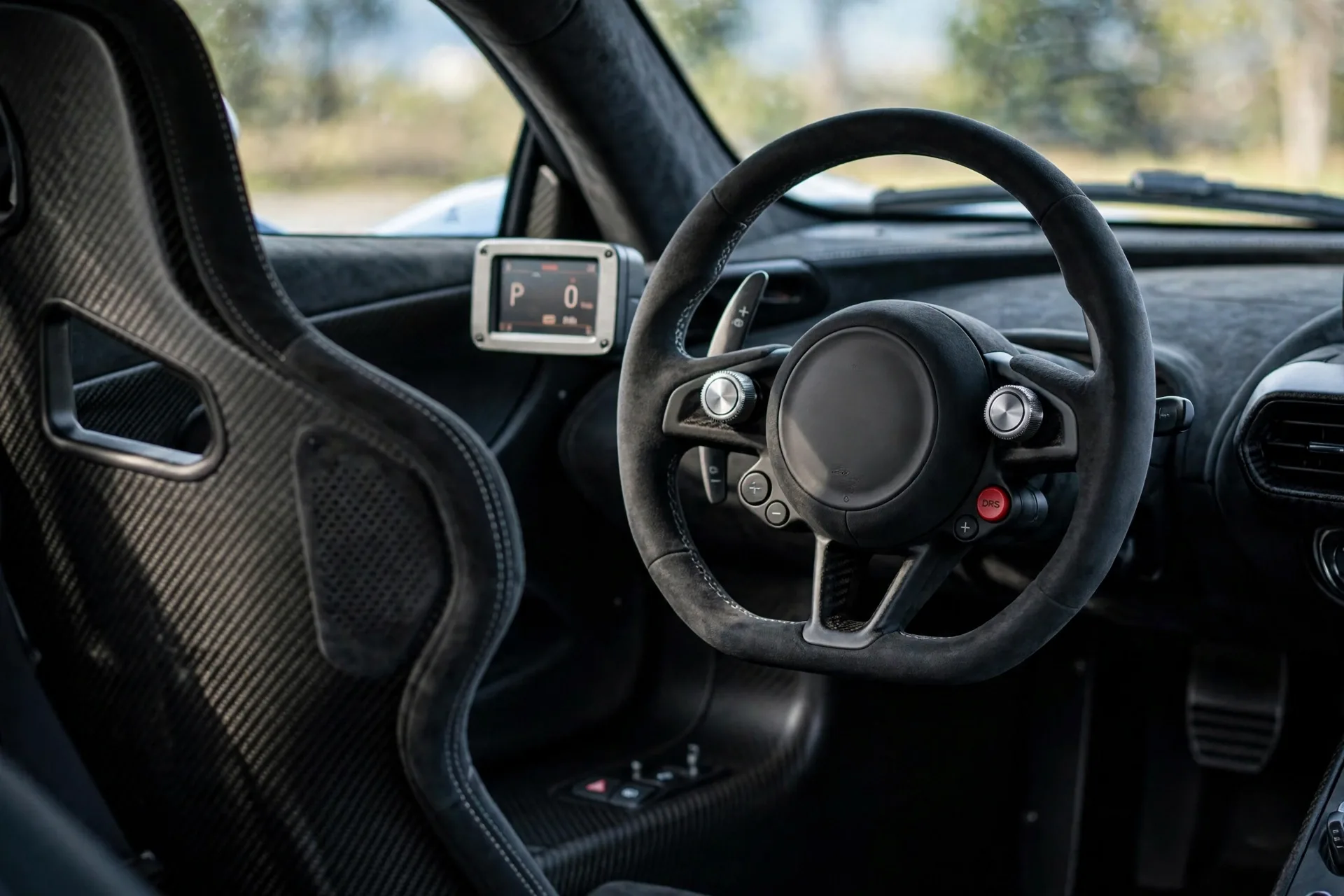
The driver still gets a say. Four modes — E-Hybrid, Balanced, Dynamic, Dynamic+ — are selected by rotary controls on the steering wheel, each re-weighting powertrain, dynamics, and efficiency. E-Hybrid gives fully electric urban driving off the 7.3 kWh battery; Dynamic+ focuses the powertrain “entirely on an emotional driving experience,” which is Audi’s way of saying it stops pretending to be sensible. Track Mode adds Wet, Dry, Race, and TC Off settings for traction control.
The energy management is motorsport thinking applied to road use: boost and recuperation strategies tied to torque distribution, coasting and brake recuperation extended to nearly every driving phase, and up to 0.3 g of purely electric deceleration — enough to cover a large share of everyday braking while charging the battery. Launch control uses stored energy for maximum acceleration with controlled traction. None of this is new in concept. Doing it all at 1,001 PS, in a car that also has to be drivable to dinner, is the trick.
03
The Wing Has Three Moods
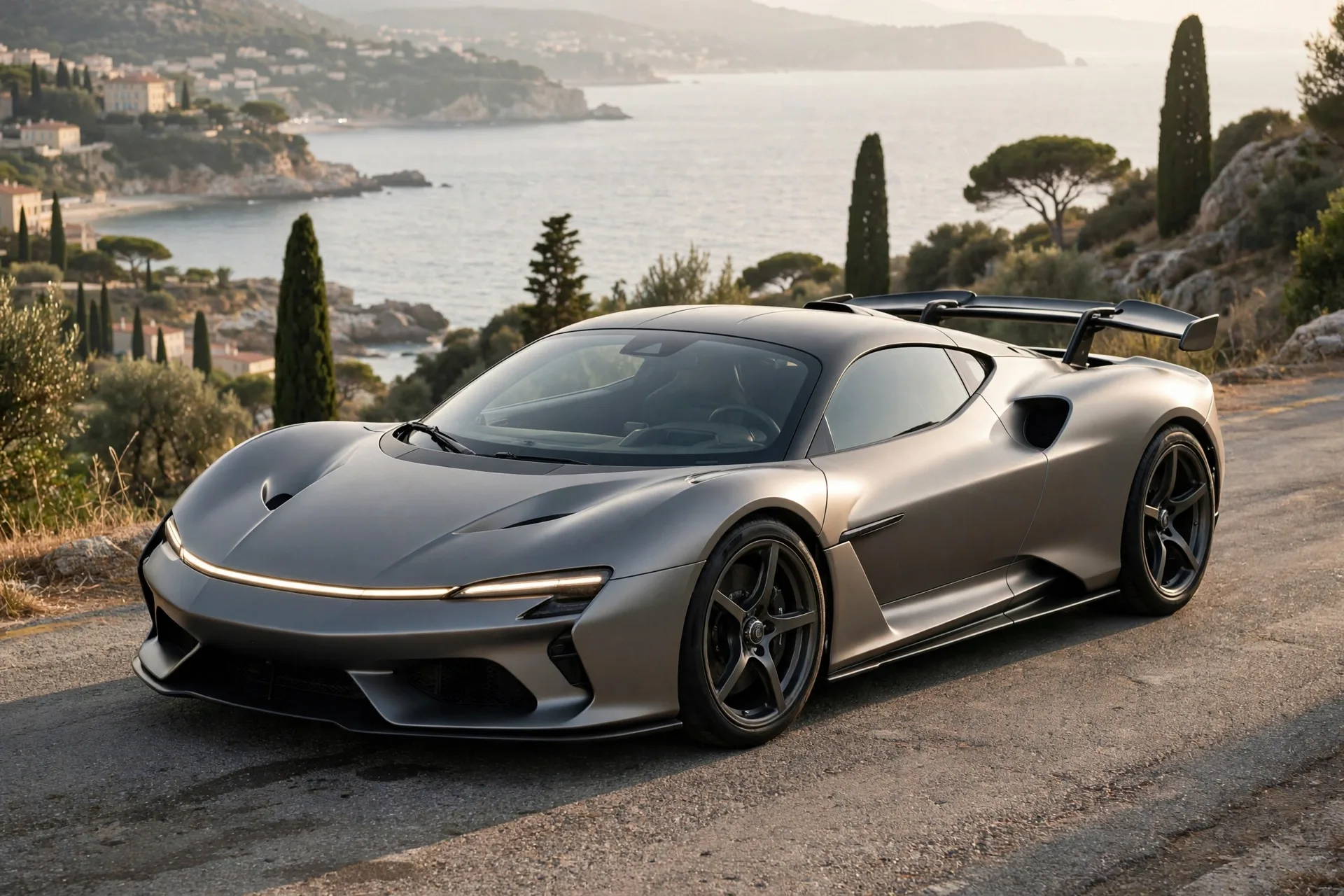
Aero first: a vented front end — an S-duct — that adds front downforce, cuts lift, and helps cool the powertrain; a front splitter; a rear diffuser. The centerpiece is the deployable adaptive rear wing with three configurations: Closed for minimum drag, Low Downforce for straights, High Downforce for braking and corners. In HD, Audi claims more than 400 kg of downforce depending on the driving situation.
And then there’s the button. The Drag Reduction System — DRS, straight from Formula 1 — can be activated manually via a dedicated steering-wheel button to drop the wing further, cut drag, and raise top speed. In Dynamic, Dynamic+, and Track modes the wing works automatically; the DRS button is for when you want to do it yourself. The solid-metal Audi rings are integrated flush into the deployable wing, which is the kind of detail that costs a fortune and that nobody asked for and that we love anyway.
Stopping it is the Audi Ceramic Pro system: brake-by-wire with variable blending between recuperation and hydraulics, ten-piston fixed calipers and 420 × 40 mm discs up front, four-piston calipers and 410 × 32 mm discs at the rear. The discs use a long-fibre carbon structure derived from Formula 1, with an internal cooling system Audi says improves heat dissipation by up to 21 percent over conventional carbon-ceramics. Energy absorption capacity: up to 2.8 megawatts — on par, Audi claims, with a current F1 car.
Underneath it all is the Audi Space Frame with a carbon exterior — a first for Audi. Almost every exterior panel is carbon fibre-reinforced polymer, built with prepreg autoclave processes borrowed from F1 and laid up by hand. Forged centre-lock wheels make their production debut. The signature colour is Titanium matte — the same paint as the Concept C design study and Audi’s F1 car. Audi claims a sub-1,750 kg dry weight (per evo’s hands-on); kerb weight is still unpublished. Treat the dry figure as Audi’s claim, not an independent measurement.
04
A Name With a Past
Tazio Nuvolari was born in Mantua in 1892, raced in a yellow pullover, won Le Mans in 1933, and joined Auto Union — Audi’s predecessor — in 1938, winning the last Grand Prix for the Silver Arrows at Belgrade in 1939. He was fearless to the point of folklore. Naming a car after him is not a casual choice; it’s a promise, and a heavy one.
Audi has used the name once before. The 2003 Nuvolari quattro concept — a 2+2 GT shown at Geneva with a 5.0-litre twin-turbo V10 making 600 hp, 0–100 km/h in 4.1 seconds, and an aluminium Space Frame — previewed the design direction Audi would follow for a decade. That car never reached production. This one will: 499 units, European order books opening in the fourth quarter of 2026, deliveries from the first half of 2027.
The development story is the F1 story. Audi’s F1 drivers have both tested the Nuvolari — Gabriel Bortoleto at Nardò, Nico Hülkenberg at Neustadt an der Donau — Bortoleto praising its clean, predictable turn-in and near-absent understeer — and prototypes are running at the Nürburgring and Nardò as production approaches. Whether the F1 halo translates into sales is the open question. The price is the other one: Audi hasn’t confirmed it. Reports point to around £500,000 (roughly €600,000), close to double the related Temerario’s money. For a car that shares its cousin’s engine, that price needs the badge, the rarity, and the theatre to do a lot of heavy lifting.
“This isn’t an R8 successor. It’s Audi walking into Lamborghini’s house and rearranging the furniture.”
Technical specifications
- Powertrain
- 4.0L twin-turbo V8 + 3 axial-flux e-motors · 7.3 kWh battery (PHEV, AWD)
- Power
- 1,001 PS (736 kW / 987 hp)
- Engine
- 800 hp (588 kW), 730 Nm, 10,000 rpm redline
- 0–100 km/h
- 2.6 s (0–200: 6.8 s)
- Top Speed
- Over 350 km/h (217+ mph)
- Downforce
- Over 400 kg (high-downforce config)
- Brakes
- Audi Ceramic Pro · 420 mm front / 410 mm rear · brake-by-wire
- Production
- 499 units
- Price
- ~£500,000 (reported, unconfirmed by Audi)
- Deliveries
- First half of 2027 (European orders Q4 2026)
Preview
2027 Audi Nuvolari — October 14, 2026
No score yet — the car hasn't debuted. Full verdict after launch.
What we love
- A V8 that revs to 10,000 rpm. In 2026. In an Audi. Let that sink in.
- It outguns the Lamborghini it borrows its engine from — 1,001 PS against 920.
- quattro predictive ride: torque, brakes, and aero thinking as one system, before grip disappears.
- A real DRS button on the steering wheel. Formula 1 cosplay you can actually press.
- Physical rotary controls for drive modes and aero — not a touchscreen maze.
What could be better
- Audi has not confirmed the price — reported ~£500,000 is close to double a Temerario for the same bloodline.
- Weight is unpublished; a hybrid V8 with a 7.3 kWh battery will not be light, whatever the carbon claims.
- 499 units means most of us will only ever read about it. Exclusivity is the point — and the problem.
- The “first supercar” marketing is cute, but the R8 existed. Audi knows. We know.
- It is a near-production prototype. Until customer cars land in H1 2027, every number here is Audi’s word, not a test.
Verdict
The Nuvolari is Audi doing the thing Audi never does: leading with its chin. A 1,001-PS hybrid supercar, limited to 499 cars, named after a 1930s Grand Prix hero, built in 405 days around a Lamborghini engine it then tuned past the Lamborghini. If this car works, it reboots the four rings as a company that builds objects of desire again — not just excellent appliances.
The caveats are real, and they are all the same caveat: nothing has been independently verified yet. No road test, no lap time, no confirmed kerb weight, no confirmed price. What Audi has shown is a near-production prototype and a spec sheet with serious intent. The intent is credible — the hardware is real, Bortoleto has driven it at Nardò and Hülkenberg at Neustadt an der Donau, and prototypes are lapping the Nürburgring as production approaches.
But the number that will decide the Nuvolari’s legacy isn’t 1,001. It’s 499. If all 499 sell — and at this level of theatre, they will — Audi builds more flagships. If it lands flat, the four rings retreat to the safety of SUVs and the R8’s ghost gets another decade of haunting. Our money’s on the car.