Issue Nº 07 — October 2026
R02Independent supertest — Green Hell
2026 Hyundai Ioniq 6 N Review: 641 HP, 7:35.42 Lap & Verdict
2026 Hyundai Ioniq 6 N · October 9, 2026 · Score 9.2/10
Independent lap — Nürburgring Nordschleife · Sport Auto Supertest
0:00.000
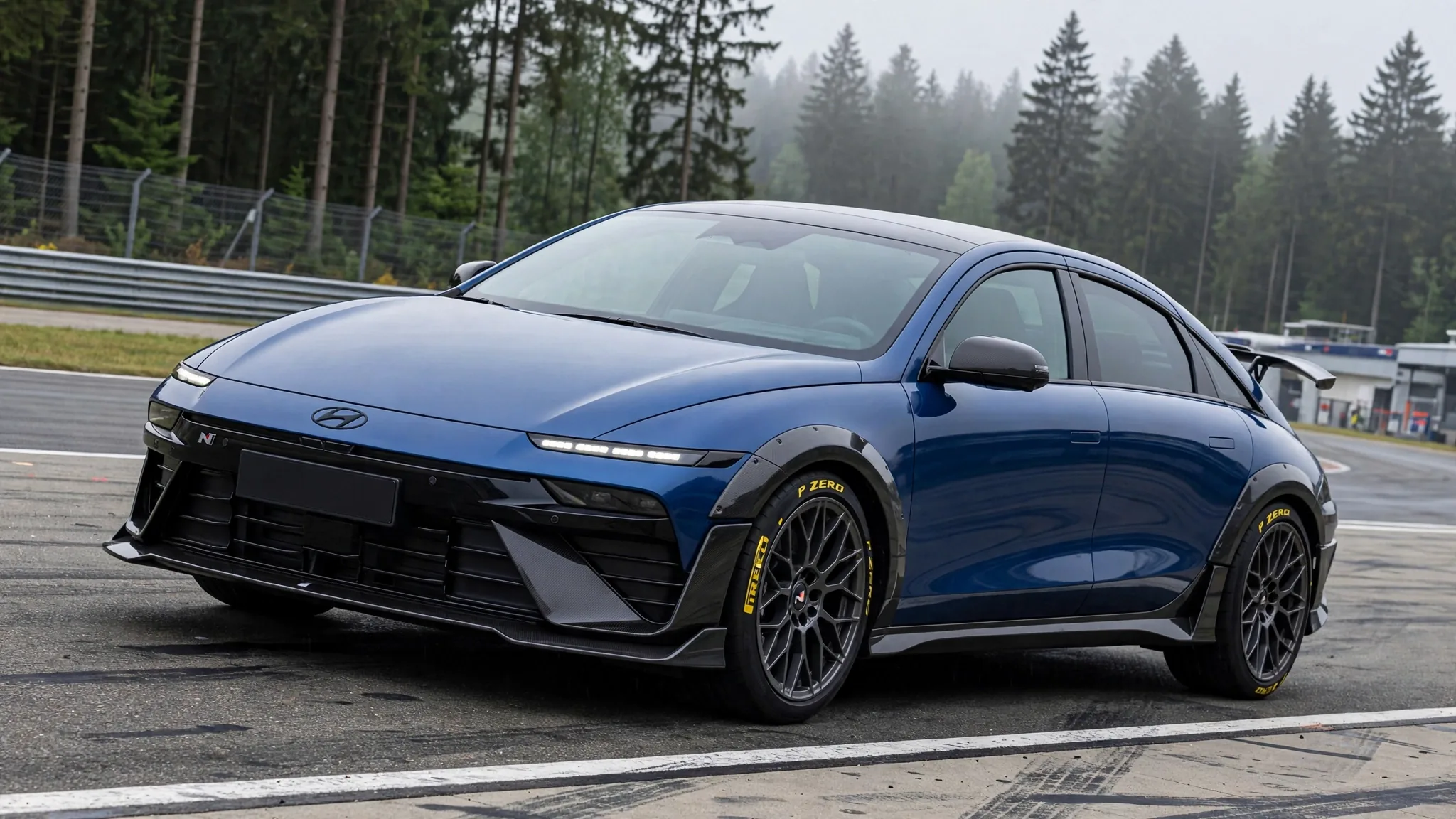
Hyundai just pulled the funniest move in the car business: it won the World Performance Car crown with a sedan that has a button labeled, in so many words, “grin.” The Ioniq 6 N makes 641 horsepower, costs less than a well-optioned BMW i4, and has now lapped the Nürburgring faster than the car that invented the modern supercar-killer myth.
Seven minutes, thirty-five point four two seconds. That is the number Germany’s Sport Auto wrung out of a four-door family sedan on the Nordschleife — quicker than the early Nissan R35 GT-R times that once melted the internet. Let that sit for a second.
Full disclosure: we haven’t driven it yet, so this is the verified breakdown, not a road test. But the numbers, the independent supertest, and a jury of 98 international journalists all point the same way: Hyundai’s N division just built the most convincing electric driver’s car on sale.
R03The hardware
The Grin Button Is Real
Start with the hardware. Two motors, all-wheel drive, 448 kW — that’s 601 horsepower in normal conversation. Then you thumb the N Grin Boost button and, for ten glorious seconds, the system unlocks 478 kW: 650 PS, 641 horsepower, 770 Nm of torque. It’s a party trick with a purpose — maximum attack for the overtake, then back to business.
N.01
N Grin Boost
641 hp for 10 seconds. The button earns its name.
N.02
N e-Shift
Simulated DCT shifts with real kick. Gimmick? Try it first.
N.03
N Active Sound+
Three profiles: Ignition, Evolution, Lightspeed.
N.04
N Drift Optimizer
Dial in drift angle and wheelspin. The nannies work for you now.
N.05
N Battery
Preconditions the pack for Drag, Sprint, or Endurance duty.
N.06
N Torque Distribution
Eleven levels of front-to-rear bias. Eleven.
But the power figure is the least interesting thing about this car. N e-Shift simulates the kick and cadence of a dual-clutch gearbox by modulating motor torque, because Hyundai figured out what every EV maker keeps missing: drivers need sensory cues for speed, load, and inertia. N Active Sound+ pipes three synthesized profiles — Ignition, Evolution, Lightspeed — through the cabin and exterior speakers. Purists will scoff. Then they’ll try it and go quiet.
The track-day brain runs deeper. N Battery preconditions the 84 kWh pack for Drag, Sprint, or Endurance duty. N Drift Optimizer lets you dial in drift angle and wheelspin instead of just switching the nannies off and praying. N Torque Distribution offers eleven — eleven — levels of front-to-rear bias. This isn’t a fast EV with a sport mode. It’s a track tool that happens to have a frunk.
R04The verdict
The Bottom Line
The Ioniq 6 N is the first electric sedan that understands the assignment. Speed is cheap now — every EV with two motors and a big battery is fast in a straight line. Feeling is the currency, and Hyundai spent its whole budget on the feeling.
A 7:35 at the Ring. A World Performance Car crown. A price that undercuts every German rival by a country mile. The asterisks exist — independent test, sticky rubber, no US price yet — but they don’t change the shape of the thing.
This is the car that makes the “EVs have no soul” argument sound tired. Hyundai didn’t just beat the establishment at its own game; it showed up with a grin button and made the establishment look like it was playing a different sport entirely.
9.2/10. The button earns its name.
What we love
- 7:35.42 Nürburgring time, independently verified by Sport Auto
- 641 hp on a button — 601 hp the rest of the time
- N e-Shift: simulated gears that genuinely add to the experience
- 800V charging: 10–80% in about 18 minutes
- 2026 World Performance Car for BMW i4 money
What could be better
- About 2,200 kg — physics still applies
- US pricing unconfirmed; tariffs could spoil the value story
- N Grin Boost only lasts 10 seconds per hit
- Simulated sound and shifts won’t convert every purist
- 487 km WLTP range is merely fine, not great
Technical specifications
- Powertrain
- Dual-motor AWD
- Power
- 641 hp (N Grin Boost; 601 hp std)
- Torque
- 770 Nm (peak)
- 0–62 mph
- 3.2 seconds
- Top Speed
- 257 km/h (160 mph)
- Battery
- 84.0 kWh NMC, 800V
- Charging
- 10–80% in ~18 min (350 kW DC)
- Range
- 487 km WLTP
- Price
- £65,800 (UK); US TBA
R05The number
7:35.42 — The Independent Witness
Here’s why we believe the hype: Sport Auto’s Christian Gebhardt took the 6 N around the Nordschleife in 7:35.42. That’s not a Hyundai press release — it’s the legendary Supertest, running since 1997, and the 6 N is only the third fully electric car ever invited. The lap was set on Pirelli P Zero Trofeo RS rubber, so file it under “serious but not showroom” like every fast Ring time ever.
Context: back in 2009, the R35 GT-R — Godzilla, the original giant-killer — needed 7:38 around the same circuit in Sport Auto’s hands. The Hyundai beats it. Yes, Nissan eventually went much quicker (7:27.56 official), and yes, comparing eras and tires is a mug’s game. But a Korean electric sedan lapping within sight of supercar royalty, independently verified, is not a stat you get to hand-wave away.
It also puts the 6 N ahead of its platform sibling. The Ioniq 5 N is brilliant, but it’s a tall crossover fighting physics. The 6 N is lower, wider, slipperier (0.27 Cd), and 0.2 seconds quicker to 100 km/h. Sedan beats SUV. The universe remains in order.
Scroll to run the lap — 7:35.42, set in near silence
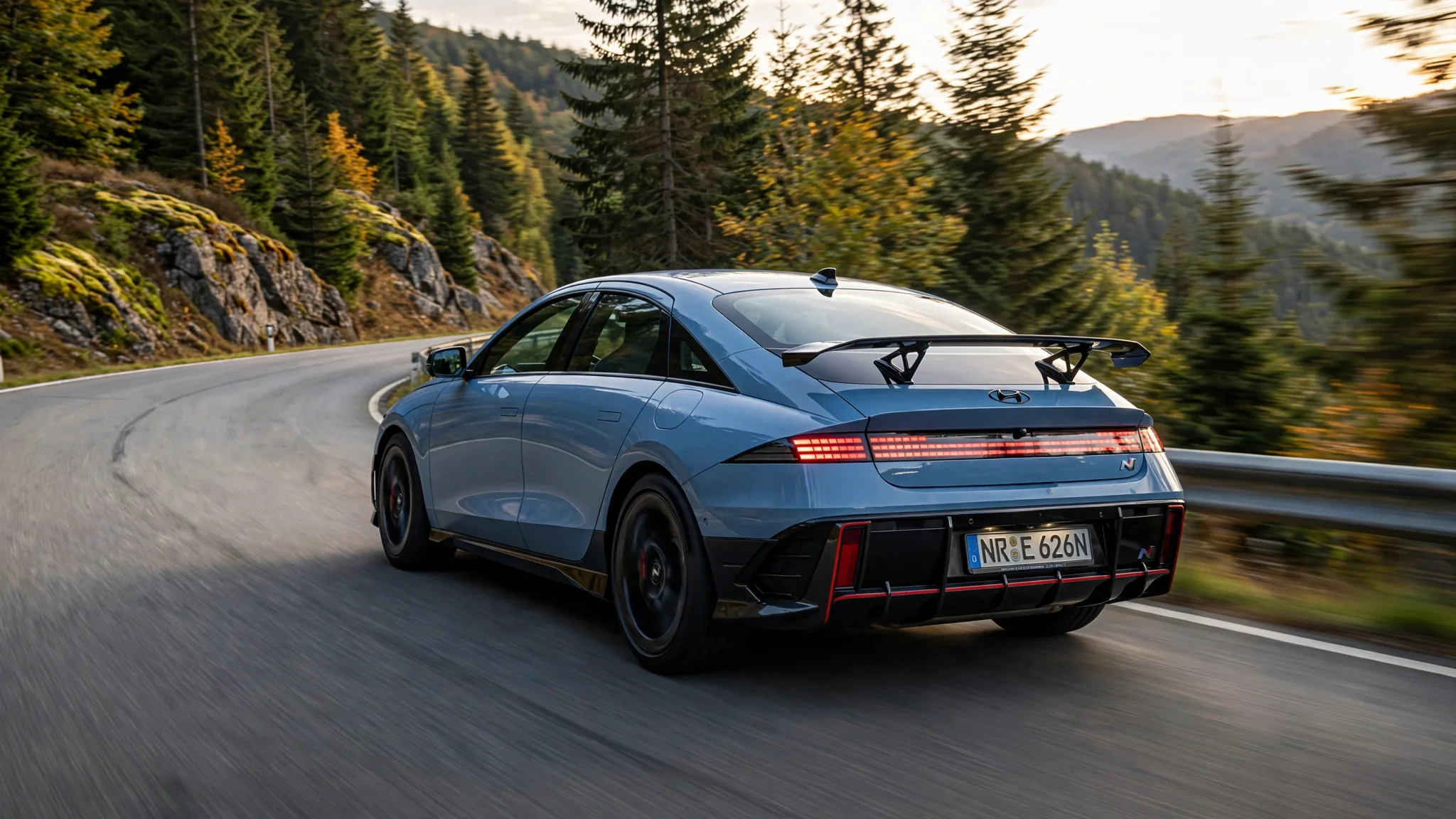
“Hyundai didn’t build an electric car that happens to be fast. It built a driver’s car that happens to be electric.”
R06The trophy
The World Agrees
On April 1, 2026, at the New York International Auto Show, the Ioniq 6 N was named World Performance Car of the Year. It beat the BMW M2 CS and the Chevrolet Corvette E-Ray — a finalist list with a combined heritage stretching back to before Hyundai existed.
This is Hyundai’s second win in three years after the Ioniq 5 N took the 2024 title, and its fifth straight year of World Car Awards recognition. Ninety-eight journalists from 33 countries voted. That’s not a marketing department patting itself on the back; that’s the global press corps looking at the spec sheet, driving the thing, and conceding.
The award matters because of what it used to mean. World Performance Car was the private playground of Porsche, Audi, and BMW — brands that earned it with decades of combustion excellence. Hyundai just walked in with an electric sedan and took the trophy home. The establishment should be nervous.
R07The money
The Price of Admission
Here’s the part that breaks brains: in the UK, the Ioniq 6 N is on sale now at £65,800 on the road. That’s BMW i4 M50 money for a car with 100 more horsepower, a faster Ring time than most things with a prancing horse, and an 800-volt architecture that charges 10–80% in about 18 minutes on a 350 kW plug.
US pricing hasn’t been announced — expect something in the $65,000–$70,000 range if the estimates hold, though tariffs could yet spoil the party. Even so, the value math is absurd: 641 horsepower, 487 km of WLTP range, five seats, and a boot. Find us another sub-$70k sedan that does all of that. We’ll wait.
The honest caveats: it weighs around 2,200 kg, because physics and battery chemistry are still negotiating. The 487 km range is merely fine. And the simulated soundtrack will never convert the “real engines only” crowd — but that crowd wasn’t buying a Hyundai anyway.