Issue Nº 02 — Autumn 2026
R01Explainer — Koenigsegg
Koenigsegg Built the 330-mph Car. Then It Never Tried.
Koenigsegg Jesko · November 13, 2026 · Explainer
Retrospective, no score. Koenigsegg built 125 Jeskos against a plan of 125 — the run ended exactly as announced in 2019. The verdict settles flop or legend on the numbers, and the missing one.
The final production total
125
Jesko built — the plan, completed
All 125 slots sold by March 19, 2019, two weeks after the Geneva reveal. Koenigsegg announced the end of production on Instagram on November 11, 2026, as Jesko 125 — a one-off Absolut in Skumpa champagne — was delivered.
125
cars built — the plan, completed
1,600hp
twin-turbo V8 on E85
25.21s
0–400–0 km/h world record
1:24.86
Laguna Seca, Attack, August 2024
330mph
claimed top speed — never attempted
503.17km/h
U9 Xtreme — the crown now
Full disclosure: The Torque Wrench hasn’t driven it — and neither have you, unless you are one of the 125. The Jesko’s production run is over, its records are in the books, and its last numbered car has been delivered. This is the verified retrospective, not a road test — every number below is traced to Koenigsegg, an independent verifier, or a timing official, and the one number that isn’t there is the whole point of the piece.
Start with the sentence that ended it. On November 11, 2026, Koenigsegg posted that Jesko 125 had been delivered to its owner, marking a milestone in Koenigsegg history. The staff lined the production hall in Ängelholm and applauded the car out of the factory. The last one is a one-off Absolut in Skumpa champagne — Swedish slang for champagne — with a green-tinted carbon stripe, bronze accents, and a brown-and-beige leather cabin. The Supercar Blog, Gazzetta dello Sport, Carscoops and MotorBiscuit all report the owner is Daniil Medvedev, the former tennis world number one, who collected it at the factory. Koenigsegg itself has not named him.
Here is the twist the headlines skip: 125 was always the plan. Koenigsegg announced the 125-car run at Geneva in March 2019, and every slot was taken within two weeks. This is not a car cancelled early. This is a car that finished exactly what it set out to do — and still left its biggest promise unkept. The Absolut was built to go faster than 330 mph. It never tried. That sentence will follow the Jesko forever, and it is the only honest place to start.
R03Chapter 01
The Last One Left to a Round of Applause
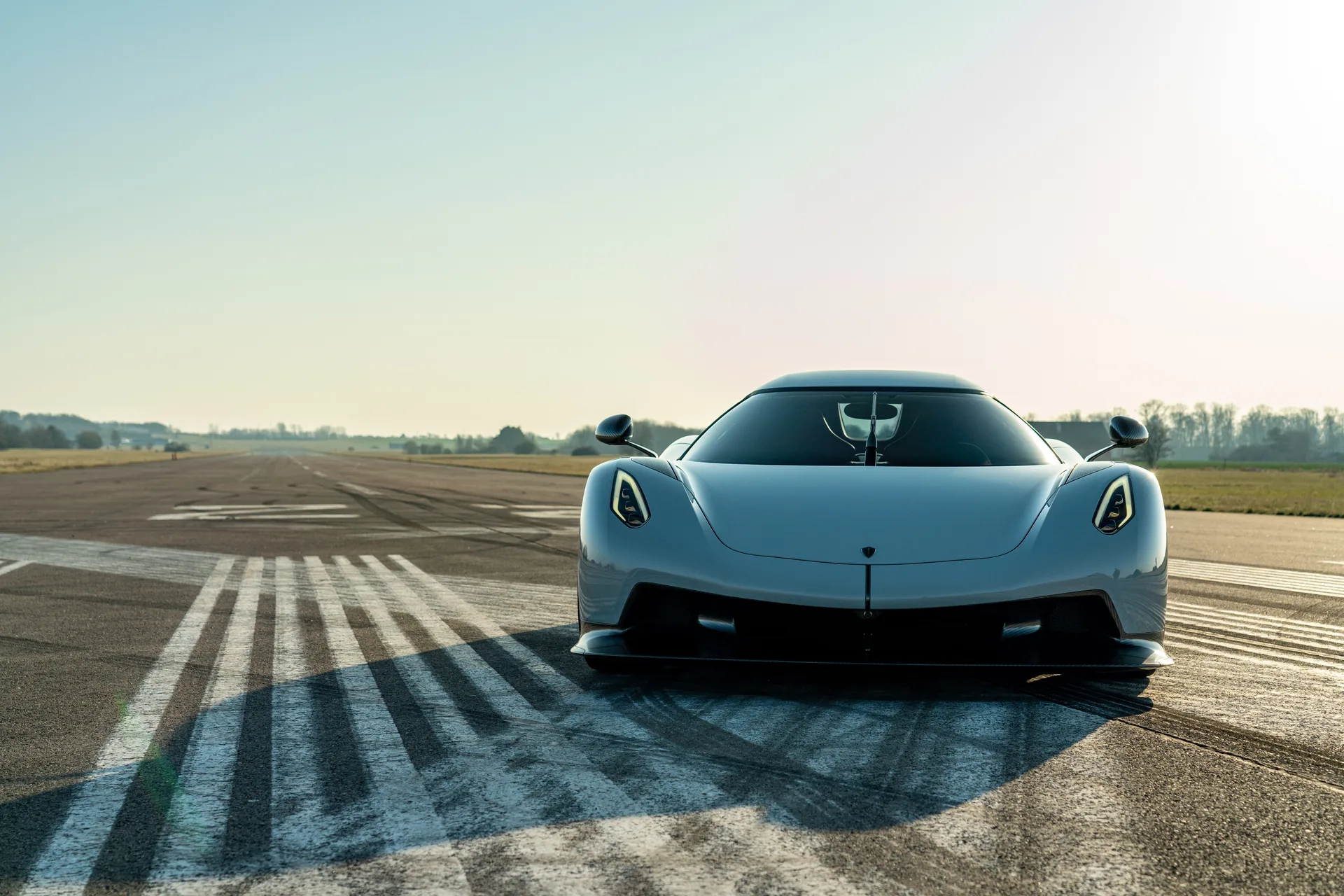
The farewell was pure Koenigsegg: no press conference, no farewell edition with a plaque and a price hike — just an Instagram post, a factory full of applauding staff, and a one-off car in champagne paint. Jesko 125 wears 125 badging inside and out, a green carbon centre stripe inspired by the Regera, rose-toned gold finishes in the cabin, and custom embroidery. It is an Absolut, the low-drag version, not the winged Attack. The fastest Jesko ever built went out the door dressed for a party, not a record attempt.
The numbers behind the goodbye are the least dramatic part of the story, which is the point. Revealed March 5, 2019, at Geneva, named for Christian von Koenigsegg’s father, all 125 build slots sold by March 19. Seven and a half years later, the run is complete — the plan, executed to the car. No successor has been announced, and Koenigsegg has not confirmed one is coming. The factory moves on to the CC850 and the CCGT1, both still to be built on the Jesko’s carbon monocoque and twin-turbo V8, and to the Sadair’s Spear, the hardcore Jesko sibling already in production.
One asterisk, because honesty demands it: Jesko 125 is the last numbered car, not literally the last Jesko off the line. One highly bespoke, delayed Jesko Attack is still in production and is expected to be delivered in 2027. The run is over. The line has one straggler. The record books will say 125, and the record books will be right enough.
125 cars
The final Jesko production total — the run announced at Geneva in March 2019, every slot taken within two weeks, completed on November 11, 2026, with the delivery of Jesko 125, a one-off Absolut in Skumpa champagne.
A 330-mph car that never went 330 mph is not a failure. It is an unfinished sentence.
— The Torque Wrench
R04The verdict
Explainer
Koenigsegg Jesko — November 13, 2026
No score — an explainer, not a verdict
The Verdict
On the stopwatch, the Jesko is a legend. The 0–400–0 world record, the Laguna Seca lap, the Gotland Ring time, a gearbox no one else has — the car did everything a hypercar is supposed to do, and it did it with 700 people in a former fighter-jet hangar. A $3 million car from Ängelholm out-accelerated everything with a combustion engine and out-lapped cars from companies a hundred times its size. If the Jesko was a product, the product was magnificent.
But the Jesko was never really a product. It was a promise — the fastest production car in the world, 330 mph, the number on every poster since 2019. The promise is unkept, and the reason is not the car. It is the venue, the timing, the caution, the seven years that slipped by while the crown moved to Abu Dhabi. The Absolut will never be the fastest car in the world. It will always be the car that could have been, and that is a crueller epitaph than any failure.
So: legend, with an asterisk the size of a runway. Not because 125 is a bad number — it is the plan, completed — but because the number that matters was never 125. It was 330, and the car never got to say it out loud. The market voted with its wallet and 125 people said yes. History votes with the stopwatch, and the stopwatch says the Jesko was the fastest accelerating combustion car ever built — and the fastest car that never went fast enough. One hundred and twenty-five cars. One world record. One run that never happened. Tighten it ’til it sings.
What we love
- The 0–400–0 record, reclaimed: 25.21 seconds, same car, new software. Koenigsegg lost the record to the Nevera R and took it back a month later with a software update. That is not engineering. That is spite, with a stopwatch.
- The Light Speed Transmission. Nine gears, any gear, instantly — the most interesting gearbox in the hypercar world, invented in a shed in Sweden.
- The Attack’s Laguna Seca lap: 1:24.86 on a track the car and driver had never seen. First visit, record lap, home for tea.
- Two cars, one engine, opposite religions. The Attack and the Absolut are the same V8 answering two different questions — and both answers are right.
- The Sadair’s Spear: the Jesko’s platform already beating the Jesko. A car so good its own sibling laps Laguna Seca faster than it did.
What could be better
- The 330-mph run never happened. Seven years, one purpose-built car, and the record went to a Chinese EV instead. That is the asterisk the Jesko will carry forever.
- 125 cars and no successor announced. The line ends, the factory moves on, and the fastest Koenigsegg ever built becomes a handover instead of a dynasty.
- The price: from ~$3 million, Absolut reportedly ~$3.5 million — and the secondary market is the only way in now. The Jesko was never for sale to the merely rich.
- The delayed Attack: Jesko 125 is the last numbered car, but one bespoke Attack is still being built for 2027. The farewell tour has a straggler.
- The two-way standard cuts both ways: by Koenigsegg’s own honest measure, no production car has yet exceeded 300 mph — including the U9 Xtreme’s 503.17. The Jesko’s defence is real, but it is a defence, not a record.
Technical specifications
- Powertrain
- 5.0L twin-turbo V8 (5,065 cc) · flat-plane crank 12.5 kg · 8,500 rpm redline
- Power
- 1,280 hp @ 7,800 rpm (petrol) · 1,600 hp on E85 · 1,500 Nm @ 5,100 rpm (E85)
- Gearbox
- 9-speed Koenigsegg Light Speed Transmission — multi-clutch, near-instant shifts to any gear
- 0–400–0 km/h
- 25.21 s — world record, Aug 7 2025, Örebro, Markus Lundh (0–400 in 16.77 s)
- Quarter mile / half mile
- 8.54 s / 12.76 s — production non-EV records
- Top speed
- 330+ mph claimed (531 km/h; simulations to 563 km/h) — never attempted
- Downforce
- Attack 1,400 kg at top speed · Absolut 150 kg, Cd 0.278
- Laps
- Laguna Seca 1:24.86 (Attack, Aug 2024) · Gotland Ring 2:56.97
- Weight
- Attack 1,420 kg kerb (1,320 kg dry) · Absolut 1,390 kg kerb (1,290 kg dry)
- Price / Production
- From ~$3M · Absolut reportedly ~$3.5M · 125 cars, 2019–2026
R05Chapter 02
Two Cars in One Body
The Jesko was always two cars sharing one engine, and the split is the whole engineering story. The engine is a 5.0-litre twin-turbo V8 (5,065 cc) with a flat-plane crankshaft weighing just 12.5 kg, revving to 8,500 rpm: 1,280 hp on pump petrol, 1,600 hp on E85, and 1,500 Nm of torque. The gearbox is Koenigsegg’s 9-speed Light Speed Transmission — a multi-clutch unit that can jump to any gear almost instantly instead of shuffling through the ones in between. Both versions get the same powertrain. Everything else is a bet on what speed means.
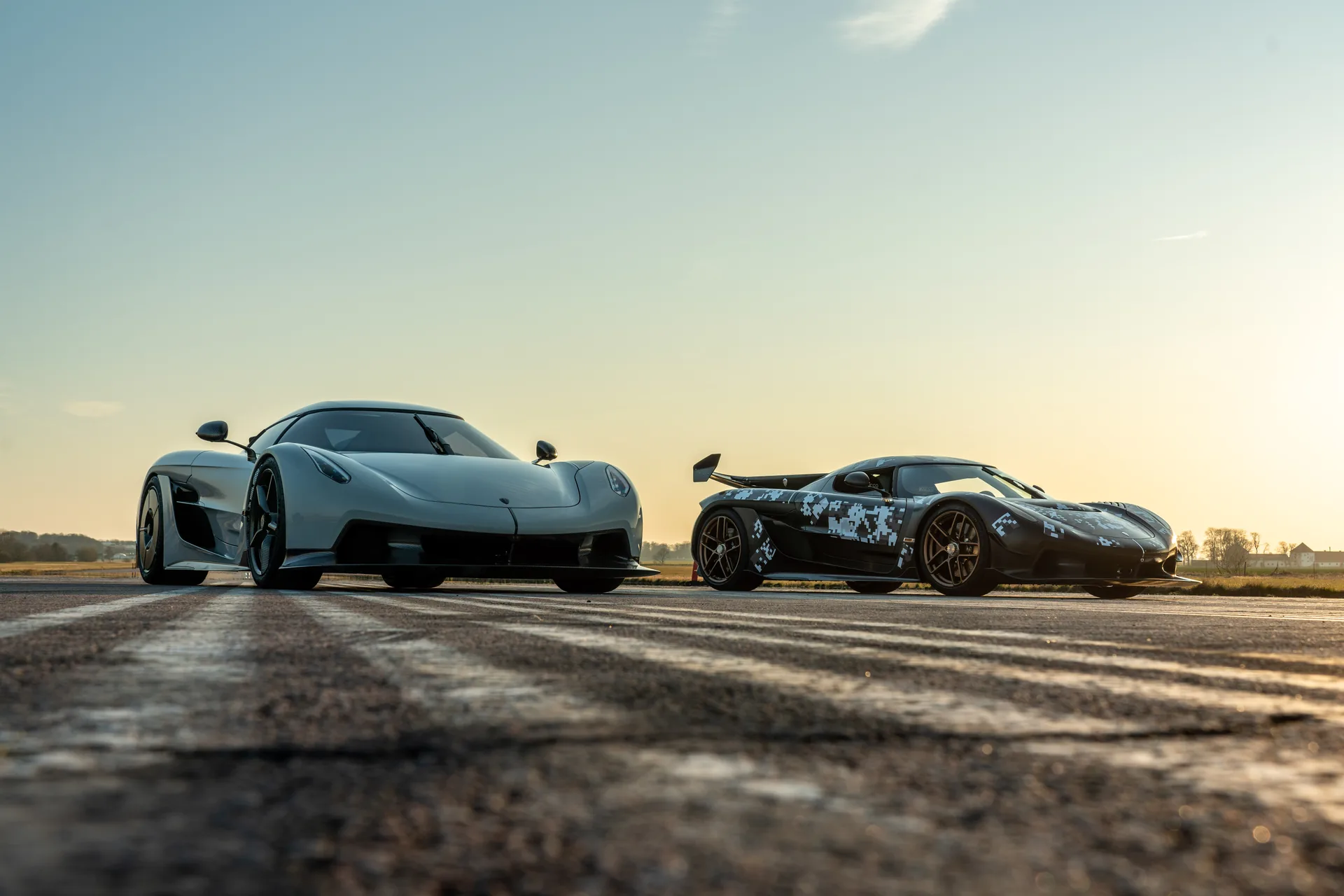
The Attack bets on corners. A huge rear wing and a deep front splitter make 800 kg of downforce at 249 km/h, 1,000 kg at 275, and 1,400 kg at top speed. It lapped the Gotland Ring in 2:56.97 — nearly seven seconds under a GT3 RS Manthey — and set the homologated production-car record at Laguna Seca on August 18, 2024, at 1:24.86, on a track neither the car nor test driver Markus Lundh had ever visited. The Attack is the Jesko that answers the question how fast around a corner.
The Absolut bets on the straight. The wing comes off, two fins go on, the tail stretches, the drag coefficient falls to 0.278 — the lowest of any Koenigsegg — and downforce drops to 150 kg. It is 30 kg lighter than the Attack and 219 mm longer. Same engine, same gearbox, opposite religion. The Absolut is the Jesko that answers the question how fast, full stop — and that question is where the story gets uncomfortable.
“It did everything except the one thing it was built for.”
R06Chapter 03
The Record Book Is Magnificent. The Missing Page Is the Point.
Start with what it did, because what it did is extraordinary. On June 26, 2024, at Örebro airfield, the Absolut set the 0–400–0 km/h world record for homologated road cars at 27.83 seconds. The Rimac Nevera R took it a year later at 25.79. On August 7, 2025, the same Jesko Absolut — with new Absolut Overdrive software and nothing else changed — took it back at 25.21 seconds: 16.77 seconds to 400 km/h, 8.44 back to zero. It also holds a production non-EV quarter-mile record at 8.54 seconds and a half-mile at 12.76. The Jesko is the fastest accelerating combustion car ever built, by the only measure that matters: the stopwatch, independently verified, twice.
Now the missing page. The Absolut was engineered, simulated and marketed to go faster than 330 mph — 531 km/h, with Koenigsegg’s own calculations suggesting up to 563 km/h in ideal conditions. It never attempted the run. Christian von Koenigsegg has said the problem was never the car: it was finding a place to do it safely, at two-way average, the way a real record demands. The Agera RS set its 277.8-mph two-way record in 2017 on an 11-mile closed stretch of Nevada highway. Eleven miles is not much room at 300 mph, and a smooth road is not smooth at that speed. In 2023 he told CarBuzz he still planned to try. He never did.
And while Koenigsegg waited, the crown moved. On November 1, 2026 — ten days before Jesko 125 was delivered — the Yangwang U9 Xtreme did 503.17 km/h (312.65 mph) on a four-lane stretch of inspected highway in Abu Dhabi, FIA-recognised, and took the title the Absolut was built for. It was a single-direction run: the two-way benchmark is still the SSC Tuatara’s 282.9 mph from 2020, and by Koenigsegg’s own two-way standard no production car has yet exceeded 300 mph. That is the honest defence, and it is a real one. It is also the defence of a car that had seven years to make the attempt and is now out of time. The Absolut will never be the fastest car in the world. It will always be the car that could have been.
R07Chapter 04
What 125 Cars Actually Bought
So what did Koenigsegg get for 125 cars? Start with the platform. The Jesko’s carbon monocoque and twin-turbo V8 live on in the CC850 and the CCGT1, and its track-bred sibling, the Sadair’s Spear — 30 cars, 1,603 hp on E85 — has already beaten the Jesko Attack at its own game, lapping Laguna Seca in 1:24.16 on November 4, 2025. The Jesko was never meant to be a dynasty. It was meant to be a test bed with a price tag, and the test bed worked.
Then there is the gearbox. The Light Speed Transmission — nine gears, any gear, instantly — is the most interesting transmission in the hypercar world, and it is a Jesko invention. The 0–400–0 record, the Laguna Seca lap, the Gotland Ring time: all of them run through it. Koenigsegg is a company of 700 people that builds its own engines, its own gearboxes, its own carbon fibre, in a former fighter-jet hangar in Ängelholm. The Jesko is the proof that a shed in Sweden can out-engineer the entire auto industry — and the proof is now parked in the history books.
No successor has been announced, and none should be expected soon. The Jesko’s ending is not a failure and not a tragedy. It is a completion — the plan, executed, with one promise left on the table. The car that was supposed to end the argument about speed instead left the argument open, and the company that built it seems fine with that. The next Koenigsegg will be judged against a ghost: a white Absolut on a Swedish runway, built for 330 mph, that never got the chance to prove it.