Issue Nº 02 — Autumn 2026
Verified — McLaren
The Supercar McLaren Named Before It Showed
McLaren McL 820 · October 31, 2026 · Preview
Preview, no score. Name and 820 PS output confirmed October 30, 2026; due 2027; no car shown, no engine, price, or lap time yet.
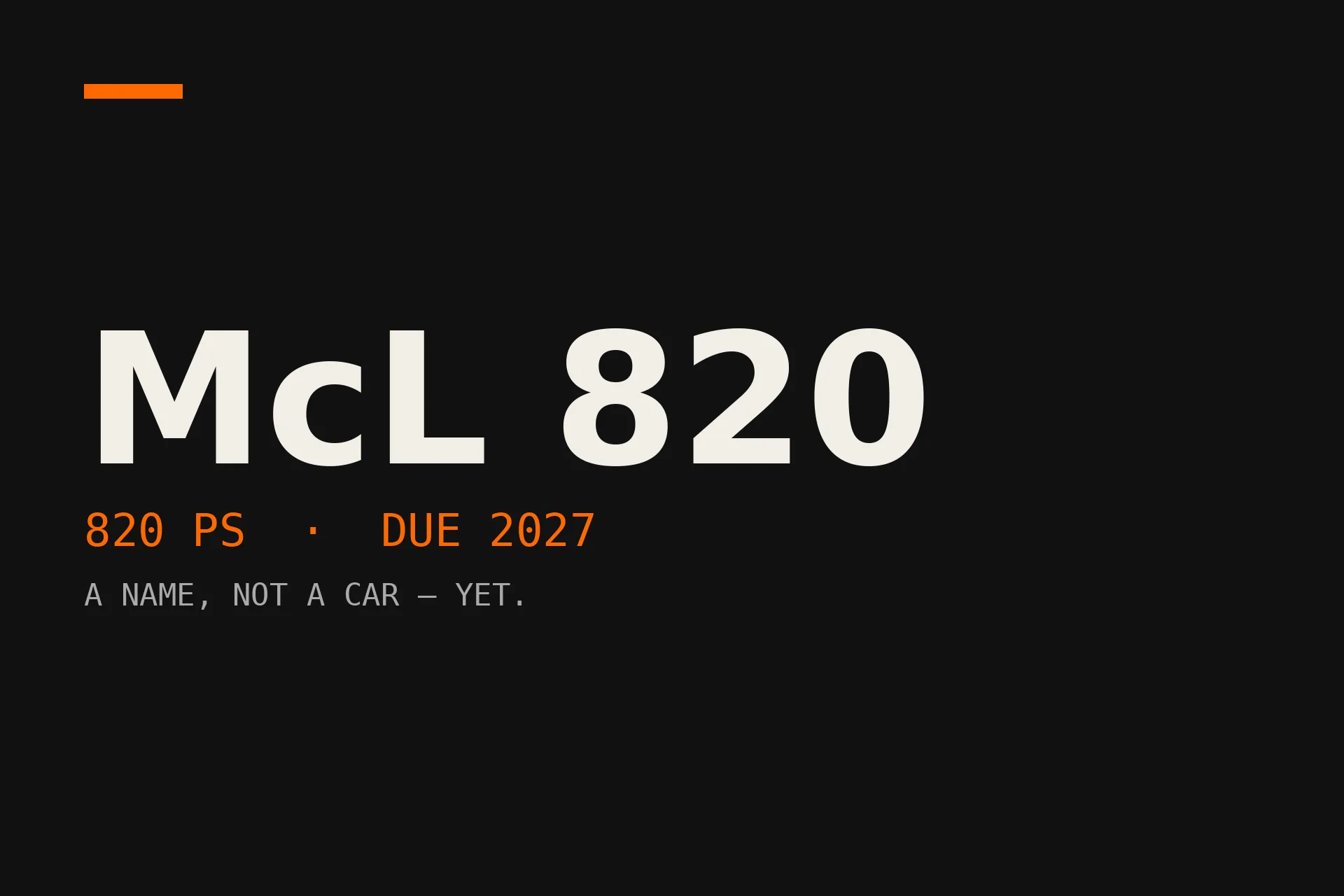
Full disclosure: The Torque Wrench hasn't driven it — nobody has, because there is no car to drive yet. This is the verified breakdown of a name, not a road test. On October 30, 2026, McLaren announced its next series-production supercar will be called the McL 820, that it arrives in 2027, and that the 820 in its name is its power output: 820 PS, about 809 horsepower. It showed no car, no engine, no price, and no photograph of anything with four wheels. What it showed, a day earlier, was a giant kiwi statue in a London shopping district with the name painted on its side. That is the whole reveal. And somehow, it might be the most McLaren thing McLaren has done in years.
Start with why the name matters, because in Woking, names are spec sheets. McLaren has named its core supercars after their power output in metric horsepower for a decade: the 720S made 720 PS, the 750S makes 750 PS, and now the McL 820 makes 820 PS. The new part is the prefix. McL comes from McLaren's motorsport naming, and the 820 is the first series-production car to wear it — the start of a system McLaren says will unify its road cars and its racing cars under one logic. When a car company puts its power figure in the badge, it is making a promise it cannot quietly walk back. The badge is the spec sheet, and the spec sheet is public.
Here is the honest frame for everything that follows. Confirmed: a name, a number, a year, and a bird. Reported but unconfirmed: a new in-house hybrid powertrain, likely V8-based. Unknown: everything else — engine, weight, price, performance, design, and whether it will ever lap the Nürburgring. This preview exists because the name itself is news: it confirms McLaren's next core supercar, its power target, and the end of the 750S era, all in three characters and three digits. What it does not do is pretend a car exists yet. Anyone showing you a picture of the McL 820 tonight is showing you a guess.
01
A Bird Carrying 820 Horsepower
The reveal happened in two acts, and the first one was better than the second. On October 29, 2026, a giant sculpture appeared in Covent Garden, London: a three-dimensional version of McLaren's Speedy Kiwi logo, wrapped in camouflage-style papaya orange and black bars, standing on a McLaren plinth. Visitors who looked closely found a message on the bird's side: McL 820. The kiwi is no random mascot. It is the emblem of Bruce McLaren, the New Zealander who founded the company, and it has been McLaren's quiet signature since the beginning. Putting the next supercar's name on a bird, in a shopping district, a full day before the announcement, is either the most confident teaser in recent memory or the strangest. Possibly both.
Twenty-four hours later came the official confirmation, and it was admirably short. McLaren announced the McL 820 as its next series-production supercar, coming in 2027, and explained the name in one sentence: “The new naming structure combines the McL prefix, inspired by McLaren's motorsport heritage, with a performance-driven numerical identifier. In the case of McL 820, the number reflects the vehicle's 820PS power output.” That is the entire announcement. No silhouette video. No shadowy studio shot. No design sketch. Further details, McLaren says, will come in 2027 — which means the car world gets a full year to argue about a car nobody has seen.
One detail deserves emphasis because it is easy to miss: McLaren confirmed the statue was its own reveal. This was not a leak, not a spy shot, not a dealer slip. The company put a bird in Covent Garden on purpose, let the internet do the rest, and then confirmed it the next day. In an era when most reveals are choreographed CGI films with orchestral swells, McLaren announced its most important car in years with a piece of street sculpture and a press release. The restraint is the story. Either Woking is supremely confident about what is coming, or it has learned that a name, delivered well, travels further than a render nobody believes.
02
Decoding the Badge
The McL prefix is new to the core range, but it is not new to McLaren. It debuted on the McL 6GT, the manual V8 concept shown at Monterey Car Week in August 2026 — the first McLaren road car with a manual gearbox since the F1, a carbon-bodied tribute to Bruce McLaren's unfinished M6GT project. Do not confuse the two cars. The 6GT is a separate, low-volume line sitting above the core range, with a production version reported for 2028. The 820 is the core car, the one that actually replaces the volume supercar, and it is the first series-production model to carry the new prefix. Same badge family, different jobs.
The number is the old McLaren habit, kept. The 720S made 720 PS. The 750S makes 750 PS. The 820 makes 820 PS — about 809 hp, which puts it roughly 69 hp ahead of the 750S and, as the outlets were quick to note, would make it the most powerful series-production McLaren yet. Note the conditional: that superlative is the press's arithmetic, not a McLaren claim. McLaren itself has said only that the number is the output. But the arithmetic is simple, and it is the reason the name landed as hard as it did. Seventy more PS than the car it follows, on a badge that cannot hide it.
There is also a new badge in the mix. The 820 will wear McLaren's newly designed badge, shown earlier in 2026, as part of the same identity reset that produced the McL prefix. Taken together — new badge, new naming system, new in-house engines on the horizon — the 820 is not just a model change. It is the first core car of McLaren's next chapter, the one where the company stops borrowing its engines and its naming logic from anyone else. That is a bigger claim than any single car, and it is why this preview treats a name announcement as a real event rather than a PR footnote.
03
Goodbye to the 750S
Every arrival here is also a departure, and the departure deserves its own paragraph. On October 8, 2026, McLaren announced it was taking final orders for the 750S, with production ending in 2027 — a decade after the 720S launched the platform in 2017. The 750S arrived in 2023 as the successor to the 720S, carrying a 4.0-litre twin-turbo V8 making 750 PS (740 hp), with a claimed 0–60 mph in 2.7 seconds and a 206 mph top speed. Those are the 750S's numbers, not the 820's, and they are worth stating plainly: they are the bar the new car has to clear, and they are a high bar.
The send-off is the 788HS, a limited run of 200 cars — 100 coupes and 100 Spiders — pushing the same platform to 777 hp through McLaren Special Operations. It is the correct way to close a chapter: not a quiet deletion from the price list, but a final, slightly unhinged version for the people who were paying attention. The 750S era was the decade when McLaren proved a small British company could build a mid-engined V8 supercar to stand next to Ferrari and Lamborghini and not apologize for it. The platform's legacy is lightness, immediacy, and a V8 that never needed hybrid assistance to feel alive.
Which raises the question the 820 will have to answer, and it is the only question that matters for the car's character: what happens to that immediacy when hybridization arrives? The 750S may end up remembered as the last non-hybrid V8 core McLaren, depending on what the 820's powertrain turns out to be. That is not nostalgia talking. It is physics. Batteries weigh something, and McLaren's entire identity is built on weighing less than everyone else. The 820's first real test will not be its horsepower figure. It will be its kerb weight, whenever McLaren finally publishes one.
04
The Long List of Unknowns
Now the part of this preview that is mostly blank, stated without embarrassment. Engine: not confirmed. What is reported, by Autocar and echoed by evo, is that the 820 will use one of two new powertrains McLaren is developing and building in-house for the first time, likely V8-based — with evo pointing to McLaren communications chief Piers Scott's line that the W1 hypercar's high-performance hybrid V8 will power the next generation of McLaren supercars. That is a credible direction, and it is still a report, not a fact. Until McLaren says it, this preview treats the engine as an open question with a likely answer.
Price: not announced. Weight: not announced. Acceleration: not announced. Top speed: not announced. Drivetrain layout, dimensions, design language, interior, aero: not announced, not shown, not even teased beyond the bird. There is no Nürburgring lap time and no announced attempt — the 820 has no lap to discuss, and this preview will not invent one or borrow the 750S's record book. There is also no photograph of the car, which means every image you see attached to this story anywhere else this week is either the statue, the 750S, or somebody's imagination. Ours is none of those: it is typographic artwork of the name, labelled as such, because that is all that honestly exists to show.
What to watch, then, is simple. In 2027, McLaren owes the world a car to go with this name: the engine, the weight, the price, and the shape. The numbers that will decide whether the 820 is a landmark or a letdown are not the ones on the badge. They are the ones McLaren has not published yet. Until then, the McL 820 is the most honest vapourware in the business — a name, a number, and a bird — and the discipline of this preview is to leave it exactly like that, without filling the gaps with guesses dressed as facts.
“McLaren announced its next supercar with a statue of a bird. The bird's name is the spec sheet.”
Technical specifications
- Status
- Next series-production supercar — announced Oct 30, 2026, due 2027
- Power
- 820 PS (about 809 hp) — confirmed through the name itself
- Naming
- McL prefix (motorsport heritage) + PS output number
- Predecessor
- 750S — final orders Oct 8, 2026; production ends 2027 (successor status per outlets; McLaren's announcement does not name the 750S)
- Teaser
- Giant Speedy Kiwi statue, Covent Garden, London, Oct 29, 2026
- Engine
- Not confirmed — reported: new in-house hybrid powertrain, likely V8-based
- Price
- Not announced
- Performance figures
- None announced — no 0–100, no top speed, no weight
- Design / photos
- None released — the car has not been shown
- Nürburgring
- No lap time, no attempt announced
Preview
McLaren McL 820 — October 31, 2026
No score yet — the car hasn't debuted. Full verdict after launch.
What we love
- A badge that tells the truth — the number IS the output, no trim-level astrology required.
- The kiwi — a statue, in public, with the name on it. No CGI teaser film, no shadowy silhouette video.
- A proper goodbye — the 750S gets final orders and a 788HS send-off instead of a quiet axe.
- Engines coming home — McLaren building its own engines in-house for the first time, if the reports hold.
- The restraint — announcing a name and stopping, instead of rendering a car that doesn't exist.
What could be better
- There is no car — the obvious one. Everything here is a name and a number.
- 820 PS without a weight is a riddle — power means nothing until mass is known.
- Hybrid means heavy, probably — the weight question hangs over everything.
- A year of speculation — details due 2027, and the vacuum will fill with nonsense.
- Two McLs, one confusing year — the 6GT and the 820 will be mixed up constantly.
Verdict
Strip away the statue and the McL 820 is a promise with a number attached — and the number is the reason the promise is credible. McLaren has named its core cars after their output for a decade, and a company does not put 820 on a badge unless it intends to deliver 820. The name is not marketing. It is a hostage to fortune, published a year before the car arrives, in a form no one can quietly revise. That is either confidence or recklessness, and with McLaren's recent record, it reads as confidence.
But a promise is not a verdict, and this preview will not pretend otherwise. The 820 has no engine confirmation, no weight, no price, and no shape. Its character — the thing that made the 750S matter — is entirely unknown, and the hybrid question hanging over it is the biggest character question McLaren has faced since it restarted building road cars. The car could be a landmark: the most powerful series McLaren, with an in-house engine, under a naming system that finally makes sense. Or it could be heavy, expensive, and late. Both futures fit inside the same three digits.
For now, the McL 820 is the most honest vapourware in the business: a name, a number, and a bird. There is no score until it is shown, let alone driven. But the question it asks the establishment — what happens when the lightweight kings go hybrid? — already has the whole supercar world paying attention. And the bird, it turns out, was the perfect messenger: small, flightless, and entirely unbothered by the noise around it.
Quick answers
Asked, answered.
What is the McLaren McL 820?
McLaren's next series-production supercar, announced on October 30, 2026 and due in 2027. The 820 in its name is its power output: 820 PS, about 809 hp. McLaren has not shown the car, and no engine, price, weight, or performance figures have been announced.
Is the McL 820 the replacement for the 750S?
In practice, yes — but say it carefully. McLaren's announcement does not name the 750S and does not use the words "750S replacement." Every major outlet reads it as the successor because the 750S is taking final orders (announced October 8, 2026) with production ending in 2027, the same year the 820 arrives.
What does McL 820 mean?
McL is a prefix drawn from McLaren's motorsport naming heritage, and 820 is the car's power output in PS (metric horsepower) — about 809 hp. It continues McLaren's habit of naming core cars after their output: the 720S made 720 PS and the 750S makes 750 PS. The 820 is the first series-production car to wear the McL prefix.
What engine will the McL 820 have?
Not confirmed. Autocar reports it will use one of two new powertrains McLaren is developing and building in-house for the first time, likely V8-based, and evo points to McLaren's line that the W1 hypercar's high-performance hybrid V8 will power the next generation of McLaren supercars. Until McLaren confirms it, the engine is a report, not a fact.
Has McLaren shown the McL 820?
No. The only teaser is a giant Speedy Kiwi statue that appeared in London's Covent Garden on October 29, 2026, with "McL 820" on its side — a statue McLaren confirmed was its own reveal. No photos, design, price, or specifications have been released; McLaren says further details will come in 2027.
Related reviews
Latest review
Porsche Mission SPreview
Porsche Unveiled a Supercar With No Engine, No Price, and No Date. On Purpose.
Read the review →
Verified Nürburgring lap
2026 Hyundai Ioniq 6 N
2026 Hyundai Ioniq 6 N Review: 641 HP, 7:35.42 Lap & Verdict
Read the review →
More from the garage
Aston Martin Valhalla SpiderPreview
Aston Martin Cut the Roof Off the Valhalla. It Got Faster.
Read the review →