Issue Nº 07 — October 2026
Verified — Porsche
Porsche Unveiled a Supercar With No Engine, No Price, and No Date. On Purpose.
Porsche Mission S · October 28, 2026 · Preview
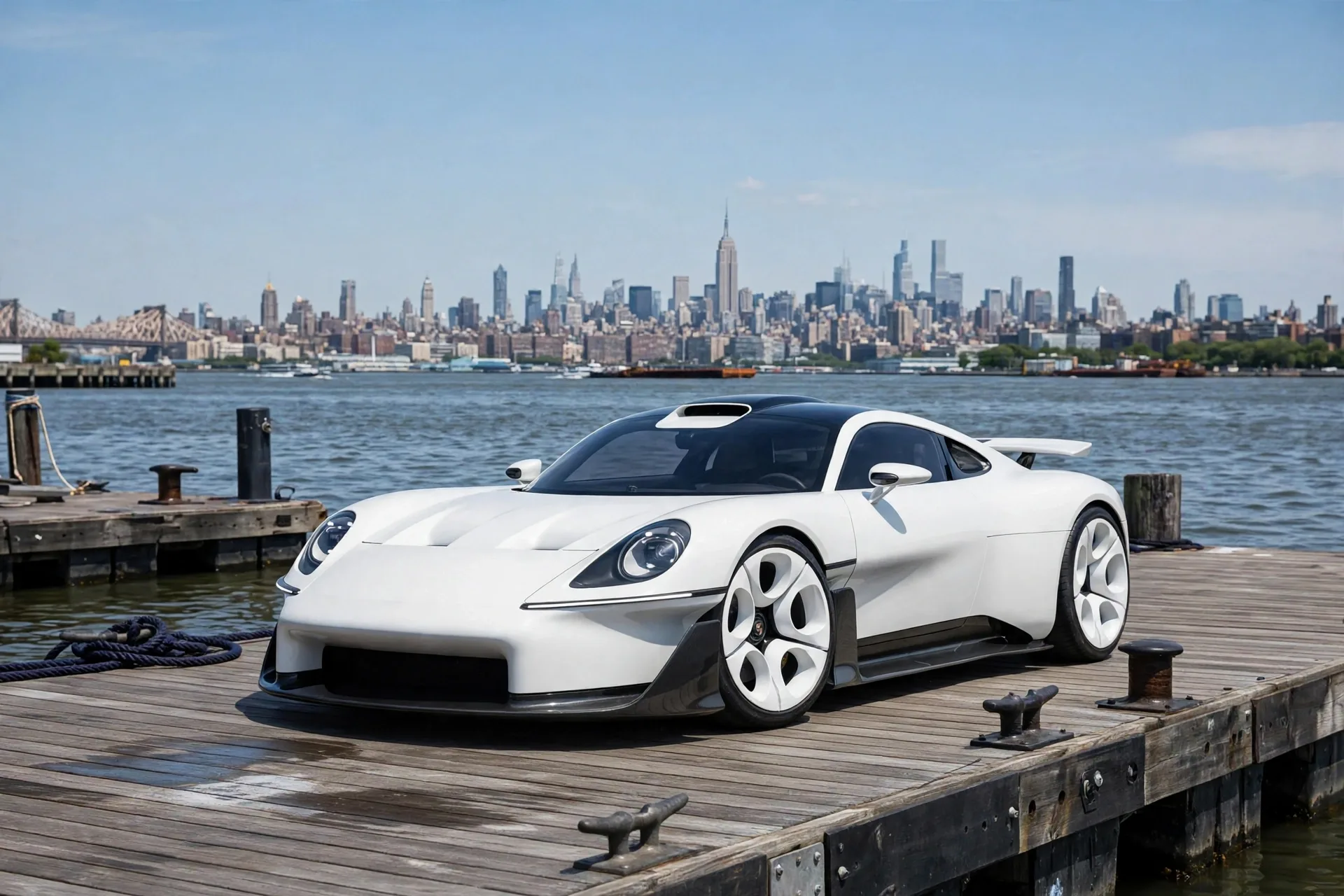
Full disclosure: The Torque Wrench hasn't driven it — this is a concept car, not a road test. The Mission S is a vision model shown in New York on October 15, 2026, with no production date, no price, and no power figure announced. What follows is the verified breakdown: what Porsche confirmed, what the rumour mill claims, and which is which. Anyone quoting you a Mission S spec sheet tonight is filling in blanks Porsche left blank on purpose.
Here is the part that matters, and it is not a horsepower figure. For the first time, Porsche will sell a super sports car above the 911 as a permanent model line — not a limited-run trophy like the Carrera GT or the 918 Spyder, but a standing tier of the range, built on its own dedicated mid-engined platform. Chief executive Michael Leiters said it plainly at the reveal: positioned above the 911, “not as a one-off hypercar, but as a permanent and versatile addition to our customer offering.” That one sentence changes Porsche's business more than any engine ever could. Ferrari and McLaren build their companies on permanent cars above their volume models. Porsche, until now, did not.
And here is the second part that matters: the car will not be electric. After the all-electric Mission X concept of 2023 never reached production — killed, in effect, by customers who did not want a silent hypercar — Porsche has read the room. The Mission S platform will take combustion engines, hybrids, and plug-in hybrids, with a manual or an automatic gearbox, and no fully electric version at all. The teaser gauges gave the game away before the reveal: an internal combustion engine revving past 7,500 rpm, and a speedometer marked to 250 mph. That speedometer marking is a gauge, not a top-speed claim — and the distinction is exactly the kind of thing this preview exists to police.
01
The Pivot: Three Years, One U-Turn
Rewind to 2023. Porsche showed the Mission X, a fully electric hypercar concept with a 900-volt architecture, and promised a decision on production. The decision never arrived. By August 2024 the design chief was telling reporters a hypercar was not really something that would happen in the near future. The electric hypercar market, it turned out, was a room full of manufacturers and very few buyers. Porsche had spent heavily on electrification while demand for electric sports cars came in softer than planned, and margins suffered for it.
Enter the reset. On October 7, 2026, at its Capital Markets Day, Porsche announced Sportwagenschmiede ’35 — roughly, “sports car foundry” — a strategy built on fewer variants, more shared parts, a longer life for combustion and hybrid powertrains, and higher prices at the top of the range. Eight days later, on a pier in Queens, New York — the same pier where the first photographs of the mid-engined 550 Spyder were taken in 1953 — Porsche unveiled the Mission S as the first visible product of that reset. The location was not an accident. Porsche calls the 550 its first super sports car, the car that defined its identity and built its American following. The Mission S is meant to pick up that thread: a mid-engined Porsche, above the 911, with an engine you can hear.
The speed of the thing is almost as telling as the thing itself. According to AutoGuide, citing MotorTrend, the Mission S went from a phone conversation between Leiters and head of style Tobias Sühlmann — who took over design in February 2026 — to a full show car in roughly eight months. Sühlmann immersed himself in the company museum and studied the cars that built Porsche's identity. Eight months from a phone call to a car on a pier is not how car companies normally work. It is how a company works when its new boss has decided the old plan is dead and wants the new one visible before anyone can argue.
One careful distinction before the excitement runs away. The Mission S is the first new super sports car tier since the 918 Spyder — but Porsche is deliberately positioning it below the limited-run hypercar tier, not as a direct 918 successor. MotorTrend puts it as “not as sky-high as a would-be 918 successor,” and reports suggest a pricier, true 918 successor could still follow as a separate line. So the Mission S is not the halo. It is the floor above the 911 on which a halo could later stand. That is a smaller claim than the headlines suggest, and a more interesting one.
02
What Porsche Confirmed vs What the Rumour Mill Invented
Start with the confirmed list, because it is shorter than the rumoured list and therefore more valuable. Confirmed: a dedicated, flexible, Porsche-only mid-engined platform, per Leiters via MotorTrend — not a reskinned sister-brand car. That matters because an earlier report, from Automotive News, had the new Porsche sharing the Lamborghini Temerario and Audi Nuvolari platform to save costs; Porsche's own statements since have said otherwise, and Autocar quotes Leiters saying the car would not be directly based on a sister-brand mid-engined supercar, though some parts could be shared. The sharing story is therefore presented here as superseded, not as the current expectation. Confirmed: combustion, hybrid, and plug-in hybrid powertrains, with no fully electric version — Leiters told Bloomberg TV there is no demand for a pure EV in this segment. Confirmed: manual or automatic gearboxes are both possible, with customer demand deciding. And confirmed, in the delightful details: an “On your own” button that turns off all the driver aids, per MotorTrend's first look.
Now the rumoured list, and every item on it wears its label. The engine: German business daily Handelsblatt reported on September 21, 2026 that the flagship, internally codenamed “S1,” will use a twin-turbo flat-eight — an eight-cylinder boxer. If true, it would be Porsche's first flat-eight in a production road car; the last one was the 908 racer of the late 1960s, and every boxer since has stopped at six cylinders. Porsche's response, at the time, was that it could not speculate or comment on future product — and at the reveal it still had not confirmed a cylinder count, a displacement, or a power figure. The output: insider reports put the rumoured flat-eight at around 850 hp and 1,000 Nm, with 0–100 km/h in about 2.8 seconds and a top speed over 330 km/h. Those numbers are reported, not announced, and they appear in this draft only with that label attached.
Even the show car's own engine is disputed, which tells you how thin the ground is. Reports from the reveal note that videos of the car sound like an eight-cylinder to some ears, while Auto Bild says the show car runs a 911 six-cylinder. Treat the exhaust note as a hint at most. The price is the same story: no official figure, with the most repeated report around €500,000 (Handelsblatt), AutoGuide expecting more than $500,000, and one outlet anticipating a starting point between roughly $265,000 for a 911 Turbo S and $331,000 for a Ferrari 296. Those two price stories cannot both be right. Leiters himself would only tell Bloomberg TV the car will cost “much more” than a 911. Timing is likewise reported, not announced: a 2029 model year car per AutoGuide, no earlier than 2029 per other coverage. Until Porsche prints a number, every Mission S figure you read is a rumour wearing a spec sheet's clothes.
None of this makes the Mission S uninteresting. It makes it a different kind of preview — one where the story is the commitment, not the numbers. A permanent line, a dedicated platform, combustion power, and a cabin built around the driver are all decisions Porsche has actually made and announced. The engine, the output, the price, and the date are decisions it has not made in public yet. A preview that pretends otherwise is an advert. This one does not.
03
A Cabin That Deletes the Future
If the platform is the strategy, the cabin is the sermon. The Mission S interior is a deliberate return to Porsche's early sports cars — the 550 Spyder and the 356 — with two lines running through the dashboard and doors to create the feeling of sitting deep within the car. Five round instruments sit behind the steering wheel, with an analogue needle at the centre of the rev counter and a display behind it. The rev counter physically moves closer to the driver depending on the driving mode, and the instrument tubes rearrange themselves side by side or behind one another as the mode changes. The key sits to the left of the steering wheel, as is Porsche custom — and there is a holder for the key itself. Push-pull controllers handle comfort and driving functions. The reimagined Sport Chrono element mixes analogue character with digital precision.
And then the deletion that will define every review of this car: there is no permanently integrated centre display and no fixed passenger display. Instead, a retractable smartphone holder compatible with MagSafe takes the driver's own phone as a navigation or information display when wanted, and the My Porsche App offers historically inspired designs for the circular instruments. In an era when supercars compete on screen inches, Porsche built a flagship whose most radical technology is a phone mount. The show car's colours make the same argument: Firn White Metallic, Light Red Metallic, Black Chrome, and Special Black in the interior, reinterpreting classic Porsche motorsport colours of white, grey, and red.
The outside tells the same story in sheet metal. Round headlights and torpedo fenders recall the 911; the flat front and the car-in-car rear treatment come from the GT1; the roofline beneath the rear wing recalls the 959; the cooling fan on the rear deck nods to the 917; the wheels reinterpret the 928's dial design with a lightweight focus; and the rear carries a fully integrated active wing, vertically stacked quad exhausts, and an over-roof air intake. Porsche's three design principles for the car are authenticity, consistency, and timelessness — and the wraparound main line connecting the front and rear light signatures is the idea that ties the whole shape together. Sühlmann's own summary is that the Mission S is “a forward-looking, holistic design strategy” that the company will “soon be translating into our future product portfolio.” Soon, notably, is not a date. It is a direction. The Mission S is a direction with a fan on the back and a key on the left — and directions, unlike spec sheets, are worth taking seriously.
“The bravest thing Porsche showed in New York wasn't a car. It was a change of mind.”
Technical specifications
- Reveal
- October 15, 2026 · pier in Queens, New York (same pier as the 1953 550 Spyder photographs) · part of the Sportwagenschmiede ’35 strategy announced October 7, 2026, at Porsche's Capital Markets Day
- Status
- Vision model / design concept — NOT a production car · previews a permanent mid-engined super sports car platform positioned above the 911
- Layout
- Mid-engined · two seats · dedicated, flexible, Porsche-only platform (per Leiters via MotorTrend)
- Powertrain (confirmed)
- Combustion, hybrid, or plug-in hybrid · NO fully electric version · manual or automatic (PDK) both possible, demand decides
- Engine (UNCONFIRMED)
- Reported twin-turbo flat-eight, internal codename “S1” (Handelsblatt, September 21, 2026) · Porsche has NOT confirmed cylinder count, displacement, or output · would be Porsche's first flat-eight production road car (last: 908 racer, late 1960s)
- Output (UNCONFIRMED)
- Reported ~850 hp and ~1,000 Nm · reported 0–100 km/h ~2.8 s, top speed 330+ km/h · NONE of these figures announced by Porsche
- Teaser instruments
- Tachometer to 8,000 rpm (concept) · teaser gauges showed an ICE revving past 7,500 rpm · speedometer marked to 250 mph — a gauge marking, NOT a top-speed claim
- Design cues
- 911 headlights + torpedo fenders · GT1 flat nose + car-in-car rear · 959 roofline · 917-style rear cooling fan · 928 dial-design wheels (lightweight reinterpretation) · integrated active rear wing · vertically stacked quad exhausts · over-roof air intake
- Interior
- Five round instruments, analogue central tach that moves toward the driver by mode · left-side key + key holder · push-pull controls · reimagined Sport Chrono · NO permanent centre or passenger screen — retractable MagSafe phone holder · white/grey/red motorsport colours (Firn White Metallic, Light Red Metallic, Black Chrome, Special Black)
- Driver aids
- “On your own” button turns off all driver aids (MotorTrend first look)
- Price
- NOT announced · reported ~€500,000 (Handelsblatt) · AutoGuide expects more than $500,000 · Leiters: “much more” than a 911 (Bloomberg TV) · one outlet anticipates a $265,000–$331,000 band — conflicting reports, all estimates
- Production timing
- NOT announced · reported 2029 model year (AutoGuide) · no earlier than 2029 (other coverage) · Porsche says only that the design direction will “soon” reach the range
- Lineage
- First new super sports car tier since the 918 Spyder (2013–2015, 918 built, 4.6-litre V8 plug-in hybrid, 887 PS) · unlike the 918 and Carrera GT, planned as a PERMANENT line, not a limited run · positioned below the limited-run hypercar tier — a separate pricier 918 successor could still follow
Preview
Porsche Mission S — October 28, 2026
No score yet — the car hasn't debuted. Full verdict after launch.
What we love
- The permanent-line commitment. A standing Porsche above the 911, rather than another limited-run trophy, is the biggest structural change to the range in decades — and the one Ferrari and McLaren customers already take for granted.
- The pivot itself. Porsche spent years and billions pointing at an electric hypercar future, then looked at the buyers and changed course in public. That takes more honesty than another concept car.
- The analogue cabin. A real key, five round dials, a tachometer that leans toward you, and no screen you did not ask for — a flagship that trusts the driver is a flagship worth watching.
- The heritage, used as language rather than costume. The 550 pier, the GT1 nose, the 917 fan, the 928 wheels — every reference earns its place in the shape instead of sitting on it like a badge.
- The “On your own” button. A supercar that headlines a switch for turning all the nannies off understands its audience better than one that headlines a screen.
What could be better
- No numbers at all. No power, no weight, no price, no date — a preview with this many blanks is a test of patience, and Porsche has not yet shown it will pass it.
- The flat-eight is still a rumour. The single most exciting claim about this car — Porsche's first production flat-eight — is unconfirmed by the company that would build it.
- The Mission X precedent. Porsche has shown a vision model above the 911 before, in 2023, and it never reached production. A concept costs a design team and a venue; a platform costs billions. The test is a production date, not a reveal.
- The price chaos. Around €500,000 in one report, a $265,000–$331,000 band in another, and “much more than a 911” from the boss — nobody knows, and the spread is wide enough to describe two different cars.
- The 918 question, left dangling. If this sits below the hypercar tier, the true 918 successor is still to come — which means the Mission S could be the warm-up act, and warm-up acts do not get remembered.
Verdict
Start with what is certain, because it is more than the headlines suggest. Porsche has committed to a permanent mid-engined line above the 911, on its own dedicated platform, with combustion or hybrid power and no electric version, in a cabin built around a driver rather than a display. That is a strategy, not a styling exercise — and it reverses three years of direction in a single reveal. The eight-month sprint from a phone call to a pier in Queens says a company that has decided, not one that is still deciding. The Mission S matters because of what Porsche has already done, not because of what it might do.
Now the asterisks, because a preview that hides them is an advert. No engine confirmed, and the flat-eight is a newspaper report. No power figure, and the 850 hp is an insider whisper. No price, with reports disagreeing by hundreds of thousands. No date, with 2029 only expected. And a predecessor in the Mission X that never made it past the show stand. The honest summary of the Mission S tonight is a direction with a fan on the back and a key on the left — a car that understands what its buyers want, built by a company that has not yet proven it will build it.
So the verdict is a waiting game with a condition attached, and the condition is a number. The moment Porsche confirms an engine — flat-eight or otherwise — a power figure, a price, and a date, the Mission S stops being a statement and starts being a car. Until then, it is the most encouraging thing Porsche has shown in years precisely because it refuses to pretend otherwise: no specs invented, no promises priced, no electric future forced on buyers who never asked for it. There is no score until it is driven. But there is already a verdict on the idea, and the idea is right.
Quick answers
Asked, answered.
Is the Porsche Mission S a production car?
No. The Mission S shown in New York on October 15, 2026 is a vision model — a design concept previewing a new mid-engined super sports car platform positioned above the 911. Porsche has not announced a production date, a production name, or a price.
What engine will the Porsche Mission S have?
Porsche has not confirmed an engine. The platform will take combustion, hybrid, or plug-in hybrid powertrains, with no fully electric version. German business daily Handelsblatt reported a twin-turbo flat-eight under the internal codename “S1,” but Porsche has confirmed neither the engine nor the codename.
How much horsepower does the Mission S make?
Porsche has not announced a power figure. Insider reports put the rumoured flat-eight at around 850 hp and 1,000 Nm, with 0–100 km/h in about 2.8 seconds — all reported, none announced. Any four-figure power claim circulating is speculative.
How much will the Mission S cost, and when will it arrive?
Neither has been announced. The most repeated price report is around €500,000, and AutoGuide expects a 2029 model year car; other coverage says no earlier than 2029. Chief executive Michael Leiters would only say it will cost “much more” than a 911.
Is the Mission S the successor to the 918 Spyder?
Not exactly. It is the first new super sports car tier since the 918 Spyder (2013–2015), but unlike the limited-run 918 it is planned as a permanent model line — and Porsche positions it below the limited-run hypercar tier, so a separate, pricier 918 successor could still follow.
Related reviews
Latest review
Aston Martin Valhalla SpiderPreview
Aston Martin Cut the Roof Off the Valhalla. It Got Faster.
Read the review →
Verified Nürburgring lap
2026 Hyundai Ioniq 6 N
2026 Hyundai Ioniq 6 N Review: 641 HP, 7:35.42 Lap & Verdict
Read the review →
More from the garage
Tesla Roadster (Second Generation)Preview
Tesla Made a Roadster Fly. The Roadster You Can Buy Is Still a $50,000 Deposit and a 2028 Promise.
Read the review →