Issue Nº 07 — October 2026
Verified — Renault
Renault Built a 540-HP Electric Rally Car. Then It Charged Supercar Money for It.
2027 Renault 5 Turbo 3E · October 19, 2026 · Preview
Full disclosure: The Torque Wrench hasn’t driven it — nobody outside Renault has. What exists today is a near-production prototype, an official spec sheet, and a reservation list that is already more than half full. This is the verified breakdown, not a road test.
Renault has done something nobody else in the business would dare do. It took its most beloved rally car — the wide-hipped, mid-engined, sideways-everywhere Renault 5 Turbo — and rebuilt it as an electric car with the motors bolted inside the rear wheels, a handbrake lever standing upright like a rally car’s, and a price tag that starts where Porsche 911s live. Then it limited production to 1,980 numbered cars and watched the order book fill up anyway.
This is either the most cynical nostalgia cash-in of the decade, or the most honest electric performance car ever built. The evidence, so far, points firmly at the second one.
01
The Motors Live in the Wheels
Start with the hardware, because the hardware is the heresy. The 3E doesn’t have one motor, or two motors on an axle. It has two in-wheel motors — one inside each 20-inch rear wheel — each rated at 200 kW. Combined: 540 hp, per Renault’s official March 2025 press release. Drive goes to the rear wheels only. There are no driveshafts, no differential, no gearbox. Just two motors, bolted where the wheels are, told what to do by software.
That layout is why the torque figure looks like a typo. Renault quotes 4,800 Nm — but that is torque measured at the wheels, after the in-wheel motors’ gearing, not at a crankshaft. It is not comparable to the 730 Nm of a conventional supercar, and anyone quoting it without that asterisk is either confused or selling something. What it does mean is instantaneous response: no drivetrain between the motor and the tarmac, and each rear wheel controlled independently for torque vectoring.
The platform is bespoke. Alpine’s engineers developed a dedicated aluminium architecture — not a stretched Renault 5 E-Tech floorpan — with a carbon-fibre superstructure on top and the 70 kWh battery under the floor, lowering the centre of gravity. Total weight: around 1,450 kg including the battery. That is roughly what a GR Yaris weighs, and it gives the 3E a power-to-weight ratio of 2.7 kg per hp — genuine supercar territory, in a car 4.08 metres long.
One wrinkle, flagged honestly: the power figure looks like it is wobbling, and half the internet is arguing about it — 533, 536, 540 and 555 hp are all in circulation for the same car. Straighten it out and most of the soup is units: 536 PS and 533 bhp are the same 400 kW wearing different badges. Renault’s March 2025 press release quoted 540 hp; Renault’s current market pages show 555 hp (410 kW). The final figure lands with homologation. Until then, treat 540 as the launch claim, 555 as the current one, and anyone stating a single number as settled fact as ahead of Renault.
The honest objection is a real one: motors in the wheels means heavy wheels, and unsprung mass is the enemy of ride and response. Analysis pieces since the Paris show have pressed exactly that point — can a wheel carrying its own motor still dance over a broken road? Renault’s counter is control: no driveshaft lag, and torque adjusted at each wheel independently. The 20-inch wheels raise the same eyebrow, until you remember nobody complains about 20s on a GT3 RS. Genius or gimmick stays genuinely open until the first independent drives — and it is the question this car will be judged on.
02
Built to Go Sideways
Renault’s brief for this car, in its own words, was “a beast of a car built for rallying, drift and track performance, adapted for the road.” The equipment list reads like a rally team’s shopping list: a dedicated drift-assist function inside the Race drive mode, and a tall vertical handbrake lever standing proud between the seats — the kind of lever you pull to lock the rear wheels and rotate the car, not the kind you thumb to hold it on a hill.
The rest of the driver’s toolkit: four drive modes via MULTI-SENSE — Snow, Regular, Sport, and Race — a power-boost button on the steering wheel for overtaking, and four levels of regenerative braking on another button. On track, Renault says the car will run several hot laps at up to 270 km/h before needing a charge. On the road, the WLTP range is quoted at over 400 km, pending homologation — a figure to treat as optimistic until the certificate lands.
Charging is properly quick: an 800-volt architecture, up to 350 kW DC, 15 to 80 percent in about 15 minutes. AC charging is a more ordinary 11 kW, around eight hours for a full charge. Bidirectional charging (V2L and V2G) comes via Mobilize. The honest asterisk is the track-day one: several hot laps, then a 15-minute charge is a different rhythm from a petrol track car’s five-minute splash-and-go. The 3E is a track toy with a charging schedule, and buyers should know that going in. First-look coverage from the Paris show put flat-out track running at roughly 15 to 20 minutes before the battery calls time — reported, not certified, but plan your track day around it either way.
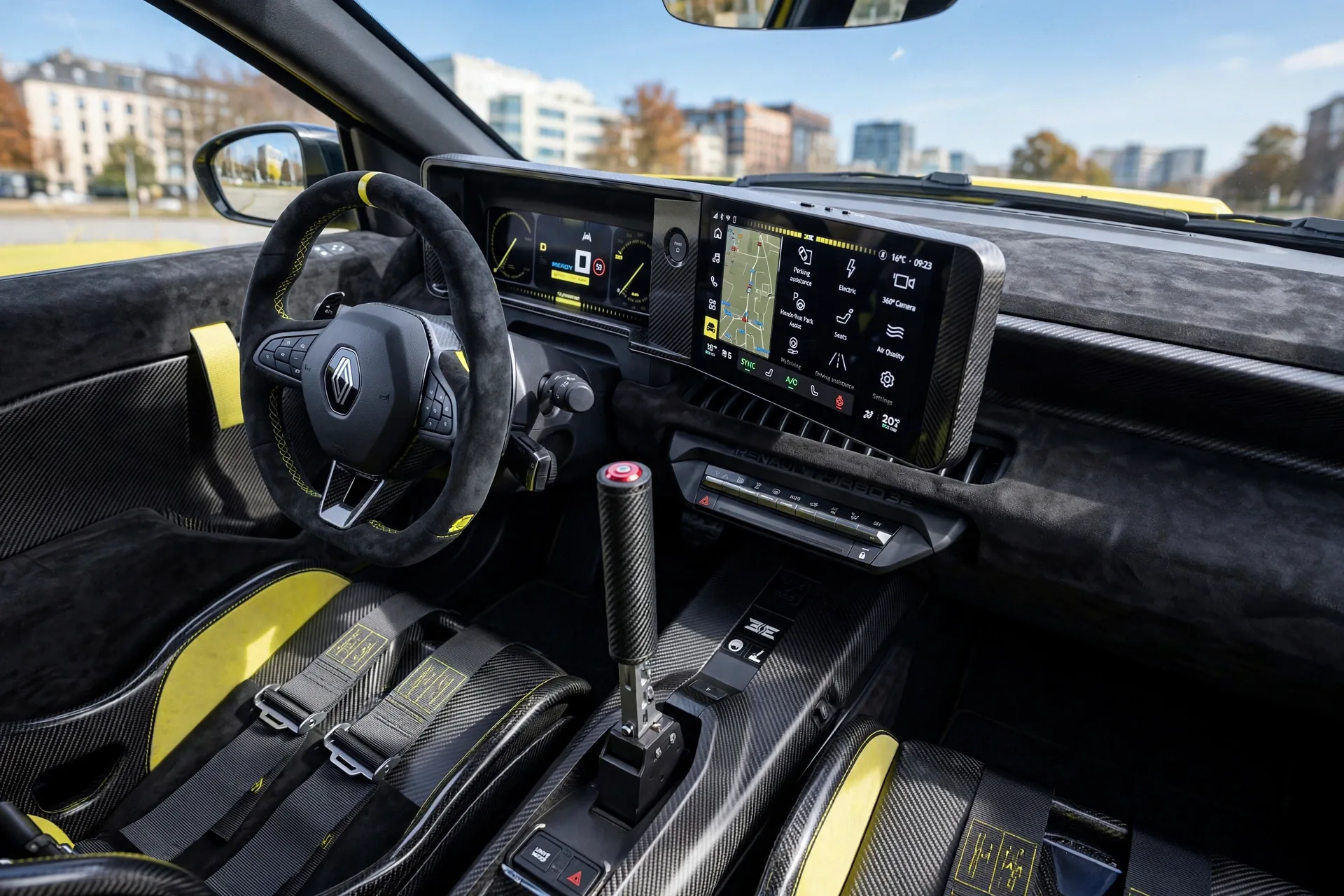
Inside, it is a two-seater with bucket seats and six-point harnesses, carbon and Alcantara trim, and a pair of OpenR screens — 10.1 and 10.25 inches — running an interface inspired by the original Turbo’s dashboard, with Google built in. The boot, Renault insists, still holds luggage. For a car shaped like this, that counts as a practicality flex.
03
The Ghost of 1980
The original Renault 5 Turbo arrived in 1980 as a homologation special: Renault took a front-engine, front-drive city car, threw the engine behind the seats, and built a mid-engined, rear-drive rally weapon with box wheel-arch flares wide enough to park a bicycle in. The road car made 160 PS from a 1,397 cc turbo four. The rally cars made up to 350 PS in Maxi Turbo form. On its very first World Rally Championship outing, Jean Ragnotti won the 1981 Monte Carlo Rally — then won the Tour de Corse in 1982 and again in 1985 in the Maxi Turbo. Renault built 4,987 road cars, and every one of them is a collector’s item now.
And yes — the name. Half the internet is currently shouting “how can an EV be called Turbo?” into comment threads, so settle it the way this site settles everything: with the record. Turbo on this car is not a parts description; it is a surname. The 1980 Turbo and the Turbo 2 after it are the lineage, and Renault is hardly the first to carry a badge past its literal meaning — Porsche sells an electric Taycan Turbo and nobody pickets Stuttgart. If the name still bothers you, the comment section is below. Argue with the Wrench.
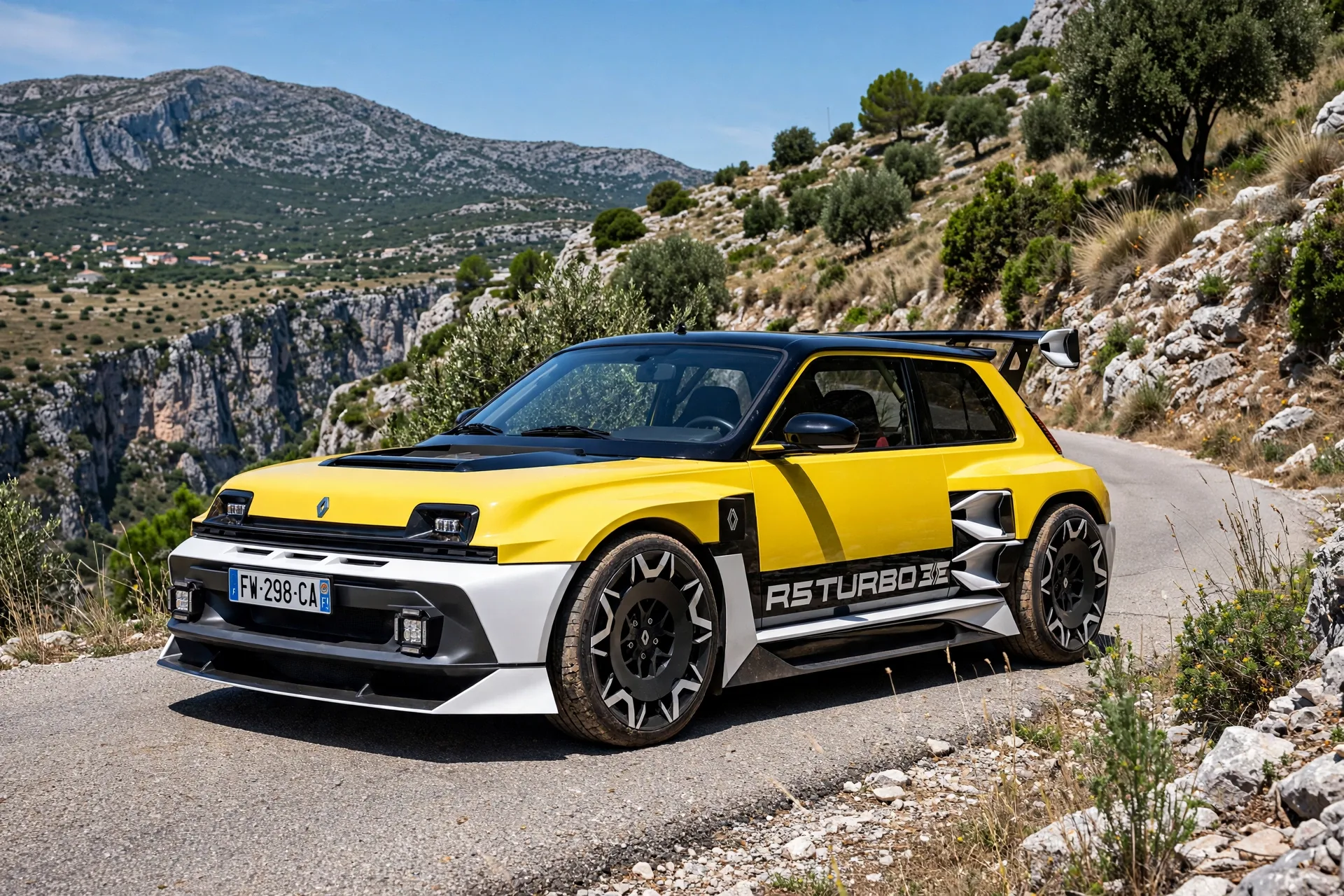
The 3E wears that history openly. The square headlights fused to the bonnet edge, the side scoops in the rear wings, the surround running from the windscreen pillars into the rear spoiler — all of it is the 1980 car, redrawn for the electric era. The historic liveries return too, including the black, yellow, and white racing colours from the 1982 Tour de Corse car, plus the Rouge Grenade red of the production originals. Buyers who want something nobody else has can sit with Renault’s designers and spec a fully bespoke livery — a process Renault is happy to charge for.
But the 3E is not a restomod. It shares just its tail lights, wing mirrors, and door handles with the ordinary Renault 5 E-Tech. Everything else — the platform, the body, the motors, the mission — is its own. The original Turbo existed because Renault needed a rally car. The 3E exists because Renault wanted to prove the electric era could still produce something unhinged. The lineage is real, and so is the difference.
04
The Price of Nostalgia
Here is where the romance meets the spreadsheet. The first 500 reservation holders were offered a provisional introductory price — £135,000 in the UK, €155,000 in Europe — before options. The standard price is €160,000. And the personalisation programme — which opens in mid-2027 — is where the numbers get silly: Renault Group CEO François Provost himself expects fully personalised examples to exceed €350,000. That figure is a ceiling for bespoke builds, not the car’s price, whatever the comment threads say. For a Renault. For a car 4 metres long. Let that sink in.
And before the outrage hardens: this complaint is 45 years old. In 1980, a normal Renault 5 cost about 33,000 francs. The Turbo cost 115,000 — three and a half times the price of the car it was based on. Renault has always charged supercar money for the tiny car with the wide hips. The 3E is the tradition, not the betrayal.
The scarcity is genuine. Production is capped at 1,980 numbered cars — a tribute to the original’s 1980 launch year — built at Alpine’s Dieppe plant, and buyers can choose their number. By the Paris show in October 2026, Renault executives were quoting over 1,100 reservations, and project leader Michael Grosjean has described the car as effectively sold out until 2028 — a deep order book, even if the “sold out” headlines are running ahead of the facts. The first 500 signatories got the introductory price; everyone else pays whatever the market — and the options list — decides.
And the timeline has slipped. Renault’s original release promised showrooms in the course of 2027. October 2026 reporting says the full tailor-made configuration programme doesn’t start until mid-2027, with first deliveries now expected from early 2028 — homologation is the final hurdle. That is not a disaster for a car like this; it is the normal rhythm of low-volume exotica. But anyone who reserved one expecting a 2027 delivery should read the small print again.
What would change the read? Two things. First, homologation: until the WLTP range and the final power figure are certified, every number in this preview is Renault’s word, not a test. Second, the first independent drives. The 3E’s whole case rests on feel — the in-wheel motors, the handbrake, the drift mode — and feel is the one thing a spec sheet cannot prove. If the first drives say it drives like a rally car, the price will look like a bargain in hindsight. If they say it drives like a fast appliance with a costume, the nostalgia premium collapses.
“Renault didn’t build an electric hot hatch. It built a rally car with a charging port.”
Technical specifications
- Powertrain
- Two in-wheel motors, one in each rear wheel · RWD
- Power
- 540 hp (400 kW) — Renault press release; some Renault pages now show 555 hp, final figures unconfirmed
- Torque
- 4,800 Nm at the wheels (in-wheel measurement, not crank)
- 0–100 km/h
- Under 3.5 s
- Top Speed
- 270 km/h (on track)
- Weight
- ~1,450 kg incl. 70 kWh battery
- Battery & Charging
- 70 kWh · 800V · 350 kW DC (15–80% ~15 min) · 11 kW AC (~8 h)
- Range
- Over 400 km WLTP (pending homologation)
- Dimensions
- 4,080 × 2,030 × 1,380 mm · wheelbase 2,570 mm · 2-door, 2-seater
- Price & Production
- £135,000 intro (UK) / €155,000 provisional (EU first 500) / €160,000 standard · 1,980 numbered · deliveries early 2028
Preview
2027 Renault 5 Turbo 3E — October 19, 2026
No score yet — the car hasn't debuted. Full verdict after launch.
What we love
- In-wheel motors, rear-drive only, no driveshafts — the most radical drivetrain in any production EV.
- 1,450 kg. In an EV. With a 70 kWh battery. The carbon superstructure earns its keep.
- A real vertical rally handbrake and a drift-assist mode. Renault built the toy, not the costume.
- It shares almost nothing with the ordinary Renault 5 — tail lights, mirrors, door handles, and that’s it.
- The 1982 Tour de Corse livery, available from the factory. Heritage you can actually order.
What could be better
- €160,000 standard — and Renault’s own Group CEO floats €350,000+ for fully personalised builds. Supercar money for a 4-metre Renault.
- Deliveries have slipped from 2027 to early 2028; homologation is still the final hurdle.
- Final power is unconfirmed — 540 hp at launch, 555 hp on Renault’s current pages, and a 533/536 units soup confusing everyone in between. Pick a number, Renault.
- Several hot laps, then a 15-minute charge: track-day rhythm is a charging schedule, not splash-and-go.
- No US sale. Europe, UK, Middle East, Japan, Australia only — Americans get to watch.
Verdict
The 5 Turbo 3E is the bravest car Renault has built since the original — and possibly the bravest electric car anyone has built, full stop. In-wheel motors, a rally handbrake, a drift mode, carbon bodywork, 1,450 kg, and a shape that makes grown adults point in the street. Renault didn’t just reboot a legend. It built the electric car the electric era was supposed to produce and then somehow didn’t.
The caveats are real, and they are all the same caveat: nothing here is independently verified yet. No road test, no homologated range, no final power figure, no confirmed delivery date. The price has already climbed from the £135,000 introductory offer toward €160,000, and the options list is where the real damage happens. This is a preview of a promise, not a review of a car.
But the promise is the right one. The original 5 Turbo proved a tiny French hatchback could beat the world on the Monte Carlo stages. The 3E’s job is harder: prove the electric era can still do unhinged. If the first drives say it can, the 1,980 cars will look cheap in hindsight. Our money’s on the car — but we’re waiting for the homologation sheet before we score it.
Quick answers
Asked, answered.
How much power does the Renault 5 Turbo 3E have?
Renault’s launch press release quoted 540 hp (400 kW) from two in-wheel motors in the rear wheels, with 4,800 Nm measured at the wheels. The 533 and 536 figures in circulation are the same 400 kW in different units; Renault’s current market pages show 555 hp (410 kW). The final figure is pending homologation.
Why is the Renault 5 Turbo 3E called ‘Turbo’ if it’s electric?
Turbo is the family name, not a parts list: the 3E succeeds the 1980 Renault 5 Turbo and Turbo 2 rally cars. There is no turbocharger. Porsche does the same thing with the electric Taycan Turbo.
How much does the Renault 5 Turbo 3E cost?
The first 500 reservations were offered a provisional introductory price — £135,000 in the UK, €155,000 in Europe. The standard price is €160,000. The €350,000 figure in circulation is Renault Group CEO François Provost’s expected ceiling for fully personalised builds, not the base price.
Is the Renault 5 Turbo 3E sold out?
No. Renault executives quoted over 1,100 reservations at the Paris Motor Show in October 2026 — more than half of the 1,980-car run — and project leader Michael Grosjean has called it effectively sold out until 2028. A deep order book, not a closed one.
How much does the Renault 5 Turbo 3E weigh?
Around 1,450 kg including the 70 kWh battery. The 1,980 figure going viral is the production cap — 1,980 numbered cars — not the weight.
When will the Renault 5 Turbo 3E be delivered?
The configuration and personalisation programme opens mid-2027, with first deliveries from early 2028, pending homologation. Earlier claims of 2027 deliveries are out of date.
Can you buy the Renault 5 Turbo 3E in the US?
No. Renault is not selling the 3E in the United States. Confirmed markets: Europe, the UK, the Middle East, Japan and Australia.
Does the Renault 5 Turbo 3E have a Torque Authority score yet?
No — this is a preview, not a scored review. The 5 Turbo 3E has not reached production yet, so there is no score. Full verdict after production cars land.
Related reviews
Latest review
2027 Toyota GR GTPreview
Toyota Built a V8 Supercar. Then It Started Interviewing Its Buyers.
Read the review →
Verified Nürburgring lap
2026 Hyundai Ioniq 6 N
2026 Hyundai Ioniq 6 N Review: 641 HP, 7:35.42 Lap & Verdict
Read the review →
More from the garage
2027 Audi NuvolariPreview
Audi’s Fastest Car Ever Has a Lamborghini Heart.
Read the review →