Issue Nº 07 — October 2026
Verified — Tesla
Tesla Made a Roadster Fly. The Roadster You Can Buy Is Still a $50,000 Deposit and a 2028 Promise.
Tesla Roadster (Second Generation) · October 26, 2026 · Preview
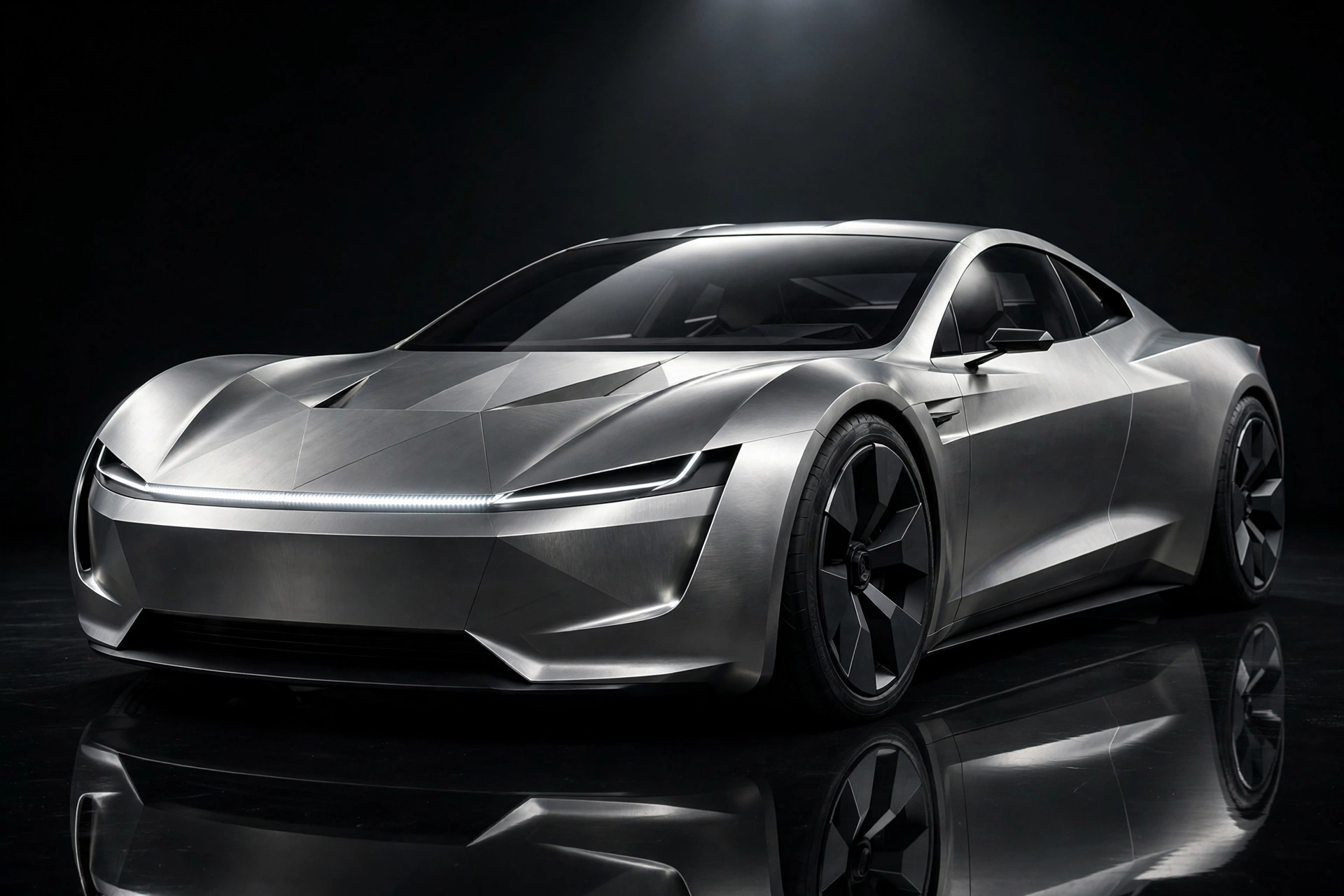
Full disclosure: The Torque Wrench hasn’t driven it — nobody has. The car that performed in Texas drove itself, with a mannequin in a SpaceX spacesuit in the driver’s seat. What exists is a stunt, a reservation page, and a set of claims from the company that has moved this car’s date at least eight times since 2017. This is the verified breakdown, not a road test.
On October 15, 2026, at SpaceX’s rocket test facility in McGregor, Texas, Tesla finally showed the second-generation Roadster — nine years after promising it for 2020. The event had already slipped once, from October 1, because the outdoor venue was unusable in severe weather. What followed was less a car reveal than a physics demonstration: the car drove up a curved ramp until it was upside down, held to the surface by fan suction, flipped in mid-air on bursts of compressed gas, and jumped clean over a lineup of Teslas — a Model 3, a Model Y, a Cybertruck, a Semi, and a Cybercab. Engineering vice president Lars Moravy called the jump a “kickflip.”
Then came the part that matters more than the stunt. Three versions. Deposits of $50,000 and $250,000. No price for any of them. A production target of 2028. And from the man on stage, the most honest sentence of the night: “Success is not guaranteed.” This is either the boldest car of the decade or the most expensive magic trick ever sold on a reservation page. The evidence, so far, contains both.
01
The Night a Car Left the Ground
Start with what actually happened, because the footage looks fake and Tesla knew it. Musk told the crowd the audience was there so people could say they saw it with their own eyes — “what you see with your eyes, you will believe.” The demonstration ran autonomously, Musk said, “to make sure we don’t kill anyone.” That is not a criticism. It is the correct call for a car with pressurised tanks doing its first public backflip, and it is also the first asterisk: nobody has driven this car. Not even Tesla, in public.
The hardware behind the show is a genuine Tesla–SpaceX collaboration, and the numbers are specific enough to take seriously. Ten cold-gas thruster nozzles, fed by roughly 600 litres of compressed air held in carbon-fibre overwrapped pressure vessels packed into every usable void in the car. Working pressure is reported at 10,000 psi. Alongside the thrusters sits a fan-based suction system under the floor that Tesla says can generate up to 2G of downforce — enough to hold the car to an inverted ramp. The show car also carries steer-by-wire controls and an active rear wing, and the styling has abandoned the svelte 2017 concept entirely for a hard-edged, angular shape in the Cybertruck idiom, inspired — Musk says — by the SR-71 Blackbird and the F-35.
The headline number from the night was a 0–60 mph run of 0.81 seconds on the event’s own timer. One report puts it at 0.67 seconds with rollout subtracted, without saying which version made the run. Neither figure has been independently timed, and that distinction is the whole story of this car so far: what Tesla showed is spectacular, and what anyone outside Tesla has measured is nothing. For context, the independently verified benchmark is the Rimac Nevera at 1.74 seconds — a car customers already own. The Roadster cannot claim that record until a production car is tested by a third party.
02
Three Roadsters, One of Which Is Real
Tesla lists three versions, and the honest way to read them is as a ladder from car to concept. The Performance is the road car: two seats, active aerodynamics and the suction system, 0–60 mph claimed under 1.6 seconds, described by Tesla as road-ready. The Thrust is the race car: two seats plus rear-mounted cold-gas thrusters, 0–60 claimed under 0.9 seconds, billed as race-ready. The Rocket is the stunt: a single seat, ten perimeter thrusters and what Tesla calls a full flight system, 0–60 claimed under 0.59 seconds, invite-only — and, per Tesla’s own site, not approved for public road use.
Now the money, and read this part twice. A Performance reservation is $50,000 in the US and $70,000 CAD in Canada. A Thrust reservation is $250,000 in the US and $350,000 CAD in Canada. The Rocket has no public deposit or price. These are deposits, not prices — Tesla has announced no price for any version. The US Performance deposit breaks into $5,000 by card and $45,000 by wire within 10 days; in Canada it is $7,000 immediately (reportedly fully refundable) plus $63,000 within 10 days, and the reservation is not final until the wire clears. Tesla’s own reservation terms say any estimated price “is only an estimate” and warn it “cannot guarantee when your vehicle will actually be delivered or if it will be delivered.” A deposit here is not a purchase. It is a paid belief.
What Tesla did not say matters as much as what it did. No horsepower. No motor configuration. No battery capacity. No final price, no configuration timeline, and no word on what happens to the people who paid $250,000 for the 2017 Founders Series — reported as 1,000 cars paid in full, a product that, per one detailed report, no longer exists as such. The Verge’s verdict on the stream, that it felt “more like a stunt show than a product reveal,” is hard to argue with: the show lasted under 30 minutes and left the spec sheet mostly blank.
03
The Hardware: Air, Fans, and a Weight Problem
Strip away the flying and the suction system is the most interesting engineering on the car. A fan that pulls the car to the road is downforce without wings — no drag penalty at speed, no ugly aero appendage, grip that works in a parking lot. If it works at 2G as claimed, it changes what a road car can do in a corner. It is also, note, the same system that lets the car drive upside down on a ramp, which is a party trick — but party tricks built on real physics are how halo cars earn their keep.
The thrusters are a harder sell as car hardware. Ten nozzles, roughly 600 litres of air, about 250 kg of it by one report, all to produce brief bursts of thrust. The air tank can be refilled between runs, which answers the obvious question and raises the next one: how many bursts before the car is just a heavy EV again? Tesla has not said. Nor has it said how a perimeter nozzle array passes pedestrian safety rules or crash testing — one reason the Rocket is not road-approved, and why one analysis calls the flying version a closed-circuit experimental vehicle in all but name.
Two reported figures decide whether the rest is believable, and both are single-source, so they stay flagged. A sub-1,700 kg weight target would undercut every current electric hypercar by hundreds of kilos — the number the whole performance story depends on, since thrust and suction cannot repeal mass. And a base car around 800 kW is reported via Top Gear, still being developed. Power, weight, battery size: the three numbers that define an EV are all either unannounced or unconfirmed. Until Tesla publishes them, treat every acceleration claim as arithmetic waiting for its inputs.
04
The 2017 Car vs the 2026 Car
This is the second Roadster reveal, and the first one is the control group. In November 2017 Tesla promised a four-seat Roadster with 620 miles of range, 0–60 mph in 1.9 seconds, a top speed over 250 mph, a $200,000 base price, and deliveries in 2020. The 2026 car keeps almost none of that. Range is now “more than 300 miles” on all trims — less than half the original promise, with no test cycle named. Seats are down from four to two, and to one in the Rocket. The base acceleration claim improved to under 1.6 seconds, but only by redefining the car around thrusters and suction. And the price went from $200,000 to “not announced,” with the deposit alone now costing $50,000.
The timeline is the indictment and the defence in one. Unveiled 2017 for 2020, then slipped at least eight times through 2021, 2022, 2023, 2024, 2025, and three unveiling dates in 2026. The Cybertruck took roughly four years from reveal to delivery; the Roadster’s gap from 2017 to a targeted 2028 is roughly eleven. Musk’s answer this time was “2028, actually,” built at Gigafactory Texas, with four or five development prototypes in existence and a larger build starting early next year, per one detailed report. Believe the date when the tooling is photographed, not before — but also remember that Tesla has, eventually, built the impossible car before. Just never on the first date it gave.
Top speed deserves its own paragraph because Tesla gave three answers. The company lists above 230 mph for all versions. Engineers separately told Top Gear the initial top speed would be 214 mph, with a 330 mph version planned. And Musk’s stated aim is to “crack halfway to the speed of sound” — roughly 383 mph. Those are not the same claim, and the spread between them is the difference between a very fast car and a land-speed record. Until one of them is attached to a production car and a measured run, the honest spec is “above 230 mph, claimed.”
05
The Skepticism Is the Story
The reaction split exactly the way it should for a car like this. Ferrari CEO Benedetto Vigna, speaking to Reuters on October 20, gave the launch 10 out of 10 for technology and 10 out of 10 for presentation, saying it showed “even in an old world, you can still innovate and dare.” That is the head of Ferrari applauding a car that does not exist yet — and it is worth more than a thousand fan posts, because Vigna has his own electric car to sell and nothing to gain from praising Tesla’s.
The market answered differently. Polymarket odds of a Roadster delivered by the end of 2027 reportedly fell from 33 percent before the reveal to about 10 percent after it; live prices around October 22 put delivery by end of 2027 at roughly 9.5 percent. Caveat, stated plainly: those markets are thin, with under $6,000 in volume on the delivery questions, so small money moves them. They are a mood ring, not a forecast — but the mood is sceptical, and the scepticism has a cause. A reveal that answers the flying question and leaves the price, power, battery, and delivery questions blank does not increase confidence in delivery. It increases confidence in the show.
Coverage split the same way, from CBS News calling it proof that “flying cars are real” to The Atlantic arguing the vehicle must never be built, with the BBC questioning whether a brief hop counts as flight at all. The fair position sits between the applause and the horror: what Tesla demonstrated is a real engineering accomplishment — a car held upside down by suction and landed by thrusters is not CGI — and a real car is still an unproven thing. The stunt proved the hardware can work once, on a stage, driverless. It proved nothing about the 2028 car, its price, its safety certification, or its range. Those proofs arrive one at a time, or not at all.
“Tesla built the car that flies before building the car you can buy.”
Technical specifications
- Reveal
- October 15, 2026 · SpaceX rocket test facility, McGregor, Texas (postponed from October 1 due to weather)
- Production target
- 2028 · Gigafactory Texas (Musk) · 4–5 development prototypes reported
- Trims
- Performance (road-ready, 2 seats) · Thrust (race-ready, 2 seats) · Rocket (air-ready, 1 seat, invite-only)
- 0–60 mph (Tesla claims, unverified)
- Performance under 1.6 s · Thrust under 0.9 s · Rocket under 0.59 s · event demo run 0.81 s on Tesla’s own timer, not independently timed
- Top speed
- Above 230 mph (Tesla) · engineers told Top Gear initial 214 mph, 330 mph version planned · Musk aim: half the speed of sound (~383 mph)
- Range
- More than 300 miles, all trims (Tesla claim, no test cycle named) · 2017 promise was 620 miles
- Thrusters
- 10 cold-gas nozzles · ~600 litres compressed air in carbon-fibre overwrapped pressure vessels · working pressure reported 10,000 psi
- Suction downforce
- Fan-based underbody system, up to 2G (reported)
- Power
- Not announced · base car around 800 kW reported via Top Gear, unconfirmed
- Battery
- Not announced
- Weight
- Sub-1,700 kg target reported (single source, unconfirmed)
- Seats
- 2 (Performance, Thrust) · 1 (Rocket) · 2017 concept promised 4
- Deposits (NOT prices)
- Performance $50,000 US / $70,000 CAD · Thrust $250,000 US / $350,000 CAD · Rocket invite-only, no public deposit · no final price announced for any trim
- Road legality
- Performance road-ready · Thrust race-ready · Rocket NOT approved for public road use (Tesla)
- Reservation terms
- Estimated price only · delivery not guaranteed (Tesla’s own terms)
Preview
Tesla Roadster (Second Generation) — October 26, 2026
No score yet — the car hasn't debuted. Full verdict after launch.
What we love
- The audacity, full stop. Nobody else in the car business would put a backflipping prototype on stage and then ask for $250,000 deposits. The industry is duller without this.
- The suction system as real engineering. Downforce without wings, grip without drag — if 2G holds up, it is a genuine idea, not a gimmick.
- The Performance trim underneath the circus. A two-seat, road-ready hypercar with active aero and suction is a real car hiding inside a stunt show.
- “Success is not guaranteed.” A CEO saying that on stage, before a stunt that could have failed in front of everyone, is the most honest sentence of the launch.
- Ferrari’s 10 out of 10. When the head of Maranello applauds your dare, the dare mattered — whatever happens to the car.
What could be better
- No price. Deposits up to $250,000 for a car with no sticker price is a belief, not a purchase — and Tesla’s own terms say so.
- No independently verified number. The 0.81-second run was timed by the company selling the car. Nothing here has been measured by anyone else.
- The Rocket is not a road car. The version that flies is invite-only, single-seat, and not approved for public roads — the headline act cannot be bought or driven.
- Nine years of slips against a 2028 target. The market’s verdict is blunt: delivery odds by end of 2027 fell to about 10 percent after the reveal.
- The 2017 promise was quietly rewritten. Four seats became two, 620 miles became 300-plus, $200,000 became “not announced.” Nobody at Tesla has explained the rewrite.
- 2017 reservation holders, unaddressed. What happens to the Founders Series buyers who paid $250,000 in full was not covered on stage.
Verdict
Start with what is real, because it is easy to lose it in the smoke. Tesla built hardware that held a car upside down and landed it from a flip, in front of a crowd, with compressed air and fans. That is not a rendering. It is not AI. It is an engineering team solving a problem nobody asked them to solve, in public, with the whole world watching. Ferrari’s CEO gave it 10 out of 10 for a reason: the industry runs on people willing to look ridiculous, and this was ridiculous in the best way.
Now the asterisks, because they are the car. No price. No power figure. No battery size. No independently timed run. A road car (Performance) that has never been driven in public, a race car (Thrust) that needs a quarter-million-dollar deposit to reserve, and a flying car (Rocket) that cannot legally use a public road. A 2028 target from a company that has moved this date at least eight times. And a reservation agreement that warns, in writing, that delivery is not guaranteed. The stunt proved the hardware can work once. It proved nothing about the product.
So the verdict is a waiting game with a number attached. If Tesla lands the Performance at anything near its claims — a road car with suction downforce and a sub-1.6-second sprint — it will be one of the great performance cars of the decade, and the deposits will look cheap. If 2028 slips the way 2020 through 2026 slipped, the Roadster joins the long list of Musk promises that stayed promises. Either way, the Roadster does not need to fly. It needs to arrive. There is no score until it does.
Quick answers
Asked, answered.
When can you buy the second-generation Tesla Roadster?
Tesla targets 2028 production at Gigafactory Texas, per Musk — after a 2017 unveil originally promised for 2020 and at least eight delays since. No final price has been announced; reservations are deposits, not purchases.
How much does it cost to reserve a Tesla Roadster?
Performance: $50,000 US / $70,000 CAD. Thrust: $250,000 US / $350,000 CAD. The Rocket is invite-only with no public deposit. Tesla has announced no final price for any version, and its own terms say delivery is not guaranteed.
Did the Tesla Roadster really fly?
The Rocket version demonstrated a driverless jump over a lineup of Teslas at McGregor, Texas, on October 15, 2026, using cold-gas thrusters — but it is invite-only, single-seat, and not approved for public road use. The road car is the Performance trim.
Is the 0.81-second 0–60 mph time verified?
No. The 0.81-second run was timed on Tesla's own timer at the event and has not been independently timed. The independently verified benchmark is the Rimac Nevera at 1.74 seconds.
Does the Tesla Roadster have a Torque Authority score yet?
No — this is a preview, not a scored review. The Roadster has not reached production yet, so there is no score. There is no score until it lands.
Related reviews
Latest review
2027 Alpine A110 EVPreview
Alpine Killed Its 1,102-Kilo Sports Car. The Electric One Targets 1,450 kg — and Keeps a Petrol Escape Hatch.
Read the review →
Verified Nürburgring lap
2026 Hyundai Ioniq 6 N
2026 Hyundai Ioniq 6 N Review: 641 HP, 7:35.42 Lap & Verdict
Read the review →
More from the garage
2027 Renault 5 Turbo 3EPreview
Renault Built a 540-HP Electric Rally Car. Then It Charged Supercar Money for It.
Read the review →