Issue Nº 02 — Autumn 2026
Verified — Denza
The 1,582-hp Supercar From a Brand You've Never Heard Of
Denza Z · October 30, 2026 · Preview
Preview, no score. Tri-motor, 1,582 hp, 76 kWh battery, UK from £142,900 — not yet independently tested, and no Nürburgring lap yet.
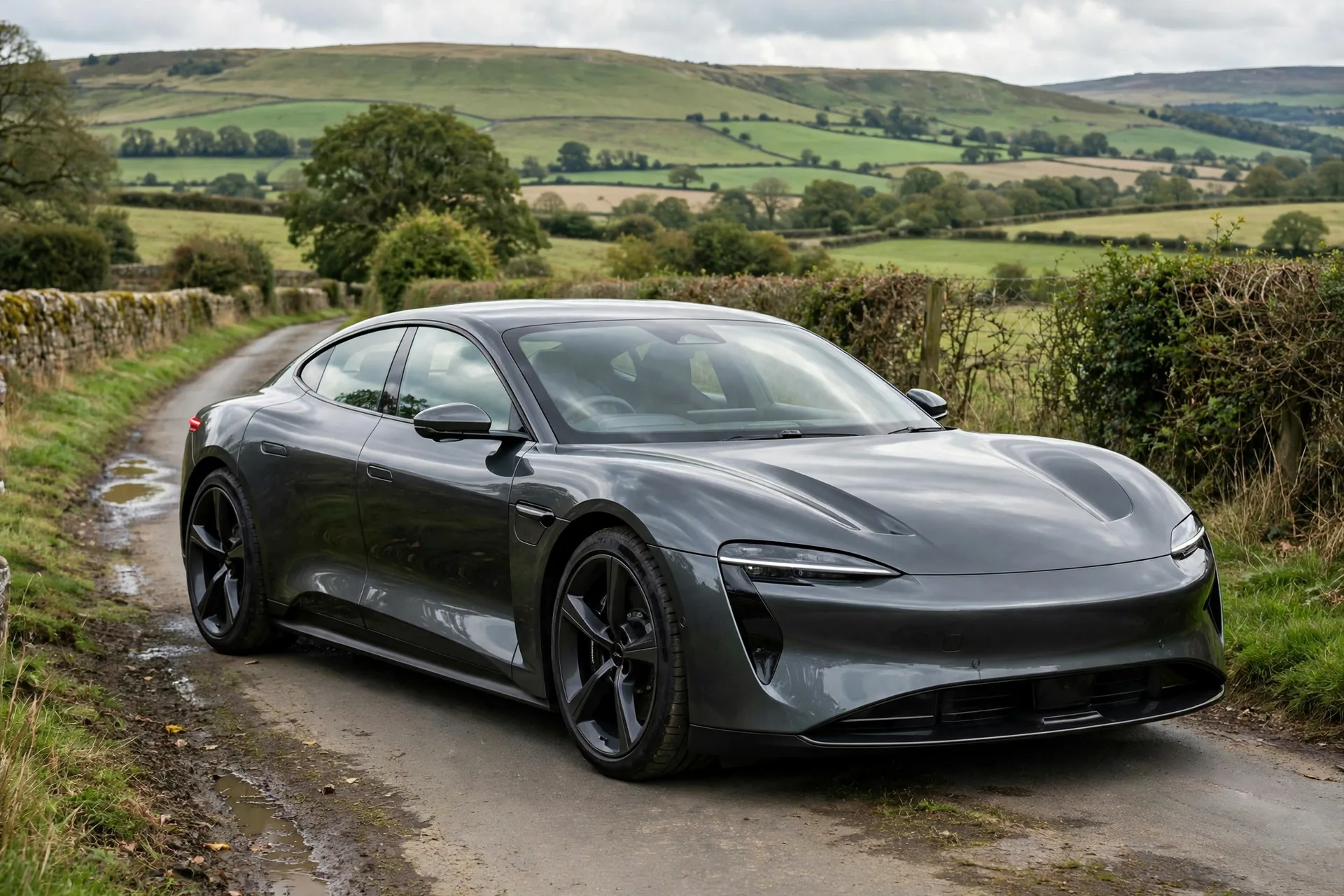
Full disclosure: The Torque Wrench hasn't driven it — this is the verified breakdown, not a road test. The Denza Z is a production car, revealed in full at the Goodwood Festival of Speed on July 9, 2026, with UK prices announced and first deliveries promised before the end of 2026. But no journalist has road-tested one, no independent tester has verified a single performance figure, and the Nürburgring lap record its Special Edition is chasing does not exist yet. Every number below is either confirmed by Denza or labelled as a manufacturer claim. Anyone quoting you a Denza Z road-test verdict tonight is inventing one.
Start with the number, because it is absurd in the best way. One thousand five hundred and eighty-two horsepower. That is the combined output of three electric motors — one at the front, two at the rear — in a four-seat grand tourer that costs less, in the UK, than a Porsche 911 Carrera 4 GTS. A decade ago, 1,582 hp was Bugatti territory, a number reserved for cars with sixteen cylinders and seven-figure prices. Now it arrives from Denza, the premium brand of BYD, a company most European and North American buyers had never heard of until very recently. The supercar establishment should be paying attention. Whether it should be worried is a different question, and it is the one this preview exists to answer.
Here is the part that actually matters, and it is not the horsepower. The Z is the first car on BYD's e3 Sports Car Platform, and it is engineered like a statement of intent: steer-by-wire with no mechanical steering column at all, independent steering for each rear wheel, magnetorheological suspension that adjusts damping in under 10 milliseconds, and a charging claim — 10 to 70 percent in five minutes — that, if it works anywhere outside a BYD showcase charger, rewrites the electric supercar's biggest compromise. The horsepower gets the headlines. The platform is the reason the headlines might be justified.
01
Goodwood, Meet the New Giant
The setting was deliberate, and Denza knew exactly what it was doing. The Z's Coupe and Racing variants made their global debut at the Goodwood Festival of Speed in July 2026, unveiled by BYD executive vice president Stella Li alongside former Formula One world champion Jenson Button, on the largest stand in the festival's history. The Spider had already been shown at Auto China in Beijing that April. You do not launch at Goodwood by accident. It is the one place where the entire European supercar establishment gathers in one field, and Denza parked a 1,582-hp electric supercar in the middle of it and announced prices.
The prices are the second shock, and they are official — confirmed by Denza UK itself, not leaked by a dealer. The Coupe costs £142,900, the Spider £159,900, and the Racing £172,900. UK order books were due to open in late summer 2026 as Denza's first British retailers opened, with customer handovers promised before the end of the year. For context, a Porsche 911 Carrera 4 GTS starts at £145,900 in the UK — more money, for roughly a third of the power. That comparison is Denza's whole pitch in one sentence, and it is why the Z matters even if you would never buy one: it forces every established supercar maker to justify its price tag against a car with triple the horsepower.
The man behind the shape is Wolfgang Egger, who has led design at BYD since 2016 and describes the Z as a dynamic sculpture of speed. The design holds up to that billing in the way that matters: it looks like a supercar first and a technology demonstrator second. Long nose, low roofline, four seats — a genuine 2+2 grand tourer rather than a two-seat toy — and a full-width rear light bar that gives the car its signature at night. It does not look like a copy of anything, which is the highest compliment you can pay a first supercar from a new brand. Whether it looks like a Denza in five years, when the brand has a range to define, is a question for later. Right now it looks like intent.
One honest caveat before the engineering chapter: the Z is not coming to the United States, and North American readers should read this preview as a dispatch from a market they cannot buy into — yet. It launches in China, the UK, and Europe, with Australia reportedly on the wish list and right-hand-drive production expected by the end of 2026. For Canadian and Mexican readers, the Z is the sharp end of a story this site will keep following: Chinese EVs are already a real buying choice in Mexico, and Canada's new quota system means they may become one here too. The Z is not that buying choice — not yet, and not at £142,900 — but it is the car that proves the technology behind it is no longer a curiosity.
02
The Platform Is the Point
Forget the headline power figure for a minute and look at what is underneath it. The e3 Sports Car Platform — pronounced e-cube — is BYD's first dedicated high-performance EV architecture, and the Z is its debut. Three permanent-magnet motors: a 500 kW unit at the front and two 340 kW units at the rear, one per wheel. That rear pair is the clever part. With a motor on each rear wheel, the car can vector torque side to side continuously, without waiting for a mechanical differential to shuffle power around. On paper, that is the kind of traction and rotation control that used to require a very expensive all-wheel-drive system and a very good chassis engineer. Here it is a consequence of the layout, not an add-on.
Then there is the steering, and this is where the Z stops being a fast EV and starts being a genuinely interesting car. It is the first car from China with an entirely in-house-developed steer-by-wire system — no mechanical steering column at all, the wheel connected to the front axle by wires and software alone. The steering wheel itself folds away. The rear wheels steer independently too, which at low speed should tighten the turning circle of a car with a 2,780 mm wheelbase, and at high speed should steady it. This is technology that established supercar makers have approached cautiously, because a steering failure in a steer-by-wire car has no mechanical fallback to catch it. BYD is betting its flagship on it working. That confidence is either impressive or alarming, and the difference will be decided by the first year of customer cars, not by a launch presentation.
The suspension is DiSus-M, BYD's magnetorheological body control system, which adjusts damping force in under 10 milliseconds — fast enough to react to a bump before you have finished feeling it. The Coupe and Spider pair it with air suspension; the Racing model gets traditional coil springs, because track cars and air springs have never been friends. Brakes are carbon-ceramic discs all round, with six-piston calipers at the front and four-piston units at the rear, which is the correct answer for stopping a car that weighs around 2,230 to 2,300 kg depending on variant. That weight is the number nobody at the launch wanted to dwell on. Two-point-three tonnes is a lot of supercar, and it is the price of a 76 kWh battery, three motors, and four seats. The motors can hide it in a straight line. A tight circuit will ask harder questions.
Inside, the Z gets a 12.8-inch infotainment display, an 8.9-inch digital instrument cluster, and a wireless charging pad — restrained by modern EV standards, and all the better for it. The cabin's real trick is the foldaway wheel, which turns the driver's seat into a lounge chair when the car is parked. It is a gimmick, and Denza knows it is a gimmick, but it is an honest one: a car with no steering column can do things a car with one cannot, and Denza is showing its working. The driver-assistance suite is God's Eye 5.0, BYD's latest system, fusing cameras, radar, and ultrasonic sensors, with optional LiDAR on higher trims. None of it has been independently tested on this car yet, and this preview will not pretend otherwise.
03
The Five-Minute Charge, Examined
Now the claim that deserves the most scrutiny, because it is the one that would change ownership if true. Denza says the Z's second-generation Blade Battery — a 76 kWh lithium-iron-phosphate pack, built into the body structure — can charge from 10 to 70 percent in five minutes, and from 10 to 97 percent in nine minutes, on a compatible charger running at up to 1,500 kW. Read that charging figure again: 1,500 kW. That is not a typo, and it is not the car's power output — the two numbers are different things, and confusing them is the easiest mistake in this whole story. The car's power is 1,180 kW. The charger's rate is 1,500 kW. One moves the car, the other fills it.
Here is the asterisk, and it is a large one. A 1,500 kW charger is BYD's Flash Charging hardware, and outside China it is still extremely rare. On an ordinary fast charger, the Z will charge at an ordinary fast rate, and Denza has not published a 10–80 percent time on the kind of charger you will actually find on a British motorway. The five-minute claim is therefore best read as a demonstration of what the battery can accept, not a promise about your next road trip. It is still a remarkable demonstration — a small LFP pack accepting megawatt charging without, apparently, melting — but the infrastructure has to catch up before the claim becomes an experience.
The battery's size is the other side of the same coin. At 76 kWh, the pack is small for a car with this much power, and the claimed WLTP ranges show it: 410 km (254 miles) for the Coupe, 400 km (248 miles) for the Spider, and 380 km (236 miles) for the Racing. Those are modest figures by 2026 EV standards, and they are manufacturer claims, not independent test results. A 1,582-hp car driven the way its buyers will drive it will not see 410 km. Nobody buys a car like this for range, and Denza knows it — the small pack is a weight decision, and weight is the enemy of everything a supercar is supposed to do. But if you are cross-shopping this against a 911, remember the 911 will do 500 km on a tank and refuel anywhere in five minutes. The Z's five-minute charge only exists where a megawatt charger does, and right now that is almost nowhere you live.
04
Three Cars, One Powertrain
All three launch variants share the same tri-motor powertrain, the same 76 kWh battery, and the same chassis architecture. What changes is the body, the aero, and the attitude. The Coupe is the baseline: fixed hardtop, 2.25 seconds to 100 km/h, 300 km/h top speed, 410 km of claimed range, £142,900. The Spider trades the roof for open air: a soft-top convertible, 2.30 seconds, the same 300 km/h ceiling, 400 km of range, £159,900. The Racing is the one to watch: a fixed rear wing, a carbon-fibre front splitter, underfloor vortex generators, extra body vents, a reprofiled front intake that Denza says increases motor cooling by 50 percent, and optional semi-slick tyres that cut the sprint to 1.96 seconds and raise the top speed to 350 km/h (217 mph), at the cost of range falling to 380 km. It costs £172,900.
The Racing's aero claim deserves its own line: up to 1,060 kg of downforce at its 350 km/h top speed, according to Denza. That is a serious number for a road car, and it is what separates the Racing from a Coupe with a wing bolted on. Whether it produces that downforce on a real circuit, with real air, is — like everything else on this car — unproven until an independent tester says so. But the hardware list reads like a car built by people who understand what downforce is for, not people who read about it in a brochure. Carbon-ceramic brakes, coil springs, semi-slicks, and a wing you could eat dinner off: the Racing is not a styling pack.
In China, the same cars cost considerably less — the Spider launched at 780,000 yuan and the Racing at 1,180,000 yuan, with the Coupe below both — which tells you how much of the UK price is export, tax, and positioning rather than hardware. That gap is the whole Chinese-EV story in miniature: the technology is cheap at home and premium abroad, and the premium is justified by the badge it is parked next to, not the parts inside it. Denza is pricing the Z against Porsche, not against BYD's own range, and that is a deliberate statement about where the brand thinks it belongs. The first customer cars, due before the end of 2026, will tell us whether buyers agree.
05
The Fourth Car Wants a Lap Record
Then there is the car you cannot buy, which might be the most important one of all. The Z Special Edition is a separate, more extreme machine: race-grade dual-layer composite bodywork with panels made entirely from carbon fibre, a Formula One-style drag-reduction system that coordinates a front active diffuser and a rear wing flap to cut drag by up to 40 percent, and more than 2,000 kg of downforce at 300 km/h, according to Denza. Power rises to more than 1,471 kW — more than 1,973 hp, or 2,000 PS — with a claimed 0–100 km/h time of under 1.7 seconds. Improved battery cooling, up 30 percent, and powertrain cooling, up 180 percent, are what make that output sustainable for more than a single launch-control party trick.
Denza's stated mission for the Special Edition is a Nürburgring Nordschleife lap record attempt, planned for autumn 2026, and a prototype has already been spied testing at the Ring wearing canards and a much larger wing than the Racing model. Let us be precise about what that means as of today, October 30, 2026: no lap time has been published. Not a fast one, not a slow one, not a rumoured one worth repeating. The attempt was scheduled for this autumn, and autumn is not over. This site's Nürburgring leaderboard only carries verified production-car laps, and the Special Edition is neither production nor lapped — so it does not appear there, and it will not until Denza publishes a time that can be checked. Any outlet quoting you a Denza Z Ring time tonight is selling you a wish.
That discipline matters, because the Special Edition is where this story could go either way. If it sets a genuinely fast electric lap time, the Z stops being a curiosity and becomes a benchmark — the car that proved a Chinese brand can build a track weapon, not just a fast grand tourer. If the attempt quietly slips into next year, or the time disappoints, the Z remains what it is today: a spectacular spec sheet waiting for proof. Either outcome is interesting. Only one of them is news, and it has not happened yet.
“1,582 horsepower used to be a Bugatti number. Now it's a BYD number — and it comes with a five-minute charge claim.”
Technical specifications
- Powertrain
- Tri-motor all-wheel drive — 1× 500 kW front motor + 2× 340 kW rear motors, one per rear wheel
- Power
- 1,180 kW / 1,582 hp / 1,604 PS · 1,240 Nm (914 lb-ft) — all variants
- Performance (claimed)
- 0–100 km/h: Coupe 2.25 s · Spider 2.30 s · Racing 1.96 s (semi-slicks) · Top speed: Coupe/Spider 300 km/h (186 mph) · Racing 350 km/h (217 mph)
- Battery
- 76 kWh Blade Battery 2.0 (LFP) · 800-volt architecture · Cell-to-Body 2.0 construction
- Charging (claimed)
- Up to 1,500 kW Flash Charging · 10–70% in 5 minutes · 10–97% in 9 minutes — requires a compatible megawatt charger, still rare outside China
- Range, WLTP (claimed)
- Coupe 410 km (254 mi) · Spider 400 km (248 mi) · Racing 380 km (236 mi)
- Dimensions
- Length 4,780 mm (Coupe/Spider) · 4,870 mm (Racing) · Width 1,990 mm · Wheelbase 2,780 mm · Height 1,330 mm (Coupe) / 1,350 mm (Spider) · Weight ~2,230–2,300 kg depending on variant (sources vary)
- Chassis
- e3 Sports Car Platform · steer-by-wire (no mechanical steering column) · independent rear-wheel steering · DiSus-M magnetorheological damping (under 10 ms) · foldable steering wheel · carbon-ceramic brakes, 6-piston front / 4-piston rear
- UK price & timing
- Coupe £142,900 · Spider £159,900 · Racing £172,900 (Denza UK, July 9, 2026) · Orders late summer 2026 · First deliveries before end of 2026 · Not sold in the United States
- Special Edition (expected)
- Over 1,471 kW / 1,973 hp (2,000 PS) · Claimed sub-1.7 s 0–100 km/h · DRS cutting drag up to 40% · Over 2,000 kg downforce at 300 km/h (claimed) · Nürburgring record attempt planned autumn 2026 — NO lap time published as of October 30, 2026
Preview
Denza Z — October 30, 2026
No score yet — the car hasn't debuted. Full verdict after launch.
What we love
- The price-to-power ratio, which is genuinely absurd. £142,900 for 1,582 hp undercuts a 911 Carrera 4 GTS while tripling its output — the establishment has never faced a value argument this blunt.
- The e3 platform's engineering honesty. Tri-motor torque vectoring, steer-by-wire, independent rear steering, and sub-10-millisecond damping are real systems solving real problems, not a bigger screen and a louder badge.
- Three distinct cars, not three trim levels. A coupe, a convertible, and a winged track car with coil springs and semi-slicks is a range with actual character in it.
- The design, which stands on its own. No copied face, no borrowed badge equity — a clean, low, four-seat grand tourer that looks like it belongs at Goodwood rather than crashed into it.
- The Special Edition's ambition. A carbon-bodied, DRS-equipped Ring-record chaser is exactly the kind of glorious overreach that makes supercars worth caring about — and Denza is actually testing it, not just rendering it.
What could be better
- Nothing is independently verified yet. No road test, no instrumented acceleration run, no verified range figure — every number in this preview is a manufacturer claim wearing a press release.
- The five-minute charge needs a charger that barely exists. Until megawatt Flash Charging is something you can actually find, the Z's headline charging claim is a laboratory result, not an ownership benefit.
- The range is modest and the weight is not. 410 km at best, 2.3 tonnes at worst — the small battery saves weight and costs distance, and a hard-driven Z will not see either claimed figure.
- Steer-by-wire with no mechanical fallback is a brave bet on a first flagship. If the software is flawless, it is the future. If it is not, there is no column to catch it — and the first year of customer cars is the test.
- You cannot buy one in North America, and the brand is unknown where it is sold. A £142,900 car from a new badge asks buyers to trust the warranty, the dealer network, and the residual value all at once — and none of those exist yet at scale.
Verdict
Strip away the headlines and the Denza Z is a bet, placed in public, at Goodwood, in front of the entire supercar establishment. The bet is that horsepower no longer belongs to heritage, that a tri-motor platform with steer-by-wire and megawatt charging can stand next to a 911 and not look like an imposter, and that buyers will pay £142,900 for a badge they cannot yet pronounce with confidence. The hardware gives that bet a fighting chance. The price gives it a punchline the establishment cannot ignore. The engineering gives it something most disruptors never bother with: a reason to exist beyond the spec sheet.
But a bet is not a verdict, and this preview will not pretend otherwise. The Z has not been road-tested, its range and charging claims have not survived contact with a real charger or a real road, its steering has no mechanical safety net, and its Nürburgring lap record is a plan, not a time. The Special Edition could change all of that in a single autumn afternoon at the Ring — or it could slip quietly into next year, and the Z would remain a spectacular promise. Promises are cheap in this business. Lap times and customer cars are not.
So here is the honest summary, and it is more encouraging than the asterisks suggest. If the first customer cars drive the way the spec sheet promises, the Denza Z is the most significant supercar debut of 2026 — not because it is the fastest, but because it moves the goalposts for everyone else. A 1,582-hp, four-seat, steer-by-wire supercar for less than a 911 GTS is not a car you have to want. It is a car every other maker now has to answer. There is no score until it is driven. But the question it asks the establishment — what exactly are we paying for? — already has an answer, and the answer is uncomfortable.
Quick answers
Asked, answered.
How much horsepower does the Denza Z make?
1,582 hp (1,180 kW / 1,604 PS) and 1,240 Nm of torque, from a tri-motor all-wheel-drive setup: one 500 kW front motor and two 340 kW rear motors. All three launch variants — Coupe, Spider, and Racing — share the same output. The 1,500 kW figure sometimes quoted is the charging rate, not the power output.
How much does the Denza Z cost?
UK prices confirmed by Denza on July 9, 2026: Coupe £142,900, Spider £159,900, and Racing £172,900. UK order books were due to open in late summer 2026, with first deliveries before the end of 2026. The car is not sold in the United States.
How fast is the Denza Z?
Manufacturer claims: 0–100 km/h in 2.25 seconds for the Coupe, 2.30 seconds for the Spider, and 1.96 seconds for the Racing on optional semi-slick tyres. Top speed is 300 km/h for the Coupe and Spider and 350 km/h for the Racing. None of these figures has been independently verified yet.
How long does the Denza Z take to charge?
Denza claims 10 to 70 percent in five minutes and 10 to 97 percent in nine minutes on a compatible charger running at up to 1,500 kW. That megawatt Flash Charging hardware is still extremely rare outside China, so on an ordinary fast charger the Z will charge at an ordinary fast rate.
Has the Denza Z set a Nürburgring lap time?
No. A more extreme Special Edition, with over 1,973 hp and a drag-reduction system, is planned to attempt a Nürburgring Nordschleife lap record in autumn 2026, and a prototype has been spied testing there. As of October 30, 2026, no lap time has been published.
Related reviews
Latest review
McLaren McL 820Preview
The Supercar McLaren Named Before It Showed
Read the review →
Verified Nürburgring lap
2026 Hyundai Ioniq 6 N
2026 Hyundai Ioniq 6 N Review: 641 HP, 7:35.42 Lap & Verdict
Read the review →
More from the garage
Porsche Mission SPreview
Porsche Unveiled a Supercar With No Engine, No Price, and No Date. On Purpose.
Read the review →