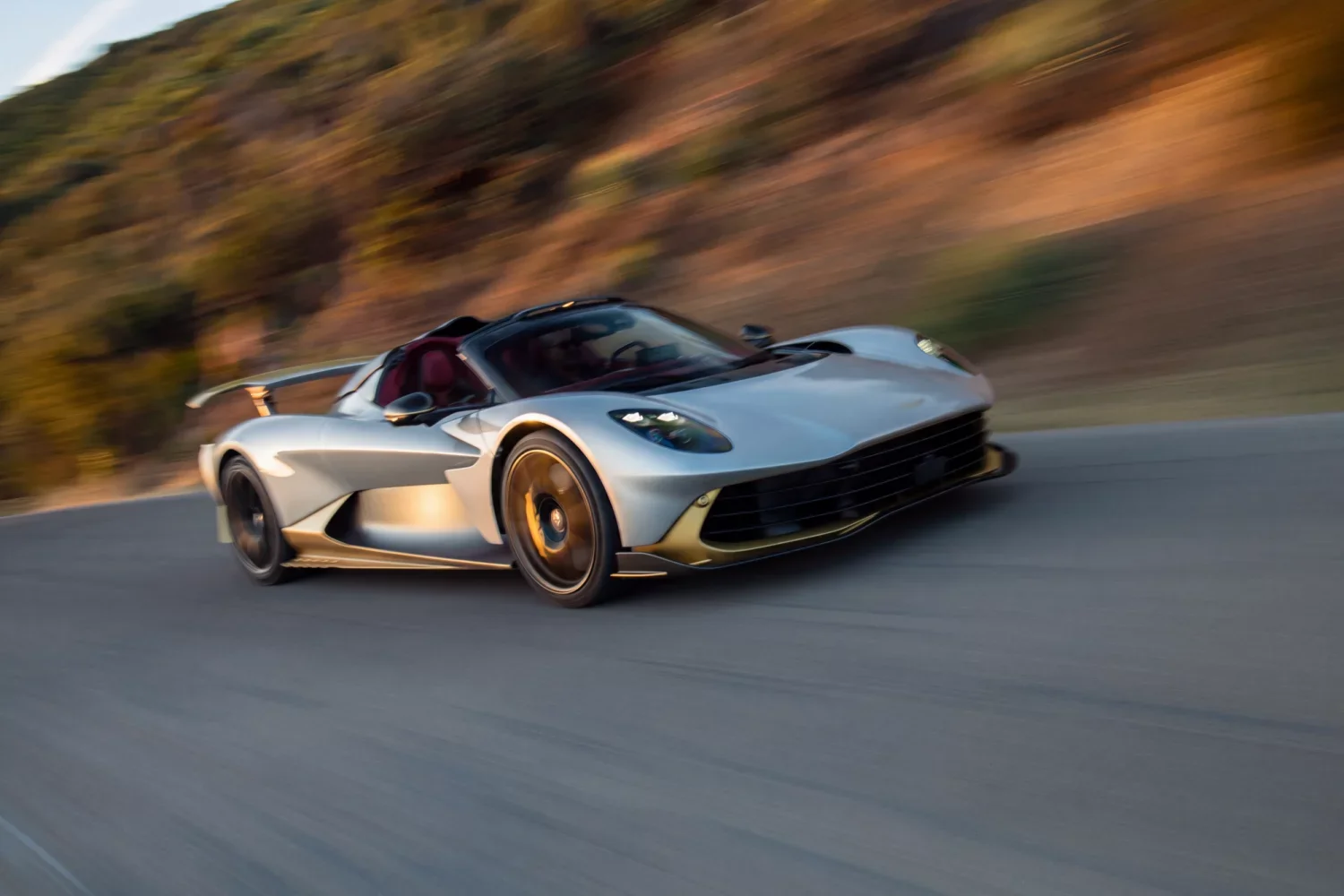
Preview — Aston Martin
Aston Cut the Valhalla's Roof Off. It Didn't Slow Down.
1,064 bhp claimed. 217 mph, roof off. ~250 spiders.
Aston Martin Valhalla Spider · October 28, 2026 · Updated November 7, 2026 · The Torque Wrench · Preview
1,064bhp
Hybrid output, claimed
2.5s
0–62 mph, predicted
217mph
Top speed, roof off
124mph
Top speed, fabric top
1,680kg
Dry weight
~250
Spiders, of 999 Valhallas
Full disclosure: The Torque Wrench hasn’t driven it — nobody outside Aston Martin has. This is a reveal, not a road test: a car shown to the press on October 27, 2026, with a public debut on October 30 at the Concours at Wynn Las Vegas. What follows is the verified breakdown, not a verdict from behind the wheel.
Aston Martin took the roof off its Valhalla hypercar and something unusual happened. The car got faster — or, more precisely, the car got faster when you take the roof off and slower when you put it back on. The Valhalla Spider tops out at 217 mph topless. Fit the standard fabric soft top and Aston Martin limits it to 124 mph, a difference of 93 mph, enforced by a sensor that knows whether the roof is fitted. A carbon-fibre hardtop is available if you want the speed back, but it does not stow in the car. So the fastest open-top Aston ever built comes with a choice: carry the slow roof, or leave the fast roof at home.
Underneath the paradox is a car that is otherwise barely changed, and that is the point. Same 1,064-hp plug-in hybrid powertrain. Same carbon tub. Twenty-five kilos heavier, and most of that is options the coupe did not offer. The Spider is not a new car. It is the Valhalla with the sky let in, and with the coupe’s most annoying flaws quietly fixed along the way.
R03Chapter 01
217 With the Sky, 124 With the Roof
Start with the number that makes no sense until you think about it for ten seconds. A fabric roof at 217 mph is a sail. Aston Martin is not going to let a roll of cloth decide whether you survive a top-speed run, so it does not: fit the soft top and the car caps itself at 124 mph. Go topless and it will run to 217 mph, the same top speed as the coupe. The carbon hardtop restores full speed too, but it is not stowable. It lives wherever you left it. So the Spider asks its owner a question no other hypercar asks: which roof did you bring, and how fast do you actually want to go?
The rest of the speed story is unchanged, which is the good news. The mid-mounted 4.0-litre twin-turbo flat-plane-crank V8 (AMG-derived) sends 817 bhp to the rear wheels through an eight-speed dual-clutch transmission with an integrated e-motor. Two more e-motors drive the front wheels, giving all-wheel drive and torque vectoring with no mechanical link between the axles. Combined output is 1,064 bhp and 811 lb-ft. Aston Martin predicts 0–62 mph in 2.5 seconds. None of that has been independently tested yet. Every figure here is Aston Martin’s claim, made on reveal night, and the honest preview says so.
The aero had to learn a new trick: knowing whether the roof is on. The active aerodynamics and the stability programme were both reworked so each knows the roof state and tailors itself accordingly. With the roof fitted, the Spider still makes more than 600 kg of downforce. A taller intake snorkel, a clip-in wind deflector that folds into three parts and stows in the sills, and revised electronics for roof-on and roof-off running at 200 mph-plus complete the package. This is not a coupe with the roof sawn off. It is a coupe re-engineered to be two cars, and the engineering shows.
93 mph
The gap between the roof you carry and the roof you leave at home.
Aston built a 217-mph convertible. Then it limited its own roof to 124.
— The Torque Wrench
R04The Outlook
Preview
Aston Martin Valhalla Spider — November 7, 2026
Full verdict after independent testing
The Bottom Line
Start with what is certain, because it is more than usual for a reveal-night car. The powertrain is the coupe’s, proven hardware with a real spec sheet. The tub is carbon, the weight penalty is 25 kilos, the doors and seats are fixed, and the aero knows whether the roof is on. That is a convertible engineered like a hypercar, not a hypercar with the roof cut off as an afterthought. The 217-mph topless figure is the headline, but the under-20-kilo structural gain is the engineering story, and engineering stories age better than headlines.
Now the asterisks, because a preview that hides them is an advert. No price, only an estimate. No independent test of any performance figure. A fabric roof that caps the car at 124 mph and a fast roof you cannot carry. Deliveries a year away, order book open now. And a public debut on October 30, after which the real scrutiny (the car in daylight, in front of people who are not on Aston Martin’s guest list) began. The Spider has earned attention. It has not yet earned belief.
So the verdict is a waiting game with a number attached, and the number is 217. If the Spider delivers its coupe’s performance with the sky open and the Touring seats prove as liveable as promised, it will be the open-top hypercar to beat, and the one-in-four rarity will make it a collector car on arrival. If the price lands far above the estimate, or the roof compromise grates in daily use, it will be a beautiful footnote to the coupe. Either way, the roof-off run is the point. A hypercar that goes faster topless is a car that understands why people buy convertibles in the first place. There is no verdict until it is driven.
What we love
- The 217-versus-124 paradox, honestly stated. A car company admitting its fabric roof is a 124-mph roof, in public, on reveal night, is more trustworthy than one pretending otherwise.
- Twenty-five kilos. A convertible penalty that small is the carbon tub earning its keep, and it keeps the Spider a performance car rather than a parade car.
- The three quiet fixes. Frameless doors, Touring seats, sill storage: Aston Martin listened to coupe owners and fixed real complaints instead of adding horsepower nobody asked for.
- The rarity is real. One in four of 999 is a genuinely small number, and the order book being open before the public debut means the people who want one are already in line.
- The debut timing. Revealed October 27, public October 30: a three-day gap between press and public is how you ride a news cycle instead of watching it pass.
What could be better
- No confirmed price. “Around £935,000” is an estimate, not a confirmed price, and a million-pound car deserves a real number before anyone signs anything.
- The roof compromise is real. The stowable roof caps you at 124 mph; the fast roof cannot be carried. You choose between speed and spontaneity every time you leave the garage.
- Nothing independently tested. Every performance figure here is Aston Martin’s claim from reveal night: 1,064 hp, 2.5 seconds, 217 mph, all unmeasured by anyone else.
- A year to wait. Deliveries around autumn 2027 mean the Spider is a deposit and a promise, not a car, and the order book is open anyway.
- The hardtop logistics. A non-stowable carbon roof means a 217-mph car that becomes a 124-mph car the moment it rains and you fitted the wrong roof that morning.
Technical specifications
- Reveal
- October 27, 2026 (press reveal, 8:00 PM EDT reports) · public debut October 30, 2026, Concours at Wynn Las Vegas
- Powertrain
- 4.0-litre twin-turbo flat-plane-crank V8 (817 bhp, rear wheels) + 3 e-motors · 8-speed dual-clutch with integrated e-motor · all-wheel drive, no mechanical link between axles
- Combined output
- 1,064 bhp · 811 lb-ft (1,100 Nm), Aston Martin claim, not independently tested
- 0–62 mph
- 2.5 seconds (Aston Martin prediction)
- Top speed
- 217 mph roof off (same as coupe) · 124 mph with fabric soft top fitted (sensor-limited) · carbon hardtop restores full speed but is not stowable
- Weight
- 1,680 kg dry, with lightweight options fitted · 25 kg more than the coupe · real-world structural increase under 20 kg (Aston Martin engineer, via Magneto)
- Roof options
- Removable carbon-fibre hardtop or fabric soft-top (soft top stows in the car; hardtop does not) · US-market cars get the carbon hardtop as standard
- Aero
- Active aerodynamics + ESP retuned for roof on/off · over 600 kg downforce with roof fitted · taller intake snorkel · 3-part folding wind deflector stowing in sill cubbies
- Doors / seats / storage
- Frameless carbon-fibre dihedral doors, revised kinematics, door glass raised ~20 mm · carbon-fibre Touring seats standard, coupe buckets no-cost option · new sill compartments (deflector, first-aid kit, warning triangle)
- Production
- 999 Valhallas total (unchanged) · Spider around 1 in 4 (~250 cars, final numbers TBC) · order book open · private viewings underway
- Deliveries
- Around autumn 2027 (evo) / third quarter 2027 (Carscoops)
- Price
- NOT confirmed · estimates range from ~£935,000 (evo) to closer to £1.3m (Autocar/CAR/This is Money); coupe ~£850,000 · Q-division bespoke work pushes individual cars higher still
R05Chapter 02
Twenty-Five Kilos and Three Apologies
The Spider weighs 1,680 kg dry, with lightweight options fitted, 25 kg more than the coupe. That number deserves a pause, because convertibles normally gain far more: bracing, reinforcement, a roof mechanism, all of it heavy. Aston Martin’s answer is the carbon tub. As the car’s engineer put it, a carbon tub does not really make a great deal of difference to stiffness when the roof comes off, so little extra bracing was needed. The real-world increase is under 20 kg, with the rest of the 25 kg gap explained by options the coupe does not offer. That is a tub doing exactly what a tub is for, and it is the quiet engineering win of this car.
Then there are the three things Aston Martin fixed while it had the car apart, and each one reads like an apology to coupe owners. The carbon-fibre dihedral doors are now frameless, with revised kinematics that make them easier to open, and the top edge of the door glass is raised by about 20 mm so getting in and out with the roof fitted is less of a contortion. The standard seats are new carbon-fibre Touring seats with much lower bolsters, because coupe owners found the originals awkward to climb over and larger drivers found them digging into their hips, the aggressive buckets remain available at no extra cost. And the sills, previously dead space between the ducts feeding the engine and transmission oil coolers, now hide compartments for the deflector, the first-aid kit, and the warning triangle. None of this makes a headline. All of it makes a car you can live with.
What did not change is the point. Same powertrain, same carbon construction, same active aero philosophy. The Spider is a Valhalla first and a convertible second, and that ordering is why the weight penalty is small and the speed is intact. The roof is the variable, not the car.
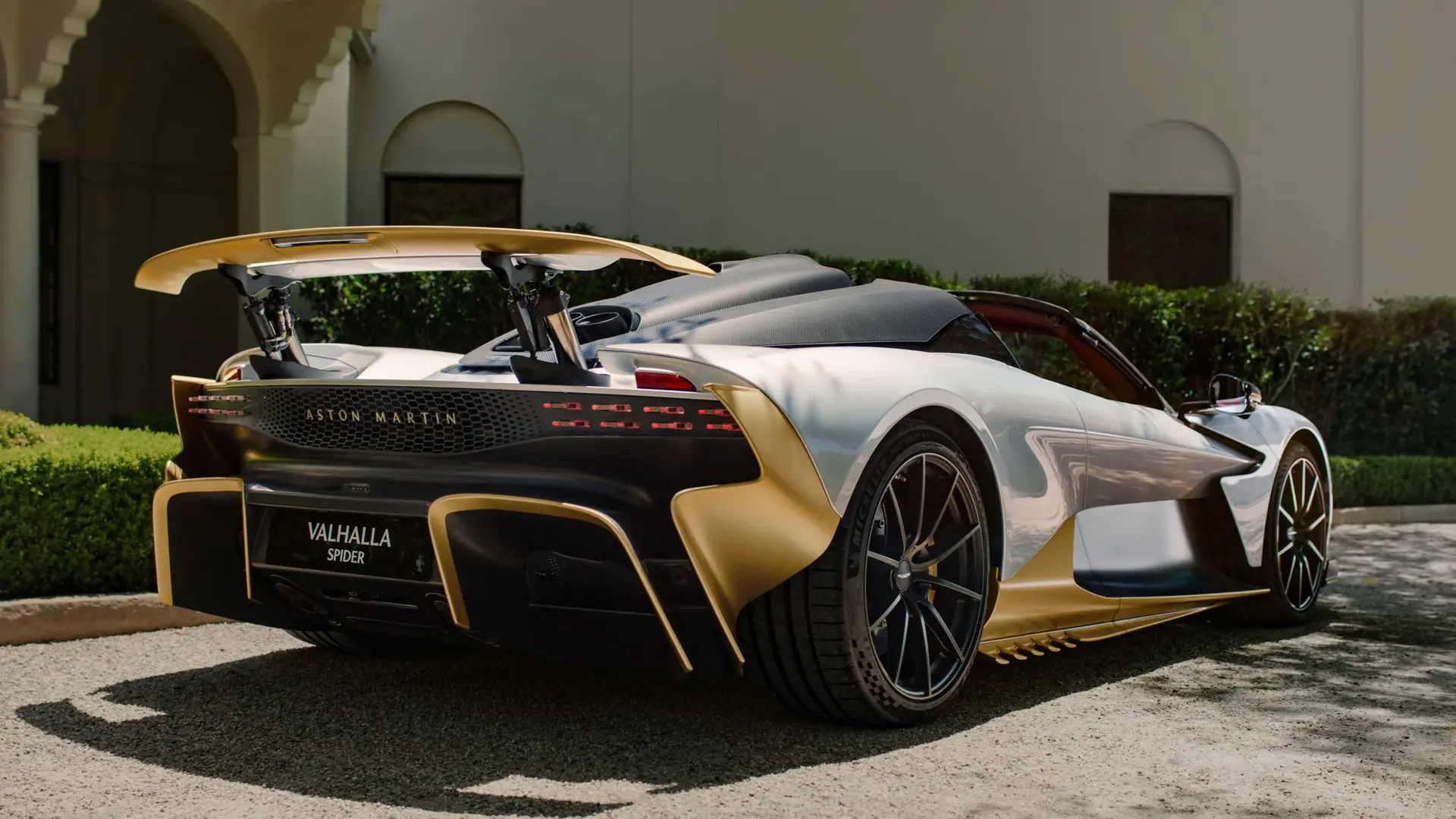
“The fastest roof on this car is the one you leave at home.”
R06Chapter 03
One in Four of 999, Priced at About a Million
Aston Martin committed to building 999 Valhallas in total. Reporting from its Q3 call suggested the combined run may sit slightly above 999, but Aston Martin has not confirmed a new number — so 999 stands as the committed figure. The Spider will account for around one in four of them, roughly 250 cars, with final numbers still to be confirmed. The order book is already open and private viewings with clients are already underway, after the October 30 public debut. Deliveries begin around autumn 2027. So the car you are reading about is roughly a year from reaching its first customer, and the people buying it are buying it now, on the strength of the coupe and a reveal-night spec sheet.
The price is the one number Aston Martin did not give, so read every figure in this paragraph as an estimate. The coupe starts at about £850,000. The Spider is estimated at around £935,000 before options (evo), while Autocar, CAR and This is Money put it closer to £1.3m — already well past £1 million before any Q division bespoke work, which would push individual cars higher still. Automotive News calls it a million-dollar car outright. Until Aston Martin publishes a price, the honest figure is “about £935,000, estimated.” Anyone quoting you a firmer number is guessing.
The context is a rival Aston Martin did not name but evo did: Ferrari’s 849 Testarossa Spider, the open-top car from Maranello that now has a direct British rival. That framing is evo’s, not Aston Martin’s, and it is useful anyway. The Spider does not exist in a vacuum. It exists in a market where the fastest open cars are also the most expensive, and where a 217-mph topless run is a headline you can sell. Whether the Spider earns that headline on the road, rather than on a spec sheet, is a question for autumn 2027.