Preview — Lamborghini
The First Hardtop in Fifty Years. The V8 Still Screams to 10,000 rpm.
907 hp. A roof that folds in 17 seconds. The first open-top V8 Lambo since 1988.
Lamborghini Temerario Spyder · November 19, 2026 · The Torque Wrench · Preview
907 hp
Combined, V8 + three motors
10,000 rpm
V8 redline, twin-turbo
2.8 s
0–100 km/h, Lamborghini
343 km/h
Top speed, Lamborghini
17 s
Roof open, up to 31 mph
$390,900
Estimated price — not yet announced
Full disclosure: The Torque Wrench hasn't driven it — nobody outside Lamborghini has. The car was revealed on a rooftop in Los Angeles on November 18, 2026, and the first customer cars don't arrive until spring 2027. What follows is the verified breakdown: which numbers are Lamborghini's word, which are reported, and which are still just estimates.
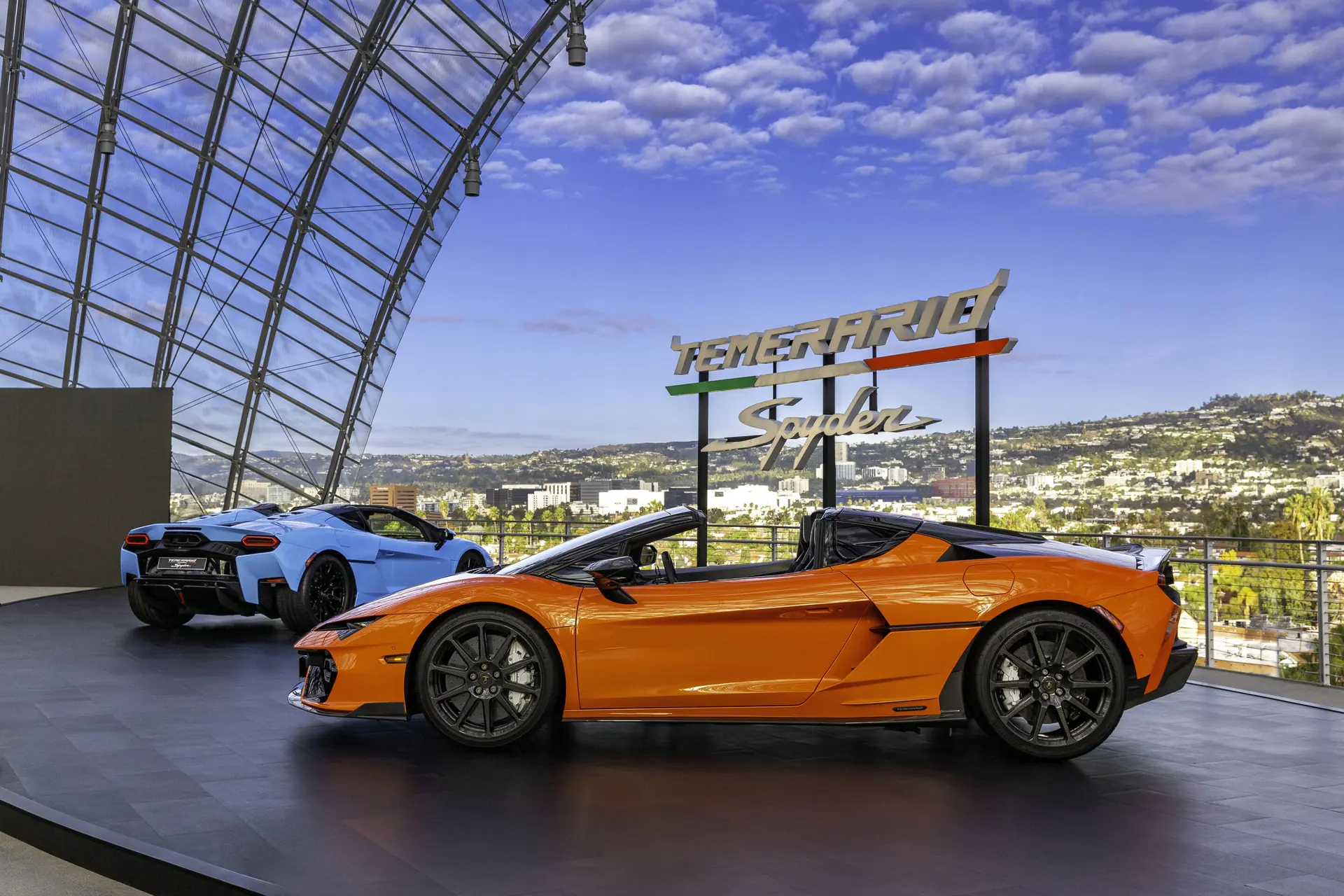
The news, straight: on the evening of November 18, 2026, Lamborghini unveiled the Temerario Spyder on the Dolby Family Terrace of the Academy Museum of Motion Pictures in Los Angeles, the Hollywood Hills behind it and the Hollywood Sign somewhere in the haze. It is the first Temerario derivative, the first Lamborghini Spyder ever with a retractable hardtop, and the first open-top Lamborghini V8 since the Jalpa ended production in 1988. The powertrain is the coupé's, untouched: a 4.0-litre twin-turbo V8 and three electric motors making 920 CV (907 hp), a 10,000-rpm redline, 0–100 km/h in 2.8 seconds, and a 343 km/h top speed. Orders opened the night of the reveal. First US deliveries land in spring 2027.
And the question that makes this car worth a whole story: why did it take Lamborghini fifty years to build a hardtop convertible — and is the roof the point, or is it in the way? The answer is in how the roof works. It doesn't fold flat over the engine like every other folding hardtop. It splits in two, stands up vertically behind the seats, and drops the car's centre of gravity when it opens. Lamborghini spent fifty years refusing to build this car, then built it in the hardest possible way. That is either engineering pride or stubbornness. With Lamborghini, it is usually both.
R03Chapter 01
The Roof That Folds the Wrong Way (On Purpose)
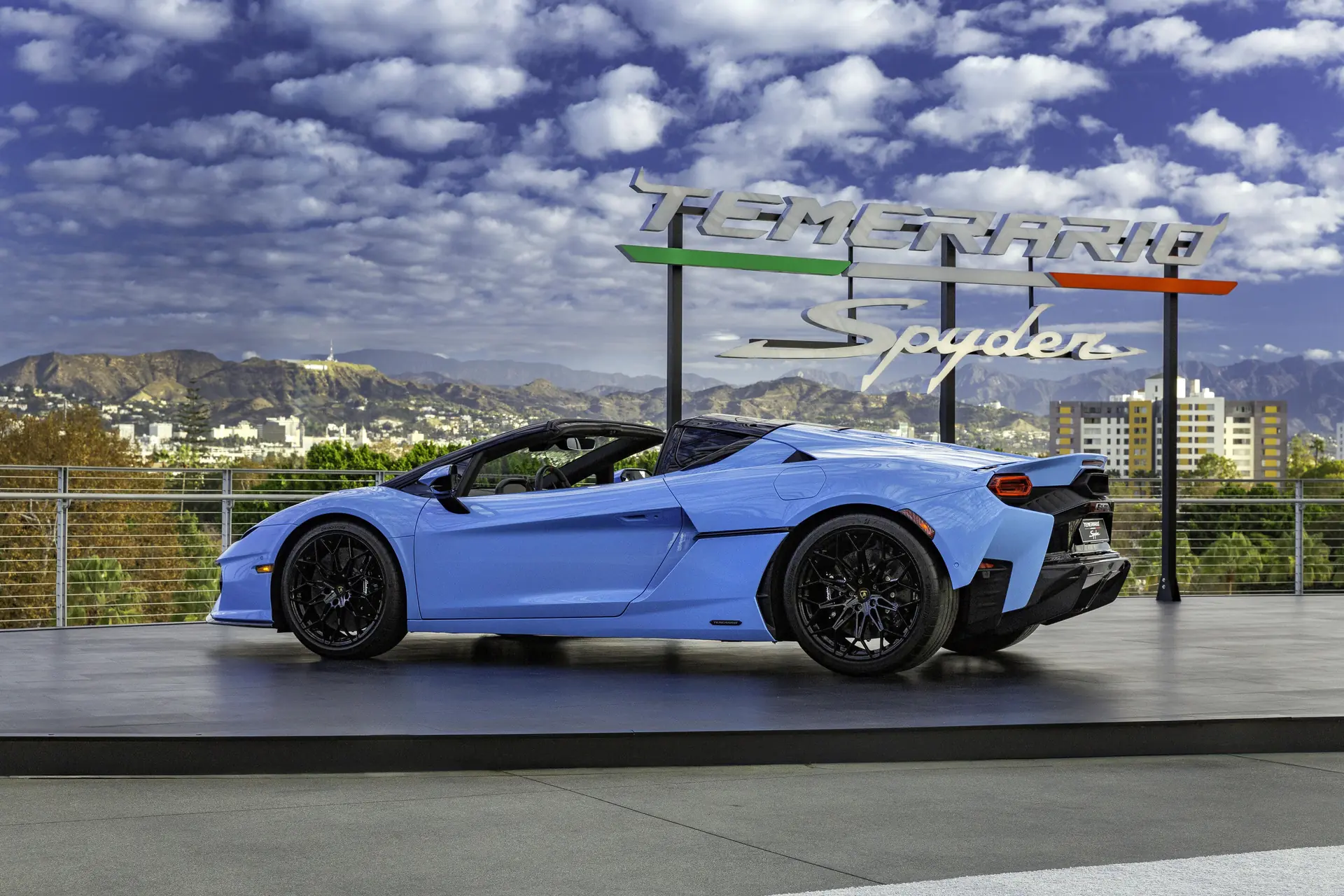
Start with the roof, because it is the whole car. Every folding hardtop in history does the same thing: the panels stack flat over the rear deck, the weight sits high and far back, and the car gets taller and lazier with the roof down. Lamborghini looked at that and refused. The Temerario Spyder's roof splits into two pieces, folds together, rotates upright, and stows vertically in a compartment immediately behind the seats, ahead of the engine. Ten electric actuators run the whole show — no hydraulics, no pumps, near-silent — and the roof opens in about 17 seconds and closes in about 18, at speeds up to 31 mph.
Here is why the vertical fold matters, and it is not a party trick. A conventional horizontal stow would raise the car's centre of gravity by about 0.3 inches and push it 0.4 inches towards the rear axle when the roof is down. The vertical stow does the opposite: the centre of gravity actually drops by a couple of tenths of an inch when you open the roof, and the weight distribution barely moves. Lamborghini built a convertible that gets better balanced with the roof down. Nobody else does that, because nobody else was willing to redesign the back of the car around the roof.
The rest of the roof story is the details that make a convertible liveable. Two sculpted hexagonal cowls rise behind the seats, framing the exposed engine cover and keeping the coupé's proportions intact with the roof up — design director Mitja Borkert's hardest problem, in his own words, was integrating the mechanism 'without turning it into an add-on, preserving the purity and tension of Temerario's proportions.' The rear window drops electronically on its own, so you can hear the V8 with the roof closed. And for the first time on a Lamborghini, there are neck warmers in the seats, with three levels of warm airflow, because even Sant'Agata has finally admitted that convertibles get driven on cold mornings. Roof up, Lamborghini says the Spyder is more aerodynamically efficient than the Huracán EVO Spyder it replaces — the hardtop's real advantage over canvas, and the reason fifty years of fabric ends here.
17 s
For the first retractable hardtop in Lamborghini history to fold away — vertically, behind the seats, on 10 electric actuators. The V8 behind it revs to 10,000 rpm.
The roof takes 17 seconds to disappear. The V8 takes 10,000 rpm to make its point.
— The Torque Wrench
R04The Outlook
Preview
Lamborghini Temerario Spyder — November 19, 2026
Full verdict after independent testing
The Verdict Before the Verdict
So what would make the Spyder a success? Three things, and they are all still unproven. First, the roof: silent, reliable, and leak-free after a thousand cycles, not just on a reveal stage. Every folding hardtop in history has had to prove it doesn't rattle, and this one is the most complicated mechanism Lamborghini has ever put on a convertible. Second, the weight: Lamborghini's brochure puts the Spyder at 1,805 kg (3,979 lb) dry, 115 kg (253 lb) more than the coupé — more than the estimated 200 pounds, but the tenth of a second to 100 km/h is all it costs on paper. Third, the price: $390,900 estimated is a fair premium over the coupé. Past $400,000 with options, the Spyder starts competing with cars that were never meant to be convertibles.
And what would sink it? The same list, read backwards. A roof that rattles. A weight figure that embarrasses the spec sheet. A price that creeps past the coupé by far more than $3,251. And the quietest risk of all: that the hardtop makes the Spyder too sensible. Lamborghini convertibles are supposed to be slightly stupid — fabric flapping, wind in your face, the V10 screaming at the sky. A hardtop that seals the cabin and drops the rear window on demand is the sensible answer, and Lamborghini doing sensible is the one thing its customers never asked for. The neck warmers are the tell: this is a convertible designed by people who thought about cold mornings. That is either maturity or the beginning of the end of the madness. Spring 2027 will tell.
What Torque Authority will track, in order: Lamborghini's official price, the first customer delivery in spring 2027, and the first independent test. Until then, this is a preview of a promise — the first hardtop in fifty years of open Lamborghinis, on a car that kept its 10,000-rpm V8 and lost nothing on paper. The roof takes 17 seconds to disappear. The V8 takes 10,000 rpm to make its point. Tighten it 'til it sings.
What we love
- The roof mechanism itself. Vertical fold, ten electric actuators, no hydraulics — and it drops the centre of gravity instead of raising it. Nobody else builds a folding hardtop this way.
- The V8 didn't lose anything. Same 920 CV, same 10,000 rpm, same 2.8 seconds to 100 km/h — a tenth off the coupé, and nothing else. Convertibles usually pay for the sky. This one barely does.
- Fifty years of heritage, honestly earned. Silhouette to Jalpa to Gallardo to this — the first open-top V8 in 38 years, and the first hardtop ever. The history isn't marketing. It is the spec sheet.
- The hardtop doesn't ruin the silhouette. Two hexagonal cowls behind the seats keep the coupé's proportions with the roof up — the hardest problem in the design, solved rather than hidden.
- The cold-morning details. Neck warmers with three heat levels and a rear window that drops on its own — Lamborghini finally admitting convertibles get driven when it's cold, not just when it's sunny.
What could be better
- No price announced. $390,900 is a report from Car and Driver, not a Lamborghini number — the Nov 22 re-check confirmed Lamborghini still hasn't published one.
- No independent test exists. Every performance number on this page is Lamborghini's word, and nobody outside Sant'Agata has driven the car.
- The hardtop's long-term sins. Rattles, seals, leaks: every folding hardtop in history has had to prove it doesn't. This one hasn't yet — and it's the most complicated mechanism Lamborghini has ever put on a convertible.
Technical specifications
- Powertrain
- 4.0-litre twin-turbo V8 + three axial-flux electric motors — 920 CV (907 hp) combined (Lamborghini)
- V8 alone
- 789 hp, 10,000 rpm redline (10,250 rpm with launch control) — the highest-revving series-production open-top turbocharged engine (Lamborghini; launch-control figure via Jalopnik)
- Torque
- 800 Nm (590 lb-ft) combined (Carscoops, from Lamborghini's press materials)
- Gearbox
- 8-speed dual-clutch, all-wheel drive (Lamborghini)
- Performance
- 0–100 km/h 2.8 s, 0–200 km/h 7.3 s, top speed 343 km/h (213 mph) (Lamborghini)
- Roof
- Two-piece retractable hardtop, 10 electric actuators, no hydraulics; opens ~17 s, closes ~18 s, at speeds up to 31 mph (50 km/h) (Lamborghini, via Jalopnik)
- Weight
- 1,805 kg (3,979 lb) dry — 115 kg (253 lb) more than the coupé's 1,690 kg dry (Lamborghini)
- Price
- ESTIMATED $390,900 before destination and tariffs (Car and Driver) — Lamborghini has not announced pricing
- Orders / deliveries
- Orders opened November 18, 2026; first US deliveries spring 2027, second quarter (Motor, CarBuzz)
- Firsts
- First retractable hardtop on any Lamborghini Spyder; first open-top Lamborghini V8 since the Jalpa (production ended 1988)
R05Chapter 02
The Same 10,000-rpm V8, Now With the Sky In
Now the engine, because Lamborghini didn't touch it — and that is the compliment. The Spyder carries the coupé's plug-in hybrid powertrain exactly as it is: a 4.0-litre twin-turbo V8 making 789 hp on its own, plus three axial-flux electric motors — two on the front axle, one between the engine and the eight-speed dual-clutch gearbox — for 920 CV (907 hp) combined and 800 Nm (590 lb-ft) of torque, driving all four wheels. The V8 revs to 10,000 rpm, and with launch control it will touch 10,250 — Lamborghini calls it the highest engine speed of any series-production open-top super sports car with a turbocharged engine. The hybrid system is what makes that redline possible: the motors fill the torque hole at low revs, so the V8 can behave like a racing engine instead of a turbo engine.
The numbers, all Lamborghini's: 0–100 km/h in 2.8 seconds, a tenth behind the coupé; 0–200 km/h in 7.3 seconds, two tenths behind; top speed 343 km/h (213 mph), identical to the coupé. One preview briefing suggested a preliminary top speed around 211 mph — Lamborghini's own figure is 343 km/h, and that is the number this piece uses. The soundtrack gets help from an optional lightweight titanium exhaust by Akrapovič, 12 percent lighter than the standard system, which Lamborghini had already announced for the coupé a week before the reveal. Roof down, the V8 is the whole point of the car. Roof up, the hardtop keeps the noise in and the weather out. Either way, nothing about the powertrain was softened for the convertible — and that is rarer than it sounds. Convertibles usually pay for the sky with power, weight, or both. This one pays with neither, on paper.
The 'on paper' matters. Nobody outside Lamborghini has driven the Spyder. The coupé was revealed in August 2024, and the Spyder is the same car with a roof mechanism where the rear deck used to be. The weight is now a Lamborghini number: the official brochure lists the Spyder at 1,805 kg (3,979 lb) dry, 115 kg (253 lb) more than the coupé's 1,690 kg dry — more than the roughly 200 pounds preliminary reports suggested. The mechanism, the cowls, the reinforcement: none of it is free. But the Spyder is still a 907-hp car that hits 100 km/h in 2.8 seconds, a tenth behind the coupé. The roof costs a tenth to 100 km/h and two tenths to 200 km/h. Spring 2027 will tell whether it costs anything more.
“The roof takes 17 seconds to disappear. The V8 takes 10,000 rpm to make its point.”
R06Chapter 03
Fifty Years of Open Lamborghinis
The Spyder name is fifty years old, and Lamborghini made sure everyone knew it. The tradition began with the Silhouette in 1976 — a targa-topped V8, the first open-top Lamborghini with eight cylinders — and Lamborghini's own newsroom spent the week before the reveal retelling that history, from the Silhouette to the 2005 Gallardo Spyder, the brand's first series-production Spyder. The Jalpa, the last open-top V8, ended production in 1988. Then came thirty-eight years of V10 and V12 convertibles with fabric roofs: Gallardo, Huracán, Aventador, all of them soft-tops. The Temerario Spyder ends two droughts at once — the first open-top V8 in 38 years, and the first hardtop in the company's entire history.
That history is why the car matters beyond its spec sheet. Lamborghini's entry-level supercar has always been the loud one, the one that sells the dream to people who can't stretch to a V12. The Huracán Spyder was the convertible that made the brand's money. The Temerario Spyder has to do the same job with a harder roof, a heavier mechanism, and a hybrid powertrain that costs more than the V10 it replaced. The coupé starts at $387,649 in the US. The Spyder's price is estimated at $390,900 before destination and tariffs — $3,251 more than the coupé, if the reports are right. Lamborghini hasn't announced pricing, and that $390,900 is a report, not a Lamborghini number. It stays labelled estimated until Lamborghini confirms it.
And the timing is the tell. The coupé was revealed in August 2024. The Spyder follows 27 months later, the first of a family — in September, product line director Paolo Racchetti gave the order as coupé, then Spyder, then the rest. The reveal landed in Los Angeles, at the Academy Museum, with the Hollywood Sign in the haze behind the terrace. The message was the location: this car is for the place where convertibles are a daily decision, not a weekend toy. Fifty years of open Lamborghinis, and the first one with a roof that folds like this, revealed in the city that invented the convertible as a lifestyle. Lamborghini knows its audience.
R07Chapter 04
Spyder vs Coupé: The Numbers Side by Side
Put them next to each other and the story is how little changed. The Spyder is not a new car. It is the coupé with the sky let in and a roof mechanism where the rear deck used to be — and Lamborghini's engineering went into making that sentence true, not into a new powertrain. Here is the honest table, with every estimate labelled as one:
Two lines in that table deserve a second look. The first is the price. There is no official Spyder price. $390,900 is what Car and Driver reports, and CarBuzz, Motor and Autoblog repeat the same number — none of them Lamborghini. If it holds, the Spyder costs $3,251 more than the coupé, which is a small premium for a hardtop convertible. If it doesn't hold, this piece will say so when Lamborghini publishes the number — the November 22 re-check against Lamborghini's own sources confirmed the price is still unannounced. The second is the weight. Lamborghini's brochure lists the Spyder at 1,805 kg (3,979 lb) dry, 115 kg (253 lb) more than the coupé's 1,690 kg dry — more than the roughly 200 pounds preliminary reports suggested. A hardtop mechanism is never free, but the tenth of a second to 100 km/h is all it costs on paper.
- →Power: identical — 920 CV (907 hp) combined, 4.0-litre twin-turbo V8 (789 hp) + three electric motors, 8-speed dual-clutch, all-wheel drive.
- →0–100 km/h: Spyder 2.8 s vs coupé 2.7 s — a tenth, the price of the roof mechanism.
- →0–200 km/h: Spyder 7.3 s vs coupé 7.1 s — two tenths.
- →Top speed: Spyder 343 km/h (213 mph), same as the coupé (Lamborghini). One preview briefing suggested a preliminary ~211 mph — Lamborghini's own figure is 343 km/h.
- →Weight: 1,805 kg (3,979 lb) dry — 115 kg (253 lb) more than the coupé's 1,690 kg dry (Lamborghini).
- →Price: ESTIMATED $390,900 before destination and tariffs (Car and Driver) vs coupé from $387,649 US (Car and Driver) — Lamborghini has not announced Spyder pricing.
- →Roof: Spyder — two-piece retractable hardtop, 10 electric actuators, ~17 s open / ~18 s close, up to 31 mph. Coupé — fixed roof, obviously.
- →Firsts: Spyder — first retractable hardtop on any Lamborghini; first open-top Lamborghini V8 since the Jalpa (1988).