Preview — Ferrari
Ferrari's Electric Car Seats Five. Designed by Ferrari and LoveFrom.
1,050 CV. 2.5 s to 100. 530 km range, Ferrari est.
2026 Ferrari Luce · October 12, 2026 · Updated November 16, 2026 · The Torque Wrench · Preview
1,050 cv
Quad-motor AWD · 1,036 hp
2.5 s
0–100 km/h · 0–200 in 6.8
310 km/h
Top speed
530 km
Range · Ferrari est., pending homologation
122 kWh
800V battery · 350 kW DC
€550,000
Price · before options
On May 25, 1947, a little barchetta called the 125 S won the Gran Premio di Roma and gave Ferrari its first-ever victory. On May 25, 2026 (exactly 79 years later, in the very same city) Ferrari unveiled a five-seat electric car with no engine, no exhaust note, and styling from LoveFrom — the studio of the man who designed the iPhone — working with Ferrari’s own Centro Stile. The symbolism was immaculate. The internet was not.
This is the Luce (Italian for “light”) — the first fully electric Ferrari, the first five-seat Ferrari, and quite possibly the most argued-about Ferrari of the modern era. It makes 1,050 CV, costs €550,000, and has already fetched $40 million at auction. Yes, you read that correctly.
Full disclosure: The Torque Wrench hasn’t driven it — this is the verified breakdown, not a road test. First customer cars arrive in late 2026 in Europe (US from Q2 2027), every one of them already allocated, and our press invitation appears to have been lost in the mail along with our dignity.
R02Chapter 01
The iPhone on Wheels
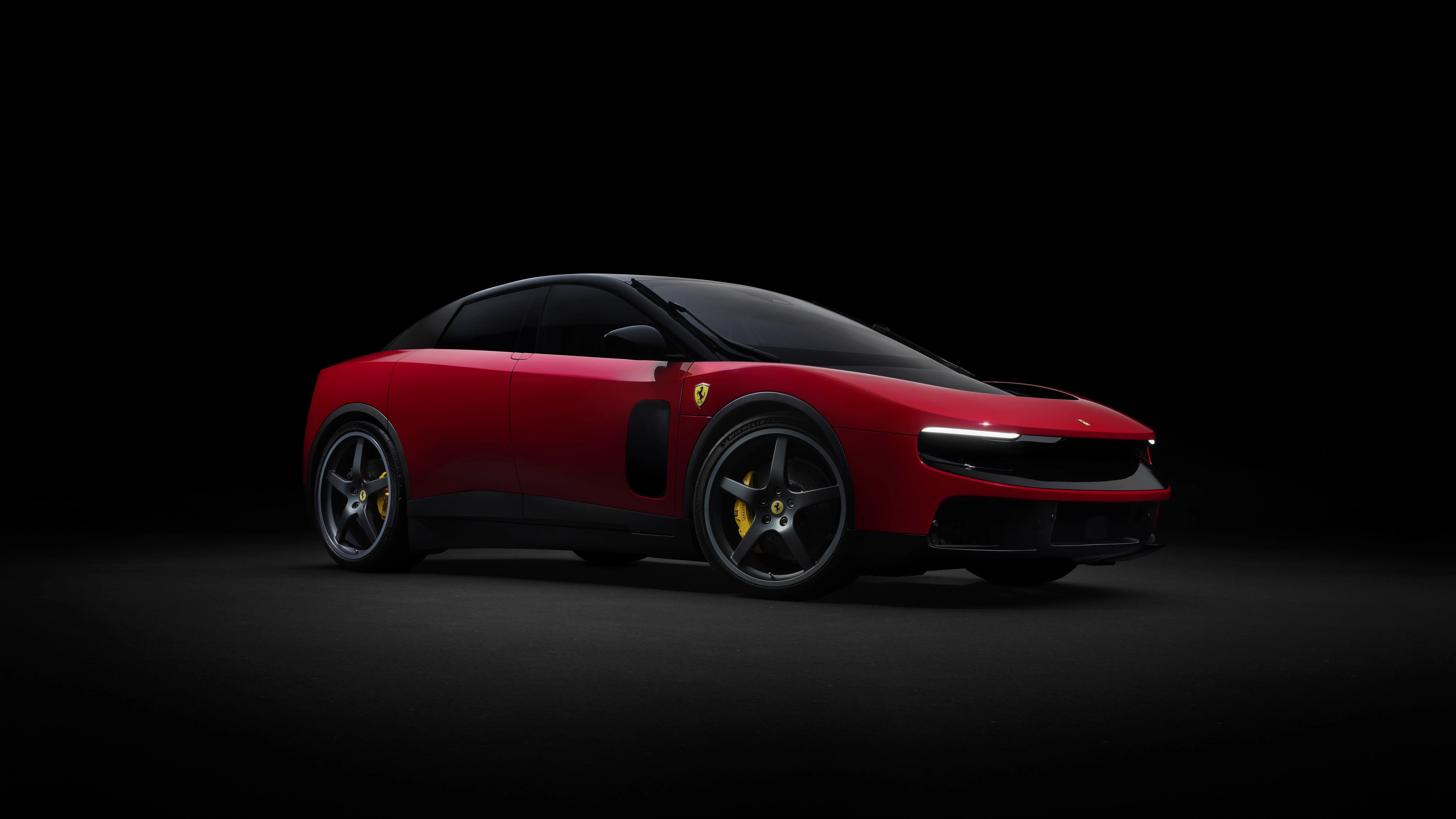
Start with the thing everyone is yelling about. Ferrari didn’t hand this car to its own Centro Stile alone, it brought in LoveFrom, the studio of Sir Jony Ive and Marc Newson, who spent roughly five years rethinking what a Ferrari even looks like when the engine isn’t in the room. The result is a single teardrop of metal and glass: a full glasshouse stretching below the beltline, floating aero wings at both ends, transparent light panels, and halo taillights nodding to the 360 Modena and 458 Italia.
01
The teardrop
One piece of metal and glass, the glasshouse stretching below the beltline.
02
Coach doors
Rear doors hinged at the back, like a 1960s grand tourer.
03
23" / 24" wheels
The largest stagger ever fitted to a series Ferrari.
04
Halo taillights
A nod to the 360 Modena and 458 Italia.
05
Upright wipers
Parked against the A-pillars. For aero.
06
Lowest drag
Ferrari claims its lowest drag coefficient ever on a road car.
It is, by every account, polarizing, Ferrari’s own word. The windshield wipers park upright against the A-pillars for aero. The rear doors are coach-style, hinged at the back like a 1960s grand tourer. The wheels are 23 inches up front and 24 at the rear, the largest stagger ever fitted to a series Ferrari. Ferrari claims the lowest drag coefficient of any road car it has ever built. The tifosi looked at all of this and had feelings.
The feelings were loud. Ferrari’s share price slid the trading day after the reveal, and former chairman Luca di Montezemolo went on the record to say he didn’t like it, a bold critique from a man whose tenure gave us the 612 Scaglietti. But the car world has been here before: the 1974 Dino 308 GT4 and the 2011 FF both got laughed at before they got collected. Controversial Ferraris have a habit of aging into icons.
11,500 Nm
That is the claimed torque at the wheels under launch control. The motors make 990. The maths does the rest.
It’s electric. It’s a five-seater. And it just sold for $40 million.
— The Torque Wrench
R03The Outlook
Preview
2026 Ferrari Luce — November 16, 2026
Full verdict after independent testing
The Bottom Line
The Luce is the hardest test Ferrari has ever set itself: convince the most tradition-bound clientele on Earth that the badge survives the death of the engine. The engineering is serious (in-house motors, an in-house battery, genuine invention in sound and interface) and the market signals — a $40 million charity hammer price, a reportedly sold-out Chinese allocation — say the clientele is listening.
The objections are real, too. It’s heavy. The range is fine, not exceptional. The design will start fights at every cars-and-coffee from now until the heat death of the universe. And €550,000 is an almost comical amount of money for a car whose party trick is silence, artfully amplified.
But here’s the thing about controversial Ferraris: the 308 GT4, the FF, the Purosangue, Maranello has a long, profitable history of being right when everyone else was laughing. The Luce isn’t the Ferrari the purists wanted. It’s the Ferrari the next fifty years needed.
The badge was always bigger than the engine.
What we love
- Four in-house motors and an in-house battery: the anti-outsourcing flex
- Real buttons in a touchscreen world; the interior is a rebuke to the industry
- The honest noise: amplified axle vibration, not a fake V12 playlist
- $40 million for Chassis 0: collectability arrived before the first delivery
- The first five-seat Ferrari: the badge, now with room for the whole argument
What could be better
- 2,260 kg: a lot of Ferrari
- 530 km of range is merely fine at this money
- The design: even Ferrari calls it “polarizing”: the tifosi jury is still out
- €550,000 in Europe, US$560,800 in the US, before options: an almost comical amount of money
- 2027 deliveries are already fully allocated: latecomers need not apply
Technical specifications
- Powertrain
- Quad-motor AWD (one per wheel)
- Power
- 1,050 CV (1,036 hp)
- Torque
- 990 Nm (11,500 Nm at wheels, launch)
- 0–100 km/h
- 2.5 s (0–200: 6.8 s)
- Top Speed
- 310 km/h
- Battery
- 122 kWh, up to 800V
- Charging
- Up to 350 kW DC
- Range
- 530 km (Ferrari est.)
- Kerb Weight
- 2,260 kg
- Price
- €550,000 (Europe) · US$560,800 (US), before options
R04Chapter 02
1,050 CV of Actual Engineering
Now the part the engineers want you to notice. Four permanent-magnet motors, one per wheel, for a combined 772 kW (1,050 CV, 1,036 horsepower) with 990 Nm at the motors and a claimed 11,500 Nm at the wheels under launch control. Zero to 100 km/h in 2.5 seconds, zero to 200 in 6.8, top speed of 310 km/h. Ferrari also gave it active suspension and four-wheel steering, because 2,260 kg of Italian grand tourer needs all the help physics will allow.
The battery is the flex: 122 kWh (210 cells in 15 modules) running at up to 800 volts, with 350 kW DC fast charging. The cells come from Korea’s SK On, the one part Ferrari will admit it buys. Everything else (the pack, the motors, the inverters) is designed and assembled in-house, inside the new E-building at Maranello. Ferrari’s argument is that building it themselves protects the car’s future: decades from now, Maranello (not a supplier) can keep it running. That is a quietly radical promise in an industry that treats EVs as disposable.
The honest asterisks: 2,260 kg is a lot of Ferrari. And 530 km of Ferrari-estimated range (pending homologation) is merely fine, at this money, rivals already stretch further. You are not buying efficiency here. You are buying the only electric car on Earth with a prancing horse on the nose, and Ferrari knows exactly what that’s worth.
“The Luce isn’t Ferrari going electric. It’s Ferrari betting the badge is bigger than the engine.”
R05Chapter 03
The Honest Noise
Every electric performance car eventually faces the soul question, and Ferrari’s answer is the cleverest in the business. Instead of synthesizing a fake V12 (the industry’s favorite party trick) the Luce mounts a precision accelerometer on its electric axles and captures the real texture and vibration of the rotating machinery. An in-house patented system filters, equalizes, and amplifies the signal, Ferrari says, like an electric guitar. The volume follows the e-Manettino dial and your use of the paddles. It only makes noise when the noise means something.
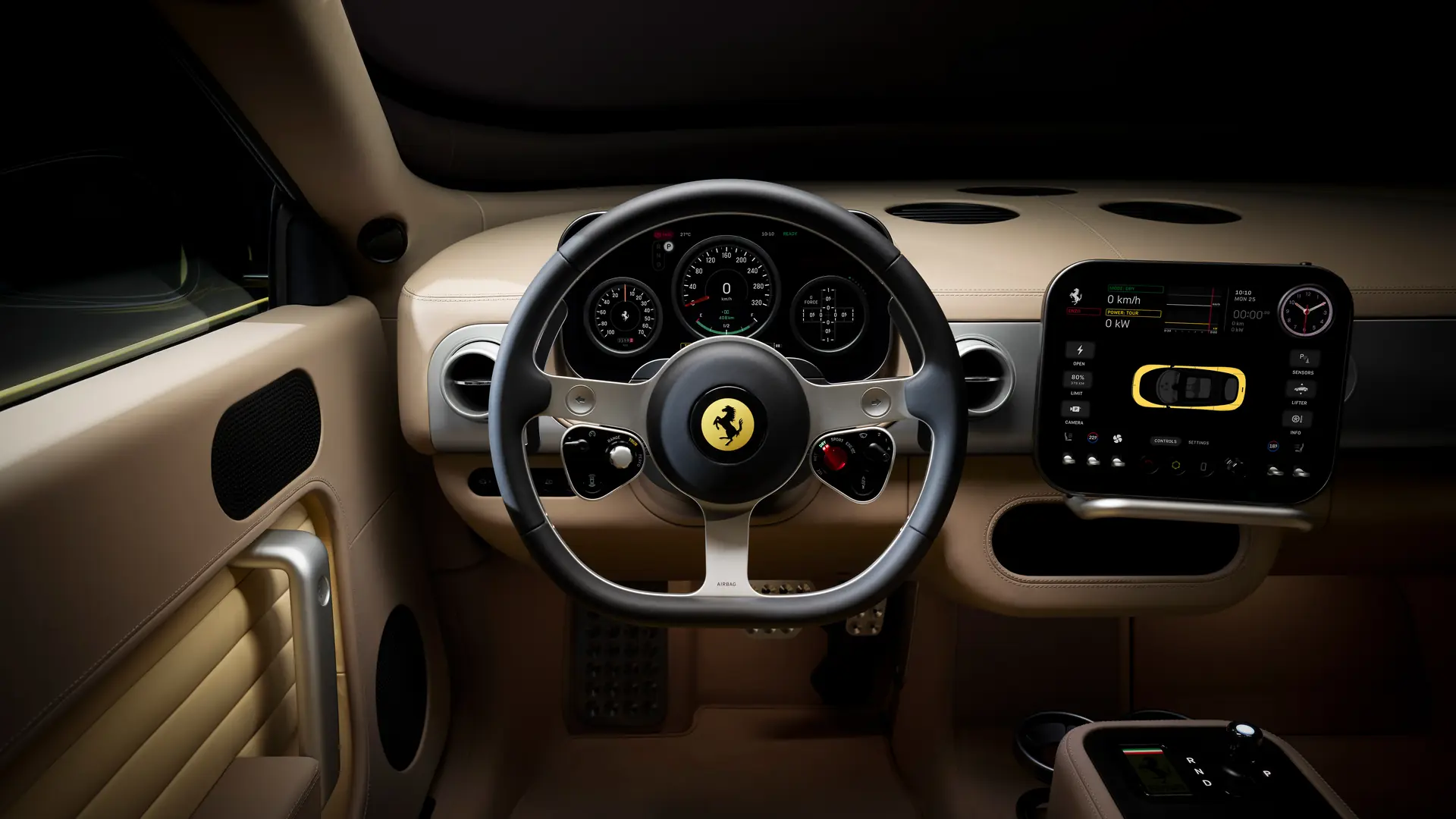
The cabin applies the same philosophy. Where the industry went touchscreen-everything, the Luce went back to machined aluminium: physical buttons, toggles, dials and switches, with a three-dial binnacle that moves with the steering wheel. Digital information lives on multi-layered OLED displays built with Samsung Display, appearing only where relevant. Even the key is a statement, an E-Ink display, which Ferrari claims is an automotive first. The man who designed the iPhone built you a car with real buttons. The irony is delicious. The ergonomics are correct.
R06Chapter 04
The $40 Million Punchline
Here’s the number that complicates the “nobody wants it” argument. In August, during Monterey Car Week, RM Sotheby’s auctioned the first production Luce (Chassis 0, in a bespoke Tailor Made spec) for $40 million at a no-reserve charity sale, the buyer’s premium waived, with every cent going to the Ferrari Foundation. The pre-sale estimate was a little over $1.1 million. The winning bidder, billionaire collector Dr. Herbert Wertheim (the same man who paid $26 million for the final Daytona SP3 a year earlier) paid more than 35 times that. It is the most expensive new car ever sold at auction. And it’s electric.
The demand story checks out elsewhere, too: Ferrari’s first 88-car allocation for China was reported to have sold out on the day orders opened in June — though several authorised Ferrari dealers in China later said the car was still available to order, and Ferrari never confirmed the sellout. Which makes the origin story even better. Ferrari chairman John Elkann credits a 2016 conversation with Jeff Bezos (yes, that one) for pushing Maranello to take EVs seriously. “I don’t know anything about cars, but I know about innovation,” Bezos reportedly told him, “and I think you really need to think hard about electric vehicles.” Ten years later, here we are.
CEO Benedetto Vigna’s pitch is technological neutrality: no other sports car maker, he says, offers fully electric, hybrid, and combustion architectures side by side. His argument being that leadership demands boldness and exploring new paths without fear. Bold is one word for a €550,000 electric five-seater. But bold is also the only word that has ever described Ferrari.
R07Chapter 05
Update: Best Innovation at the Golden Steering Wheel
On November 10, 2026, the Luce won Best Innovation at the Golden Steering Wheel awards in Berlin — the 50th edition of Europe’s big automotive prize. Ferrari chairman John Elkann collected it on stage. The jury cited the dedicated electric platform, four motors, more than 60 new patents, and the design. It is the first major award for Maranello’s first EV, and it landed about five months after the reveal.
Elkann also confirmed the demand story on the night: every Luce Ferrari plans to deliver in 2027 is already allocated. The car the internet roasted in May is sold out into next year. The tifosi jury is still out. The order book is closed.
R08Chapter 06
Seventy-nine years of defiance
The badge that just survived its own electric shock. Here’s the weight it carries.
- →1947 · 125 S — The first prancing horse: Enzo’s first car wins at Rome. The legend starts here.
- →1962 · 250 GTO — The icon: Three dozen built. Once the most valuable car on Earth.
- →1987 · F40 — The last signature: The final car Enzo approved. Raw, loud, perfect.
- →2013 · LaFerrari — The hybrid heresy: V12 plus KERS. The purists survived. So did Ferrari.
- →2022 · Purosangue — The four-door heresy: A Ferrari with rear doors. The world didn’t end.
- →2024 · F80 — The hypercar: 1,200 PS from a V6 hybrid. The ceiling, raised.
- →2026 · Luce — The reset: No pistons. Five seats. The badge, redefined.