Preview — Bugatti
The W16 Is Dead. Long Live the V16.
1,800 hp. No turbos. A watch for a dashboard.
Bugatti Tourbillon · November 18, 2026 · The Torque Wrench · Preview
1,800 PS
Combined, V16 + three motors
9,000 rpm
V16 redline, naturally aspirated
€3.8M
Net, before tax and options
250
Cars, all allocated
2.0 s
0–100 km/h, Bugatti claim
445 km/h
Top speed with Speed Key, claimed
Full disclosure: The Torque Wrench hasn’t driven it — nobody outside Bugatti has. Top Gear rode shotgun while Mate Rimac drove. What follows is the verified breakdown of the car that has to replace the W16: which numbers are Bugatti’s word, which are reported, and what the Seville heat test actually proved.
The news, straight: on June 20, 2024, Bugatti revealed the Tourbillon at Molsheim — a naturally aspirated 8.3-litre V16 built with Cosworth, three electric motors, 1,800 PS (1,775 hp) combined, a dashboard built by Swiss watchmakers, and a €3.8 million net price for 250 hand-built cars. First deliveries were promised for 2026. Two years later, in 2026, the car is still proving itself: a heat test in Seville at 45 degrees, and a passenger ride for Top Gear through the Vosges. No customer car has been handed over yet. No independent test exists. Type approval has not been granted.
And the question that makes this car worth a whole story: Bugatti killed the W16 — twenty years of quad-turbo dominance, the engine that defined the modern hypercar — and replaced it with something nobody asked for. A V16 with no turbos. A hybrid that exists to make a combustion engine feel faster, not to save fuel. A dashboard that is a watch. Did they build something better than the Chiron, or just something different? The numbers say better. The proof is still out there, sweating in Spain.
R03Chapter 01
Seville: The Sunset That Proved It
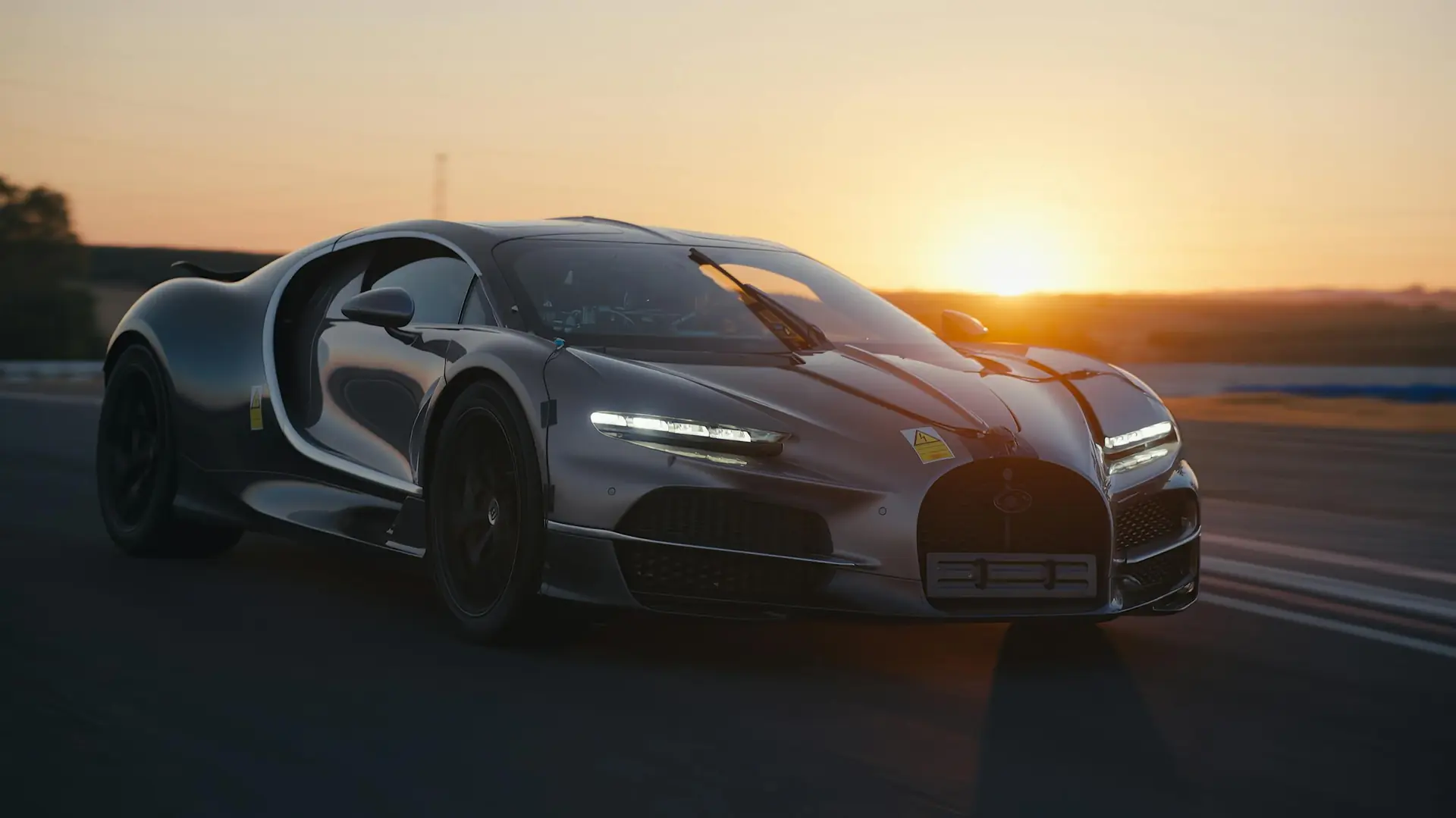
Start with the photograph, because it is the story. That is not a launch render. That is a dark grey validation prototype at the Sevilla Circuit at sunset, headlights on, test-equipment stickers still on the nose — a yellow warning triangle and a sensor on the fender — doing the least glamorous job in the hypercar business: proving it will not cook itself. Bugatti published the picture in October 2026 with a release called ‘Mastering the heat’, and the release is unusually honest about what the car was doing there.
The job: validate the cooling. A 1,800-hp hybrid is a thermal problem wearing a beautiful body — a V16, three electric motors, an 800-volt battery, all of it making heat, all of it wrapped in a shape Bugatti refused to compromise. So the prototypes carry more than 200 thermocouples, measuring the thermal state of the car as it moves between environments, across three areas: the cabin climate system, temperatures across critical components, and the wider cooling architecture. On public roads around Seville the temperature hit roughly 45 degrees. On track it stayed above 40, with tyres, brakes, powertrain and cooling all pushed at once, repeatedly. That is the complete thermal stress test, and Bugatti says the systems passed.
And the context makes it more than a photo shoot. This was not the car’s first heat test. About fifteen months earlier, an earlier XP development car went to Dubai and took temperatures above 50 degrees. At the other end of the scale, the same programme went to Arjeplog in Sweden, at minus 30, to work on low-grip dynamics, braking, stability and whether the cabin still works when everything outside is frozen. Dubai, Arjeplog, Seville: three climates, one demand — that the car behaves the same everywhere its owners will take it. The Seville sunset is the middle of that story, and it is the first time the Tourbillon has looked like a finished car doing a real job instead of a concept doing a turntable.
1,800 PS
From a naturally aspirated 8.3-litre V16 and three electric motors — 300 PS more than the Chiron, with no turbos anywhere in the building.
No turbos. No screens. 1,800 PS and a dashboard built by watchmakers.
— The Torque Wrench
R04The Outlook
Preview
Bugatti Tourbillon — November 18, 2026
Full verdict after independent testing
The Verdict Before the Verdict
So what is the Tourbillon? A promise, kept in the engineering and unproven in the world. Bugatti killed the most successful hypercar engine ever built and replaced it with something harder, lighter and more honest: a naturally aspirated V16 that revs to 9,000 rpm, a hybrid system that exists to make it feel faster rather than to save fuel, and a cabin built like a watch because screens go out of date and dials do not. On paper it beats the Chiron on every line that matters — more power, less weight, higher top speed — at a price half as big again, in half the numbers. On paper, it is the best Bugatti ever built.
But paper is all anyone has. No customer has a car. No independent tester has driven one. Type approval has not been granted. The fastest anyone outside Bugatti has gone in it is a passenger ride through the Vosges, and the most the car has proved is that it can survive 45 degrees in Seville without cooking its occupants. That is real proof, and it is not enough. The Tourbillon will be judged the day the first owner takes delivery, the day the first magazine straps its timing gear to one, and the day the first one crosses an auction block. Until then, the verdict is a question, not an answer.
Here is the question, stated plainly: did Bugatti build something better than the Chiron, or just something different? The numbers say better. The Seville heat test says serious. The watch on the dashboard says forever. And the man who runs the company is already dreaming about a manual one, which says the V16 has a future beyond the hybrid. The W16 is dead. Long live the V16 — now go and prove it deserved the funeral. Tighten it ’til it sings.
What we love
- The V16 itself. Naturally aspirated, 9,000 rpm, built with Cosworth, no turbos anywhere — the first modern Bugatti without them, and the bravest engine decision in the hypercar business.
- The watch dashboard. More than 600 parts, titanium and sapphire and ruby, built by Swiss watchmakers to 50-micron tolerances at most, five microns at the tightest, fixed in place while the wheel rotates around it. Screens date like phones. This ages like a watch.
- The Seville honesty. Bugatti took a validation prototype to 45-degree public roads, 50-degree Dubai and minus-30 Arjeplog, with 200 thermocouples on board, before a single customer car existed — and published the pictures.
- The weight. Under 1,995 kilos despite a hybrid system, a battery and three motors — lighter than the Chiron it replaces. New cars are supposed to get heavier. This one didn’t.
- Rimac’s manual hint. The boss himself, floating a lighter, manual, non-hybrid V16 to Top Gear before the first delivery. The platform has somewhere to go, and the somewhere is analogue.
What could be better
- No independent test exists. Every performance number on this page is Bugatti’s word, type approval has not been granted, and no outlet has driven the car — Top Gear rode shotgun.
- The price in dollars is a mess. €3.8 million net is the only official figure; $4.1 million and $4.6 million are media estimates that disagree by half a million dollars.
- The cabin is narrow and the seats don’t slide. Fixed to the floor, height and backrest only, pedal box moves instead — and Top Gear found no practical armrest for the passenger.
- No customer car delivered yet, and reported waits run to three years or more. The verdict on this car is years away, and 250 people bought it on a promise.
- The hybrid question. A 24.8 kWh battery, three motors and an 800-volt system, carried forever, to serve an engine that makes 1,000 PS (986 hp) on its own — and Rimac is already dreaming about deleting all of it.
Technical specifications
- Powertrain
- 8.3-litre naturally aspirated V16 (Cosworth) + three electric motors — 1,800 PS (1,775 hp) combined (Bugatti)
- V16 alone
- 1,000 PS (986 hp) at 9,000 rpm, 900 Nm — the engine weighs 252 kg (Bugatti)
- Electric side
- Three motors, ~800 PS — two on the front axle, one at the rear; 24.8 kWh gross oil-cooled 800V battery (25 kWh in Bugatti's prose), 60+ km WLTP electric range (Bugatti)
- Performance
- 0–100 km/h 2.0 s, 0–400 km/h under 25 s, top speed 445 km/h with Speed Key (380 km/h without) — all Bugatti claims, none independently verified
- 0–200 km/h
- Under 5.0 s (Bugatti, June 2024 presentation); Top Gear timed ~5 s with Rimac driving, Oct 2026
- Weight
- Under 1,995 kg DIN (Bugatti claim) — lighter than the Chiron (1,995 kg kerb)
- Price
- €3.8 million net before tax and options (Bugatti) — US dollar figures ($4.1M at launch, $4.6M per MotorTrend) are media estimates, not Bugatti prices
- Production
- 250 cars, hand-built in Molsheim — all build slots allocated (Bugatti, Sept 2024)
- Deliveries
- First customer deliveries from 2026 (Bugatti) — no customer handover announced as of November 18, 2026
- Type approval
- Not yet granted (Bugatti footnote, Aug 2026) — the car has no EU homologation or US certification yet
R05Chapter 02
The V16, and Why No Turbos Matters
Now the engine, because it is the whole point. The W16 is dead — four turbos, eight litres, twenty years of dominance, gone. In its place Bugatti did the hardest thing on the menu: it built a brand-new 8.3-litre naturally aspirated V16 with Cosworth, revving to 9,000 rpm, making 1,000 PS (986 hp) on its own, weighing just 252 kilos. No turbos. No intercoolers. None of the plumbing that defined two decades of Bugatti packaging. Then it added three electric motors — two on the front axle, one at the rear — for another 800 PS, fed by a 24.8 kWh gross (rounded to 25 kWh in Bugatti's prose) oil-cooled 800-volt battery in the central tunnel and behind the seats. Combined: 1,800 PS (1,775 hp). The most powerful Bugatti ever built.
Here is what the hybrid is for, and it is not what you think. It is not there to save fuel. Bugatti’s own launch release says the electric side exists for throttle response and torque-fill — the instant shove that covers the gap while a naturally aspirated engine climbs to its power band. The motors spin to 24,000 rpm. The e-axles deliver more than 6 kW per kilogram. And once the car is up to speed, the front axle disconnects and the Tourbillon becomes a rear-drive car with roughly 1,000 PS (986 hp) — the V16, on its own, doing the work. Top Gear’s Ollie Marriage, riding shotgun while Mate Rimac drove through the Vosges, put it simply: ‘I’ve never experienced anything like this V16.’ The engine, he wrote, changes character completely at around 3,000 rpm, and the sound only gets more intense towards 9,000.
The rest of the car is built to the same ‘hardest possible option’ standard, to quote Bugatti’s CTO Emilio Scervo. A next-generation T800 carbon structure with the battery as a structural part of the monocoque. Multi-link suspension, forged aluminium, with 3D-printed arms that saved 45 percent of the suspension weight against the Chiron — plus an AI-developed 3D-printed hollow airfoil arm at the rear. Brake-by-wire, carboceramic brakes, bespoke Michelin Pilot Sport Cup 2s (Bugatti's own release printed the name transposed as 'Pilot Cup Sport 2'). A rear wing that stays submerged at top speed and becomes an airbrake under braking. And the result Bugatti is proudest of: despite the hybrid system, the battery and the extra motors, the Tourbillon weighs less than the Chiron — under 1,995 kilos, against the Chiron's 1,995. Mate Rimac puts the difference at 'just a few kilos.' Twenty years of progress, and the new car is lighter than the old one. That almost never happens.
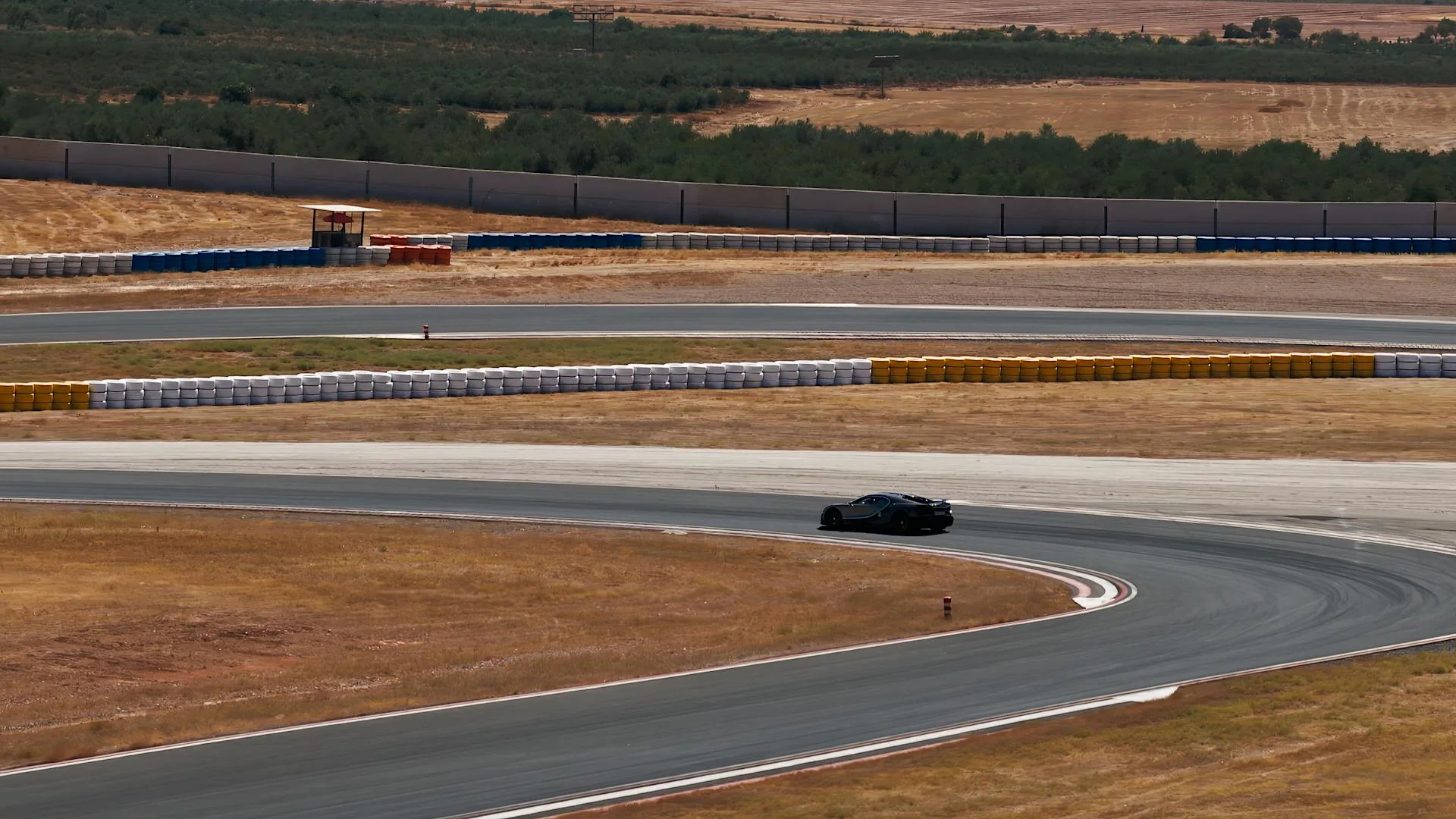
“No turbos. No screens. 1,800 PS and a dashboard built by watchmakers.”
R06Chapter 03
Tourbillon vs Chiron: The Numbers Side by Side
Put them next to each other and the scale of the bet is obvious. The Chiron was the most powerful production car in the world when it arrived in Geneva in March 2016 — 1,500 PS (1,479 hp), 1,600 Nm, 420 km/h, €2.4 million, 500 cars. It sold out. It became the backbone of Bugatti for eight years. The Tourbillon has to beat it on every line that matters, with half the production run and a price tag more than half as big again. Here is the honest table — Bugatti’s claims for the new car, Bugatti’s published figures for the old one:
Two lines in the table below deserve a second look. The first is the price. €3.8 million net is the only official figure Bugatti has ever published, and it is the only one this piece will state as fact. The dollar numbers floating around — about $4.1 million at launch, $4.6 million in MotorTrend’s guide — are media conversions and estimates, not Bugatti prices, and they disagree with each other by half a million dollars. If you are shopping for one, the euro figure is the real one. The second is the production run. Two hundred and fifty cars, every slot allocated shortly after the June 2024 reveal, per Bugatti. Half the Chiron’s run, sold out before a single customer car existed. That is either the strongest vote of confidence in Bugatti’s history, or 250 people buying a promise. Both readings are true until the cars arrive.
- →Power: Tourbillon 1,800 PS (1,775 hp) vs Chiron 1,500 PS (1,479 hp) — plus 300 PS, and the new car has no turbos.
- →Engine: Tourbillon 8.3-litre naturally aspirated V16 + three electric motors vs Chiron 8.0-litre quad-turbo W16 — sixteen cylinders in a V against sixteen in a W, and the difference is everything.
- →0–100 km/h: Tourbillon 2.0 seconds (Bugatti claim) vs Chiron 2.4 seconds — four tenths, on paper.
- →Top speed: Tourbillon 445 km/h with the Speed Key, 380 km/h without (Bugatti claim) vs Chiron 420 km/h limited.
- →Weight: Tourbillon under 1,995 kg (Bugatti claim) vs Chiron 1,995 kg kerb — the hybrid is lighter than the car it replaces, by a few kilos.
- →Price: Tourbillon €3.8 million net vs Chiron €2.4 million net at launch — up 58 percent, before a single option.
- →Production: Tourbillon 250 cars vs Chiron 500 — half as many, all of them allocated before the first delivery.
R07Chapter 04
What Would Make It, What Would Sink It
So what would make the Tourbillon a success? Three things, and they are all still unproven. First, deliveries — on time, in 2026, to the 250 people who already paid for a promise. Second, the V16 living up to its billing: the sound, the response, the 9,000-rpm climb that Top Gear heard from the passenger seat and nobody else has heard at all. Third, the analogue cabin ageing the way Bugatti promises it will — a dashboard of more than 600 parts, titanium and sapphire and ruby, built by Swiss watchmakers to tolerances of 50 microns maximum, down to five microns for the tightest parts, fixed in place while the steering wheel rim rotates around it. No screens, except one that hides until you need the reversing camera. Bugatti’s argument is that screens date like phones and dials age like watches. In ten years, we will know if they were right. On a concours lawn in a hundred years, the bet is that the dials still look right.
And what would sink it? The same list, read backwards. Weight and complexity: a 24.8 kWh battery, three motors, an 800-volt system and a dual-clutch gearbox, all of it carried forever, all of it there to serve an engine that makes 1,000 PS (986 hp) on its own. The cabin: Top Gear found it narrow, the seats fixed to the floor with no fore-aft adjustment — the pedal box moves instead — and no practical armrest for the passenger. The price: €3.8 million net is a number nobody can defend until owners have cars, and no owner has one yet. And the strangest risk of all comes from Bugatti’s own boss. Mate Rimac told Top Gear he is already thinking about a lighter, manual, non-hybrid Tourbillon — no hybrid hardware, no dual-clutch, a real clutch pedal bolted to the V16, roughly 300 kilos lighter by Top Gear's estimate. ‘Absolutely. You bet,’ he said, when asked about a manual. Nothing is announced. There is no timeline. But the man who runs Bugatti is publicly dreaming about deleting the hybrid system from his own flagship, before the first customer car is delivered. That tells you where his heart is. It also tells you the Tourbillon is a platform, not a final answer.
What happens next is simple to state and impossible to schedule. Bugatti opened a new production building, La Manufacture, at Molsheim in July 2026, and says first deliveries land in 2026. As of today, November 18, no customer handover has been announced. Reported waits run to three years or more. There is no resale market, no independent test, no lap time — and no Nürburgring lap to chase, because Bugatti has never played that game. What Torque Authority will track, in order: the first customer delivery, the first independent test, and the first auction result. Until then, this is a preview of a promise — the most expensive promise Bugatti has ever made, and the most interesting car it has ever built. The W16 is dead. The V16 has to prove it deserved the funeral.