Explainer — McLaren vs Gordon Murray
The F1's Designer Built It Again. McLaren Is Suing Him for It.
Three seats. A 12,100-rpm V12. A manual gearbox. And a lawsuit from the company whose legend it honours.
McLaren v Gordon Murray: The S1 Lawsuit · November 28, 2026 · The Torque Wrench · Explainer
681 hp
S1 · 4.2L Cosworth V12
12,100 rpm
S1 redline
75
S1 cars · GMA's current figure
$20.63M
S1 LM chassis #1 at auction
627 PS
F1 · 6.1L BMW V12
240.1 mph
F1 top speed · 1998 record
Full disclosure: The Torque Wrench hasn't driven either car — and this one isn't a road test at all. It is a lawsuit, reported on November 28, 2026, between the company that owns the most famous supercar ever built and the man who designed it. What follows is the verified breakdown of what McLaren has actually said, what Gordon Murray Automotive has actually said, and everything neither side has said yet — because in this story, the silences are the story.
The news, straight: McLaren has begun legal proceedings against Gordon Murray Automotive over the design of the GMA S1, a V12 manual supercar unveiled in August 2026. The claim, first reported by The Daily Telegraph, concerns copyright and design rights around the original McLaren F1. McLaren confirmed the proceedings. GMA said it is confident of its position and will robustly defend the claim. No court filing has been published. No case number, no court, no list of the designs McLaren says were copied, and no statement of what McLaren wants from the court. Every account of the suit traces to one report and two short statements.
And the reason this is the most personal lawsuit in car history: the man being sued designed the car at the centre of it. Gordon Murray was the chief engineer of the McLaren F1 — the three-seat, central-driving-position, naturally aspirated V12 masterpiece unveiled at Monaco in 1992, the car that set the production-car speed record at 240.1 mph in 1998 and won Le Mans in 1995. Thirty-four years later he built the S1: three seats, central driver, naturally aspirated V12, six-speed manual, under a tonne, with a gold-plated heat shield over the exhaust. McLaren's position is that the S1 is too much like the F1. Murray's position is that the S1 is his — the same hand, the same ideas, the same seven design principles, applied to a new car. The court, whenever it speaks, will decide who owns a shape. Until then, this is what is on the record.
R03Chapter 01
The Lawsuit in One Paragraph
Start with what is actually on the record, because it fits in one paragraph. On Saturday, November 28, 2026, The Daily Telegraph reported that McLaren had filed a complaint against Gordon Murray — 'last week', over copyright and design issues, understood to relate to the S1. McLaren confirmed to the Telegraph that proceedings had been initiated 'in relation to the protection of intellectual property rights', filed through the law firm Allen Overy Shearman Sterling. GMA responded that Murray's designs are 'distinctive and innovative' and 'challenge convention', that it is confident of its position, and that it will 'robustly defend the claim'. That is the entire public record. One report, two statements, and a law firm's name.
McLaren's statement, as quoted in the coverage, is a defence of a legacy: 'The F1 represents one of the most significant achievements in automotive history and stands as a testament to the vision, ingenuity and uncompromising standards that define McLaren today.' The company's position, in the same statement, is that it has a responsibility to protect the integrity of the F1. GMA's statement is shorter and sharper: distinctive, innovative, confident, and ready to fight. It also carries the human detail that will follow this case everywhere it goes — the S1 and the S1 LM were, in GMA's words, 'conceived and engineered during Gordon's battle with oesophageal cancer', and Murray has said he designed the S1 LM while undergoing chemotherapy. He is now in remission. Designing the car, by his own account, is what got him through the treatment.
Now everything that is not on the record, because the list is longer than the record. No court has been named. No case number has been published, and no docket has been found. It is not clear whether the defendant is Murray personally, GMA the company, or both — the Telegraph's report says Murray, McLaren's statement says GMA. Nobody outside the filing knows which designs, drawings, or registered rights McLaren is relying on, or what it wants from the court: damages, an injunction, a stopped production run, or something narrower. A case number and a filing name are circulating on social media — McLaren Automotive Limited v Gordon Murray Automotive Limited, case IL-2026-000184 — and neither has been confirmed by any court publication or by either company. Until a filing appears, the lawsuit exists as a confirmed fact with an unconfirmed shape. That is not a small caveat. It is most of the story.
34 yrs
Between the F1's unveiling at Monaco in 1992 and the S1's reveal at The Quail in 2026 — same designer, same ideas, different century.
McLaren is suing the man who designed the F1 for building a car too much like the F1. The man is Gordon Murray. The car is the S1.
— The Torque Wrench
R04The Answer
Explainer
McLaren v Gordon Murray: The S1 Lawsuit — November 28, 2026
An explainer, not a verdict
The Answer
So what is actually happening? McLaren has sued Gordon Murray Automotive over the S1, a car its own designer built as a tribute to the car he designed for McLaren thirty-four years ago. McLaren says it is protecting the F1. GMA says its designs are distinctive and innovative and it will robustly defend the claim. No filing is public, no court is named, and no one outside the case knows what exactly McLaren says was copied or what it wants. That is the whole of it — a confirmed lawsuit with an unconfirmed shape, and a car at the centre of it that nobody disputes is beautiful.
And what does it mean? It means the fight is not really about a bumper or a headlight. It is about who owns a legacy when the legacy has a human author. McLaren owns the F1 — the name, the cars, the records, the brand. Murray owns the hand that drew it, the seven principles he has applied to every car since, and the gold heat shield he keeps quoting back. The S1 is the place where those two ownerships collide: a car that is unmistakably Murray's and unmistakably an F1 descendant, built by the same man, in the same spirit, with the same ideas. The T.50 proved McLaren would let him do it once. The S1 proves there is a line somewhere. The lawsuit is McLaren saying where.
What Torque Authority will track, in order: the filing, when it appears — court, defendants, scope, relief; GMA's formal defence; whether the S1's 75 cars or the S1 LM's five are touched by any of it; and whether this ends in a courtroom or in the quiet settlement these cases usually end in. Until then, the S1 is a 681-hp, 12,100-rpm, manual V12 argument for one man's right to keep designing the car he has been designing since 1988 — and the F1 is still the car every supercar is measured against, including the one its own designer just built. Tighten it 'til it sings.
What we love
- The S1 itself. A 12,100-rpm naturally aspirated V12, a six-speed manual, three seats, under a tonne. The car is the argument for Murray's side, and it is a very good argument.
- The gold heat shield. A 24-carat gold-plated heat shield over a polished Inconel exhaust — the F1's 16 grams of gold foil, quoted back at McLaren thirty-four years later.
- The 1992 Monaco nod. The low auxiliary lights and the wheels cite the 1992 Monaco show car, not the production F1 — Murray citing his own sketchbook, in the metal.
- GMA's answer, in one line. 'Distinctive and innovative' — short, confident, and it puts the burden back on McLaren to say exactly what was copied.
- The S1 LM's auction. $20,630,000 for chassis #1 — the most expensive new car ever sold at auction. The market has already voted on whether Murray's tribute is worth something.
What could be better
- No filing, no case. Everything traces to one Telegraph report. No court, no case number, no published claim — the story is a statement and a rebuttal, not a docket.
- The 64-to-75 wobble. GMA announced 64 cars, matching the 64 road-going F1s. Its release now says 75. Nobody has explained the extra eleven — and the symmetry was the point.
- No price, no performance. The S1's price is undisclosed and it has no published 0–60 or top speed. The tribute is priced like a secret.
- The S1 LM's shadow. The suit is understood to cover the S1 LM too — a five-car, $20.6-million-a-car tribute to the Le Mans-winning GTR. If McLaren's claim bites, it bites the most valuable new cars on earth.
- The question nobody can answer yet. If the designer is the same man, who owns the shape — the company that paid for it, or the hand that drew it? The court will decide. The internet already has.
Technical specifications
- The claim
- McLaren has confirmed legal proceedings against Gordon Murray Automotive over copyright and design rights around the original McLaren F1 (The Daily Telegraph, Nov 28, 2026)
- The car at the centre
- GMA S1 — 4.2-litre Cosworth naturally aspirated V12, up to 690 PS (681 hp) at 12,100 rpm, six-speed manual, central driving seat (Gordon Murray)
- The other car
- GMA S1 LM — 4.3-litre V12, 720 PS (710 hp), 957 kg, five built, chassis #1 sold for $20,630,000 (Gordon Murray; RM Sotheby's)
- The original
- McLaren F1 — 6.1-litre BMW S70/2 V12, 627 PS (618 hp), 1,140 kg dry, 240.1 mph, 106 built 1992–1998 (Wikipedia)
- The LM parallel
- McLaren F1 LM — five built, 680 PS, 1,062 kg, Papaya Orange, honouring the five GTRs that finished Le Mans 1995 (Wikipedia)
- What's not public
- No court filing or case number has been published; the exact scope, the rights relied on, and the relief sought are undisclosed (Exotic Car Trends; Rush)
- GMA's position
- Murray's designs are distinctive and innovative; GMA is confident of its position and will robustly defend the claim (The Daily Telegraph)
- McLaren's position
- McLaren says it has a responsibility to protect the integrity of the F1 (The Daily Telegraph)
- The production wrinkle
- S1 production listed at 75 cars in GMA's current release; the August announcement said 64 (Gordon Murray)
- The price
- S1 price undisclosed, every allocation sold before the reveal; S1 LM chassis #1 sold for $20,630,000, the highest price for a new car at auction (Gordon Murray; New Atlas)
R05Chapter 02
The Car at the Centre
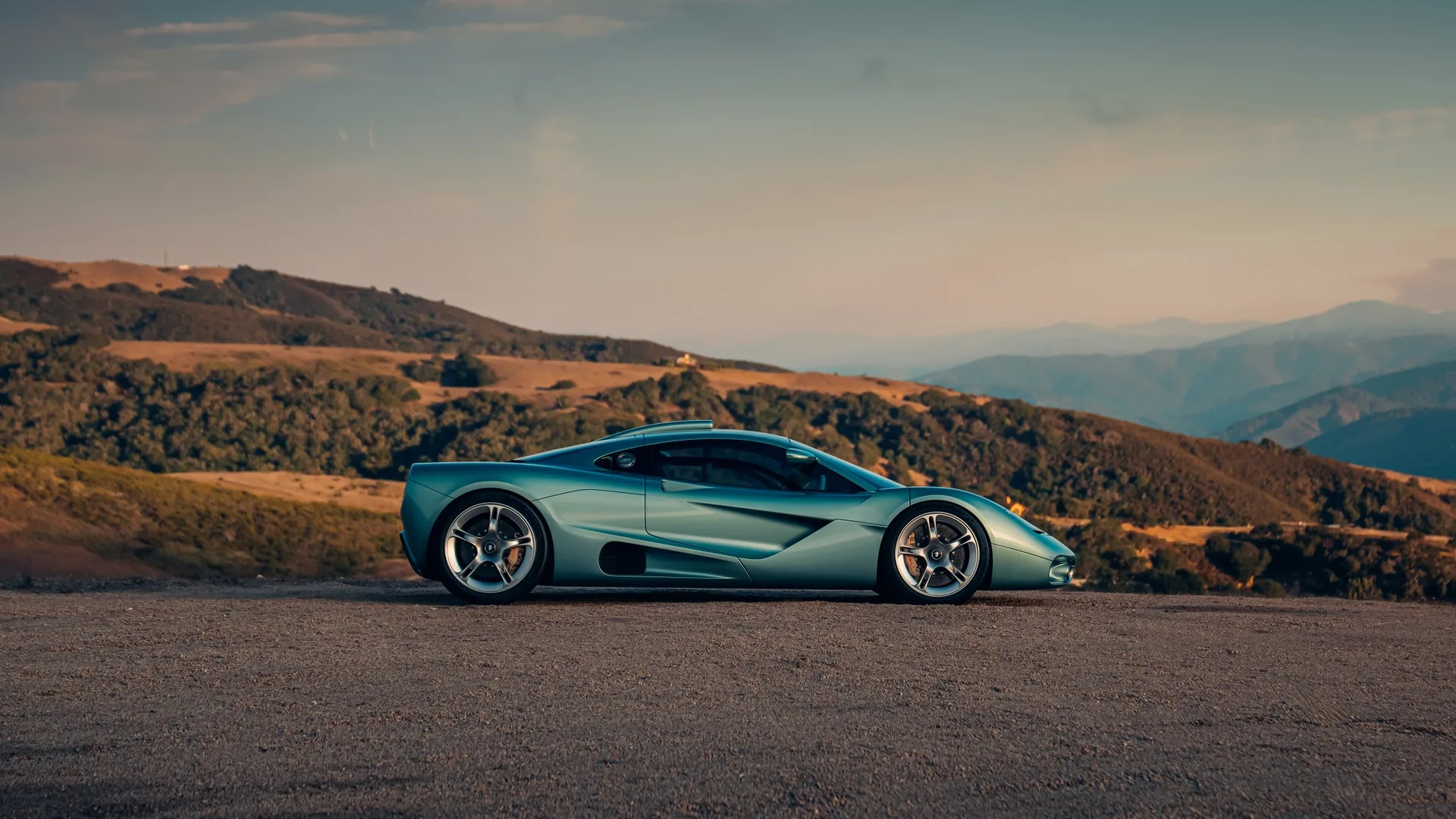
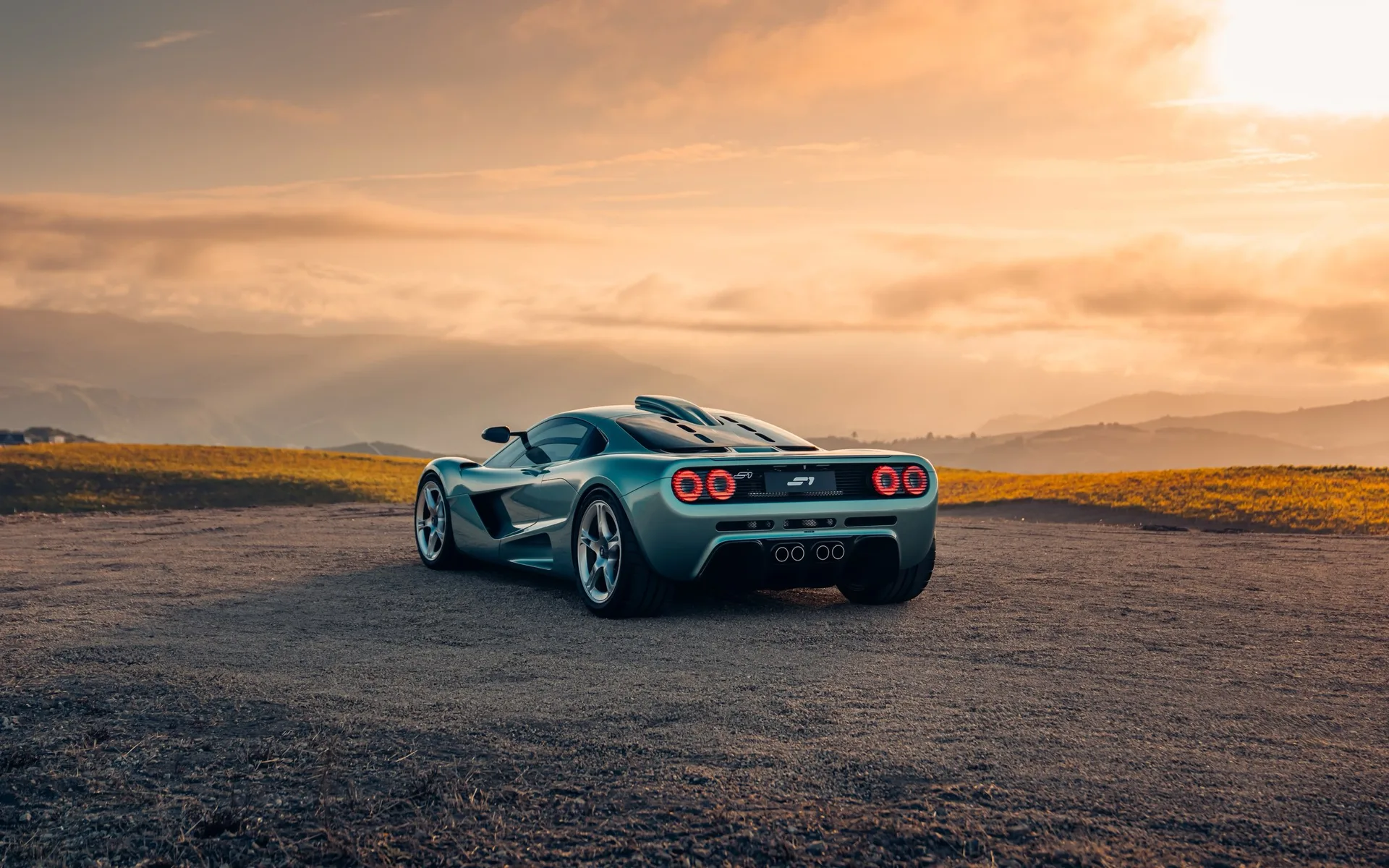
The S1 is the car McLaren is suing over, so look at it properly. Gordon Murray Special Vehicles — GMA's bespoke division, launched in 2025 — revealed it on August 14, 2026, at The Quail during Monterey Car Week, on the same lawn, the same day, as McLaren's own McL 6GT reveal. It is a touring-focused evolution of the S1 LM: a bespoke 4.2-litre naturally aspirated Cosworth V12 making up to 690 PS — 681 hp — at 12,100 rpm, with around 500 Nm at 7,000 rpm and 80 per cent of its torque available from 2,500 rpm. Six-speed manual, with a touring sixth gear as standard. Carbon-fibre monocoque derived from the S1 LM platform. Target weight below the T.50 — under 997 kg — despite a more luxurious cabin, a proper audio system, and acoustic insulation. Central driving position, three seats, dihedral doors with drop-down glass, and switchable power steering for when the driver wants the assistance off. Price: undisclosed. Production: GMA's release now lists 75 cars, each individually commissioned. Every allocation was sold before the cover came off.
The F1 echoes are not accidental, and GMA has never pretended otherwise. The central seat. The naturally aspirated V12. The manual gearbox. The engine bay, where a polished Inconel exhaust sits under a 24-carat gold-plated heat shield — the F1's engine bay was lined with around 16 grams of gold foil, and the S1 quotes it back, thirty-four years later, in the same metal. The low auxiliary lights in the nose and the lightweight wheels are a nod to the 1992 Monaco show car — the F1 as Murray first sketched it, an element that never saw production. The S1 strips away the S1 LM's fixed rear wing, long front splitter, and deep side skirts; every exterior body panel is new, and the downforce now comes from an active rear aero system integrated into the bodywork. GMA's own line is that the S1 is not derived from the T.33 or the T.50. It is a touring car built on the S1 LM's bones, tuned for the road instead of the track.
One number in the S1's story changed after the reveal, and it is worth a paragraph because the original number was the point. In August, GMA announced 64 cars — the exact number of road-going McLaren F1s ever built. Sixty-four F1s, sixty-four S1s: the symmetry was the tribute. GMA's press release now lists 75 cars worldwide, and nobody at the company has explained the extra eleven. Maybe demand. Maybe a second allocation. Maybe a typo that became a policy. Whatever the reason, the neatness is gone — and with it, the cleanest piece of evidence that the S1 was built as a mirror of the F1. The car is the same. The count is not.
Then there is the S1 LM, the car the suit is understood to cover as well — and the more dangerous one for McLaren's case to touch. Revealed at The Quail in August 2025, it is the track-bred original: a 4.3-litre Cosworth V12 making 720 PS at 12,100 rpm, 957 kg, a fixed rear wing and a front splitter, a road-legal tribute to the F1 GTR that won Le Mans in 1995. Five were built. All five were bought by a single collector. And then chassis number one — the final chassis of the run — sold at auction in Las Vegas on November 24, 2025, at the amfAR gala, for $20,630,000: the highest price ever paid for a new car at auction, charity sales excluded. If McLaren's claim reaches the S1 LM, it reaches the most valuable new cars on earth, owned by people who do not enjoy surprises.
“Who owns a shape — the company that paid for it, or the hand that drew it? That is the whole lawsuit, and nobody has answered it yet.”
R06Chapter 03
S1 vs F1: The Comparison McLaren Doesn't Want You to Make
Put them side by side, because the lawsuit is a comparison with lawyers attached. The F1: a 6.1-litre BMW S70/2 V12, 627 PS — 618 hp — and 650 Nm, six-speed manual, 1,140 kg dry, a 240.1 mph top speed set by the XP5 prototype at Ehra-Lessien on March 31, 1998, a Guinness record that still stands for a naturally aspirated production car. One hundred and six built between 1992 and 1998, sixty-four of them road cars, at £540,000 when new. The S1: a 4.2-litre Cosworth V12, 690 PS — 681 hp — and around 500 Nm, six-speed manual, under 997 kg, a 12,100 rpm redline against the F1's 7,500, seventy-five cars at an undisclosed price. The S1 has more power, less weight, and a redline the BMW could only dream of. The F1 has the record, the history, and a top speed the S1 has never been asked to match — GMA has published no performance figures for it at all.
What is genuinely the same is the philosophy, and it is Murray's philosophy in both cases: three seats, the driver in the middle, a naturally aspirated V12 behind them, a manual gearbox, a carbon monocoque, and an obsession with weight that borders on the religious. The F1's kerb weight was 1,140 kg dry in 1992, when a supercar weighed that much because nobody knew how to make it lighter. The S1 targets under 997 kg in 2026, when every other supercar has given up and gone hybrid. The gold is the same joke told twice: the F1's engine bay was lined with gold foil because gold reflects heat better than anything else; the S1's exhaust wears a 24-carat gold-plated heat shield because Murray remembers. The cars are thirty-four years apart and the ideas did not change. That is the defence, and it is also the accusation.
But there is a detail the shouting misses, and it is the detail that decides design cases: the F1's body was not styled by Gordon Murray. Murray designed the car — the concept, the engineering, the packaging, the three-seat layout sketched in an airport lounge after the 1988 Italian Grand Prix. The bodywork was styled by Peter Stevens. If McLaren's claim is about the shape of the S1, the shape it resembles was drawn by a third man, who is not a party to the suit. And there is a precedent sitting in Murray's own showroom: the T.50, revealed in 2020, is also a central-seat, naturally aspirated Cosworth V12, manual-gearbox tribute to the F1 — and McLaren never sued over it. The S1 is closer to the F1's look than the T.50 was: lower, cleaner, more obviously a descendant. Somewhere between the T.50 and the S1, in McLaren's view, homage became copying. Nobody outside the filing knows where McLaren drew that line — and that is the question the case will actually answer.
The LM pairing makes the point twice over. The McLaren F1 LM — five built in 1995, 680 PS, 1,062 kg, Papaya Orange, honouring the five GTRs that finished Le Mans — and the GMA S1 LM — five built in 2025, 720 PS, 957 kg, honouring the GTR that won it. Same number of cars, same occasion, same orange-versus-green logic of a tribute built to be recognised. McLaren's claim, as reported, covers the S1 — and is understood to reach the S1 LM too. The symmetry is the evidence and the defence at the same time: the S1 LM is a tribute to a race car, and tributes are supposed to be recognisable. The law's question is whether recognisable is the same as infringing. The car world's question is whether anyone should be surprised that the man who designed the F1 keeps designing cars like the F1.
R07Chapter 04
What Happens Next
The honest answer is that nobody outside the filing knows — and the filing is not public. What to watch, in order: the filing itself, which will name the court, the defendants, and the designs McLaren says were copied; the scope, which will say whether this is about the S1's shape, its details, or something narrower; and the relief, which will say whether McLaren wants money, a stopped production run, or a quiet settlement. No source has said McLaren is trying to stop S1 deliveries, and it would be wrong to assume it is. The 75 cars are sold. The five S1 LMs are built. The $20.63 million chassis is in a collection. A lawsuit does not unbuild a car.
The stakes are lopsided in a way that makes the case fascinating. For McLaren, the F1 is the crown jewel — the car its own statement calls one of the most significant achievements in automotive history — and a company that has spent thirty-four years polishing that legacy is not going to watch its designer sell a modern version of it without a fight. For GMA, the S1 is the flagship of a tiny company built on one man's name, and the S1 LM is the most valuable new car ever sold at auction. For the buyers, a design lawsuit is the one thing nobody budgeted for: not the power, not the price, not the provenance — the paperwork. And for the rest of us, the case will set a line that matters beyond these two companies: how closely may a designer revisit his own greatest work, and at what point does his own handwriting become someone else's property?
There is one more thing the reveal made clear, and it is the thing the internet will argue about until the filing appears: the S1 was designed while Murray was fighting oesophageal cancer, and the S1 LM — the car that became the $20.63 million record — is the car he designed through chemotherapy. GMA says the two cars reflect his resilience and determination. Murray is in remission. Whatever a court decides about the shape of the S1, that part is not in dispute: the man who designed the most famous supercar ever built spent his illness designing its successor, and then his old company sued him for it. The law will decide who owns the shape. The story is already decided. Tighten it 'til it sings.