Preview — Ford
Go Like Hell, Again: Ford's GT41 Takes a 5.4 V8 to Le Mans
41 inches tall. 5.4 litres. No turbos. Two cars, one target: Le Mans, June 2027.
Ford GT41 · November 27, 2026 · The Torque Wrench · Preview
41 in
Ground to air intake — the name
5.4 L
Naturally aspirated Coyote V8
~670 hp
Combined, class-capped (BoP)
220 mph
Claimed top speed (Ford)
2
Cars, full 2027 WEC season
Jun 2027
Le Mans — 60 years after 1966
Full disclosure: The Torque Wrench hasn't driven it — nobody has raced it. Ford pulled the cover off the GT41 at Ford Field on Thanksgiving Day, November 26, 2026, in front of a football crowd, and the car has not turned a wheel in anger since. What follows is the verified breakdown of the car that has to take Ford back to the top step at Le Mans: which numbers are Ford's word, which are the rulebook's, and which are still just a driver's guess.
The news, straight: Ford is going back to the top class at Le Mans, and it is doing it with a naturally aspirated 5.4-litre Coyote V8, no turbos, in a prototype called the GT41. LMDh rules, an ORECA chassis, a spec hybrid system, rear-wheel drive only. Two cars, nine rounds of the 2027 World Endurance Championship, starting in Qatar on March 27 and ending — if Ford gets its wish — with an outright win at Le Mans in June, sixty years after the 1-2-3. The name is a measurement: 41 inches from the ground to the air intake, the same logic that named the GT40. The film that introduced it was directed by Zack Snyder and narrated by Matt Damon, the man who played Carroll Shelby. Ford is not being subtle about what this is.
And the question that makes this car worth a whole story: can a company that has not fought for the outright win at Le Mans since 1969 walk back into the hardest room in motorsport and win it — against Ferrari, which has won the last three, and Toyota, which won the last one? Ford's answer is to do everything in-house: the engine, the team, the dynos, the software, the drivers' first laps. The bet is that the company that built the GT40 still knows how to build a winner from scratch. The evidence so far is 14,300 kilometres of testing and a 30-hour endurance run. The proof is still seven months away, in France, in June.
R03Chapter 01
The Name Is a Measurement
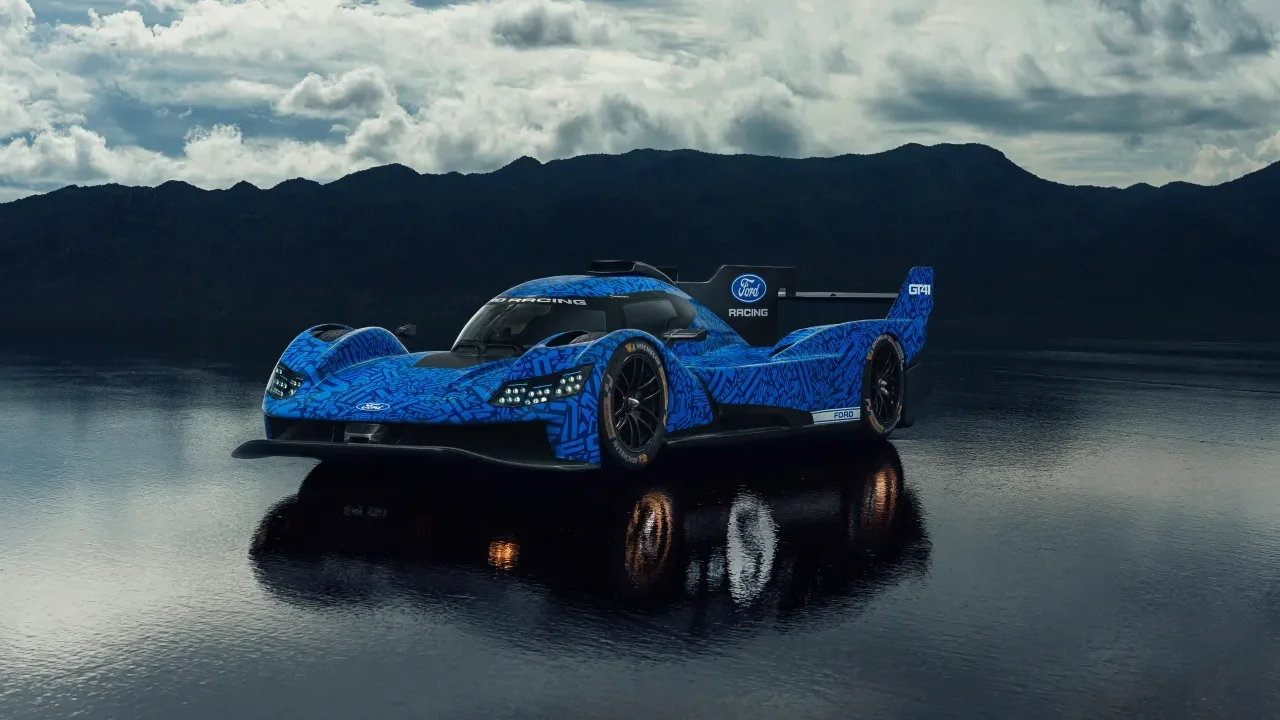
Start with the name, because Ford earned it the old-fashioned way: with a tape measure. The GT40 was called the GT40 because it was just over 40 inches tall. The GT41 is called the GT41 because it stands 41 inches from the ground to the top of its air intake. The current LMDh regulations allow a maximum height of 1,060 millimetres — just a little over 41 inches — so Ford built the car as low as the rules allow and named it after the number. One outlet reads the regulation figure as 41.7 inches; Ford's number, the one on the car, is 41. Sixty years, one inch.
The name is the least of the history in this car. In a display case at Ford's new headquarters in Dearborn this week lay the unsigned contract for Ford's purchase of Ferrari. 'Yes, Ford really did try to buy Ferrari,' the company's chief archivist told Magneto. That failed deal is the reason the GT40 exists at all — Henry Ford II's revenge, built into a race car, finished 1-2-3 at Le Mans in 1966 and won four years straight. The GT41 arrives sixty years after the 1-2-3, wearing the same colours, with the same target. Bill Ford said it plainly at the reveal: 'Our 1-2-3 triumph at Le Mans in 1966 remains one of the defining moments in motorsport history. We cherish that history, but we are driven by the opportunity to take on new and greater challenges.'
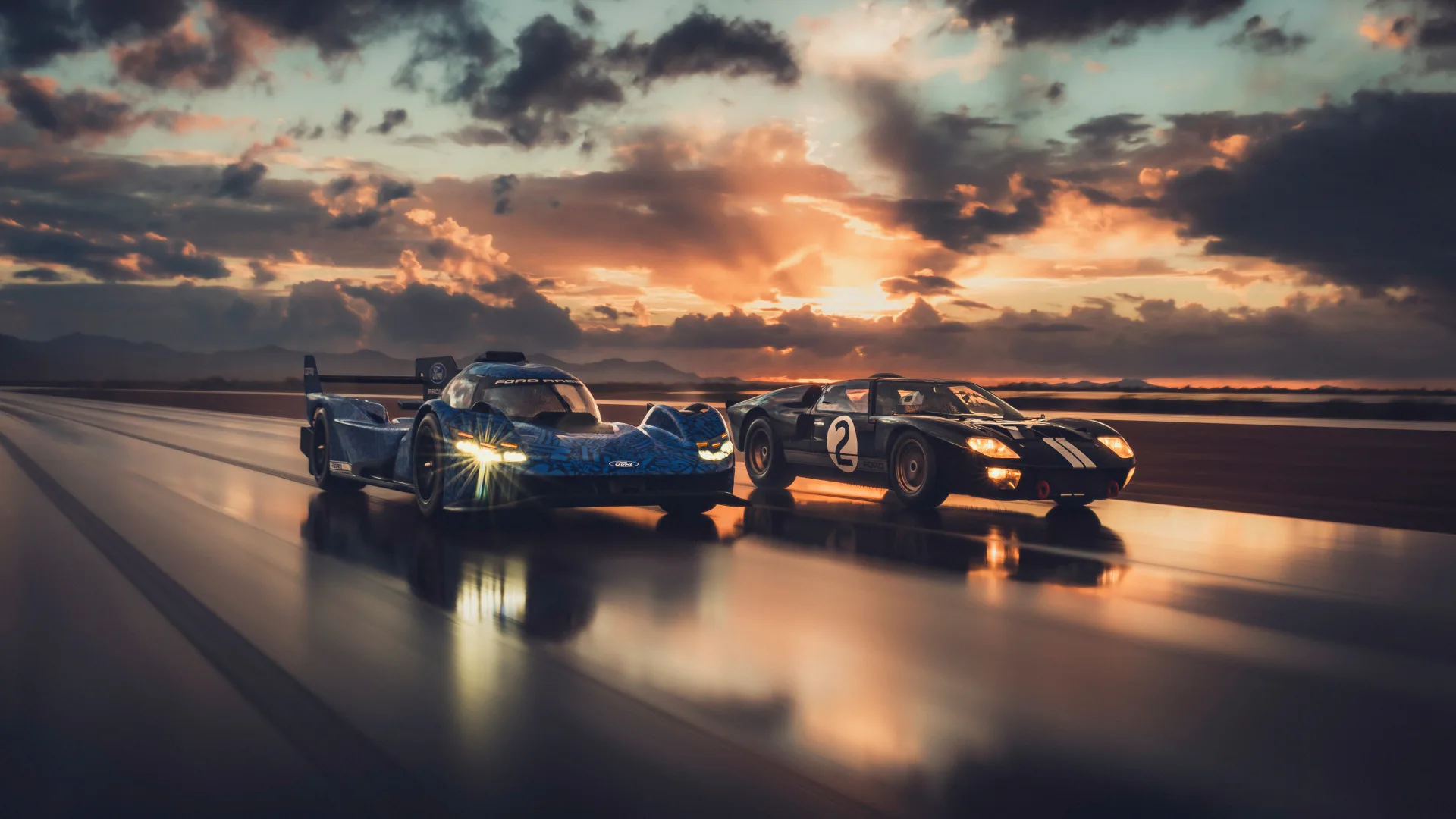
And the reveal itself was pure Ford theatre. Not a motor show, not a livestream from a studio — a Thanksgiving Day NFL game, Detroit Lions against Chicago Bears, at Ford Field, in front of the home crowd. The car sat on the field with four GT40s — the red No. 1, the black No. 2, the gold and the white-and-red cars — under a screen that read GO LIKE HELL. The last time Ford fielded a full factory effort in the WEC it was the Ford GT in LMGTE, 2016 to 2019, a class win at Le Mans on debut. This time the target is not a class. It is the whole race.
5.4 L
A naturally aspirated Coyote V8, built in-house in Dearborn — no turbos, past 9,000 rpm, and a hybrid system that only exists because the rules say so.
Sixty years after the 1-2-3, Ford is going back to Le Mans with a V8 and the same two words: go like hell.
— The Torque Wrench
R04The Outlook
Preview
Ford GT41 — November 27, 2026
Full verdict after independent testing
The Verdict Before the Verdict
So what would make the GT41 a success? Three things, and they are all still unproven. First, survival: two cars finishing the Qatar opener in March, and both cars finishing Le Mans in June — the 30-hour test at Aragón says the foundations are there, but a test is not a race. Second, pace against the best field Le Mans has seen in decades: a podium in year one is the team's own stated goal, and Priaulx is right that winning in year one would be a surprise. Third, the engine living up to its billing — the sound, the reliability, the 9,000-rpm climb that the dyno videos promise and no rival has heard at full chat yet.
And what would sink it? The same list, read backwards. A car that is quick in testing and fragile in racing — the fate of every ambitious debut since the class began. A Balance of Performance table that never gives the V8 a fair fight. A first season spent learning the lessons Ferrari and Toyota learned years ago, in public, at 200 mph. And the quietest risk of all: that doing everything in-house, the decision Ford is proudest of, turns out to be the slowest way to catch a field that has been racing these rules for years.
What Torque Authority will track, in order: the final race livery in February, the homologation in January, the Qatar debut on March 27, and then Le Mans in June — sixty years after the 1-2-3, against the deepest field in the race's modern history. Until then, this is a preview of a promise — a 41-inch V8 missile, built by hand in the same building as the GT40's engines, aimed at the one race Ford measures itself by. Ford went back to Le Mans in 2016 with a new GT and won its class on debut. This time the target is the whole race. Go like hell, again. Tighten it 'til it sings.
What we love
- The name. Forty-one inches, measured with a tape, not voted on in a meeting — the same logic that named the GT40, sixty years later.
- A naturally aspirated V8 in 2027. No turbos, no intercoolers, fewer things to break at 3 a.m. on the Mulsanne — and the noise that decision buys.
- In-house, all of it. The engine, the team, the dynos in Dearborn, the software from the Red Bull engineers — Ford built this itself instead of renting a winner.
- The testing honesty. Fourteen thousand kilometres, six European tests and a 30-hour run before the reveal — the car earned its unveiling instead of debuting on a promise.
- The livery's secrets. A flag, an eagle, the Spirit of Detroit and the triple-sill stripe from the 1966 1-2-3, hidden in the camouflage. The final livery in February has a lot to live up to.
What could be better
- It hasn't raced. Everything on this page is a promise until Qatar on March 27 — and Le Mans in June is where promises go to die.
- The power number is the rulebook's, not Ford's. ~670 hp is the class cap; Ford has published no official output, and a driver's '750 horsepower' is enthusiasm, not a spec.
- The aero isn't final. The reveal car is not in its final aerodynamic specification, and bodywork homologation only freezes at the end of December.
- The field is brutal. Ferrari has won three straight Le Mans, Toyota won the last one, and McLaren arrives in 2027 too — Ford's own drivers say a podium in year one would be great.
- You can't buy one, and there is no road car. The Cobra badge in the film is a tease, not a product — Ford announced no Mustang, no Cobra, nothing with a price.
Technical specifications
- Powertrain
- Naturally aspirated 5.4-litre Coyote-based V8 + spec LMDh hybrid, rear-wheel drive (Ford; FIA WEC)
- Engine
- 5.4-litre Coyote-based V8, designed and developed in-house by Ford Racing in Dearborn; first fired July 2026; revs past 9,000 rpm in development (RACER; Ford Muscle)
- Hybrid
- Spec LMDh system — Bosch ~50 kW motor-generator + power electronics, Williams battery, Xtrac 7-speed sequential; rear axle only (evo)
- Chassis
- LMDh — ORECA chassis; developed and operated in-house by Ford Racing (RACER)
- Power
- ~670 hp (500 kW) combined — the Hypercar class cap, Balance of Performance-adjusted. Ford has published no official output (evo; Mustang Fan Club)
- Top speed
- ~220 mph (354 km/h) — Ford claim (RaceFans)
- Weight
- LMDh class minimum ~1,030 kg before Balance of Performance (AutoRacing1)
- Height
- 41 inches, ground to air intake — the name; LMDh maximum height 1,060 mm (Ford; RACER)
- Drivers
- Logan Sargeant, Mike Rockenfeller, Sebastian Priaulx, Tom Blomqvist, Matt Campbell, Nick Yelloly; reserve Tom Dillmann (FIA WEC)
- Debut
- 2027 FIA WEC, 9 rounds, 2 cars — Qatar 1812km March 27, 2027; Le Mans June 2027 (RACER; AutoGuide)
R05Chapter 02
A V8 With No Turbos in a Turbo World
Now the engine, because it is the whole point. A naturally aspirated 5.4-litre Coyote-based V8, designed and developed in-house by Ford Racing in Dearborn, with no turbo in sight. In 2027, in the top class of endurance racing, against turbo hybrids from Ferrari and Toyota, Ford chose the simplest, loudest possible answer. The reasoning, from Ford's own people, is gloriously pragmatic: no turbos means no intercoolers, less cooling, less bulky packaging for the aerodynamics, and fewer things to go wrong over 24 hours. Programme manager Dan Sayers, who came over from Red Bull's Formula 1 powertrain operation, put it like a man who has spent his career counting failure modes: 'I'm a simple person, and for an endurance car, the simpler the better — you lose the intercoolers, you lose the turbos.'
The engine is also the most hand-made thing Ford has built in decades. It is assembled by two builders, Ben Johnson and Kyle Stevens, in an 800-square-foot room converted from two decommissioned test cells in Ford's 1949 dynamometer building — twenty feet from the cell where the 1960s Le Mans engines were developed. It first fired in July 2026. On the dyno it revs past 9,000 rpm, and the shipping crate Ford teased it in was marked with three numbers: 500 kW, 5.4L V8, over 9,000 rpm. One report puts the internals at a 94 mm bore and 96.5 mm stroke with a 10,000 rpm series limit — reported, not confirmed — and the block shares its heritage with the Coyote road-car family, the same bloodline as the Mustang Dark Horse's engine and the GT3 car's 5.4.
Here is the number nobody should quote as a Ford figure: the power. Ford has not published an official output. What exists is the rulebook: Hypercar class power is capped at 500 kW, about 670 hp combined, engine plus hybrid, adjusted by Balance of Performance. That is the number in the specs below, labelled as the class cap, because that is what it is. The hybrid side is all spec hardware — a Bosch motor-generator of about 50 kW with Bosch power electronics, a Williams battery, an Xtrac seven-speed sequential — acting on the rear axle only, because LMDh cars are rear-wheel drive, full stop. Driver Sebastian Priaulx, after his first laps, called it '750 horsepower, electric motors and everything else.' That is a driver's enthusiasm, not a Ford figure, and it stays labelled as his words. The claimed top speed is around 220 mph. The class minimum weight is around 1,030 kg before BoP. Every one of those numbers is a rule or a claim. None of them is a Ford spec sheet — because Ford hasn't published one.
“Sixty years after the 1-2-3, Ford is going back to Le Mans with a V8, no turbos, and the same two words: go like hell.”
R06Chapter 03
Fourteen Thousand Kilometres Before Anyone Saw It
The reveal was the end of the story, not the start. By the time the GT41 sat on the field at Ford Field, it had already covered more than 14,300 kilometres across two development prototypes in six European tests. The timeline, from the people who ran it: shakedowns in August 2026 at Ford's own driving centre and on an airfield, then a first proper test at Paul Ricard in France, a four-day test at Portimao in Portugal — more than a thousand kilometres at each — then Silverstone, Monza and Imola. Last week, two cars ran a 30-hour endurance test at Motorland Aragón in Spain, at the same time. Three cars have been built out of a planned six. Final bodywork homologation is due by the end of December; the full homologation paperwork lands by the end of January.
The drivers have been part of it from the start, and their first impressions are the most honest material Ford has released. Sebastian Priaulx, 25, after his first laps at Silverstone: 'It definitely feels heavier [than the LMP2]. It feels faster but in low-speed corners it's a little bit more like a GT car: more dive and pitch and weight transfer, which I don't mind.' Logan Sargeant, the former Williams F1 driver, after the first test at Paul Ricard: 'It was fantastic to drive it for the first time. It was extremely smooth from a power delivery point of view.' His hardest lesson was the brakes — 'You have to be quite gentle on the brakes for the most part. You definitely can't overload them.' The line-up around them is the strongest Ford could assemble: Le Mans winner Mike Rockenfeller (outright with Audi in 2010), ex-Porsche factory driver Matt Campbell, Tom Blomqvist, Nick Yelloly — and Priaulx, whose father Andy drove for the Ford GT factory squad at Le Mans. Reserve is Tom Dillmann, a two-time class winner. One rival Le Mans winner told evo it is 'one of the best driver line-ups. It's very strong.'
And the programme behind them is bigger than the car. Ford announced the return on January 30, 2025, named ORECA as chassis supplier by the end of that year, renamed Ford Performance to Ford Racing, and then made the decision nobody expected: it runs the team itself, in-house, instead of hiring an established outfit. The engineering is split between Dearborn, Charlotte in North Carolina, and Venture Engineering in Oxfordshire — eighteen to twenty hours of coverage a day, work handed across the Atlantic overnight. Ford engineers embedded at Red Bull in Milton Keynes brought Formula 1 software know-how across; the Mustang GT3 programme contributed torque-control lessons. The testing moves to America now — Sebring and Circuit of The Americas in December and January, another endurance run, possibly a shakedown in Qatar before the opener. The car shown at the reveal is not yet in its final aerodynamic specification. There is, as Sayers says, 'still a huge amount of work to do before we arrive for the season opener.'
R07Chapter 04
The Hardest Room in Motorsport
So who, exactly, is Ford walking in on? The Hypercar class in 2027 is the deepest manufacturer field Le Mans has seen in decades. Ferrari has won the last three Le Mans 24 Hours in a row, 2023 to 2025. Toyota won in 2026 and has taken three of the last four WEC titles. Cadillac and BMW are quick. Aston Martin's wailing V12 Valkyries joined last year. McLaren — the 1995 winner — returns in 2027 with its own LMDh car, and Genesis is coming too. Ford is not entering a rebuilding class. It is entering a knife fight, late to the fight, with a car that has never raced.
Ford knows it, and to its credit the team is not pretending otherwise. Priaulx, asked what a realistic first season looks like: 'I think to get a podium would be great in our first year. Just to be up there would be very good. I think winning is going to be tough, especially the first year. Second year, I think we can fully go for it.' Sayers, on the scale of the challenge: 'The level of competition in Hypercar is incredibly high and there are no shortcuts to success.' Rushbrook, on what the programme is for beyond the trophy: 'It's about building a competitive motorsport program that delivers value across our business and helps shape the future of Ford Racing.' Nobody at Ford is promising a win in June. They are promising a proper attempt, built properly, by their own people. That is the honest version, and it is worth more than a poster promise.
There is one more thing the reveal made clear, and it is the thing the internet will argue about until March: the livery. Blue on blue, still in a camouflage pattern — the functional camo of testing, evolved, with pieces of American iconography hidden inside it: the flag, a bald eagle, the Spirit of Detroit statue, and — per RACER — the Statue of Liberty. The triple-sill stripe from the factory GT40s that finished first, second and third in 1966 runs along the sills. The final race livery arrives in February, at the Ford Racing season launch. And in the film, tucked on a fender, there is a modernized Cobra badge. Before anyone runs with it: Ford's announcement names no road car. No Mustang, no Cobra. The badge is a tease in a film, not a product. If Dearborn ever builds the road car, that is a different story — and this site will be first in line to argue about it.