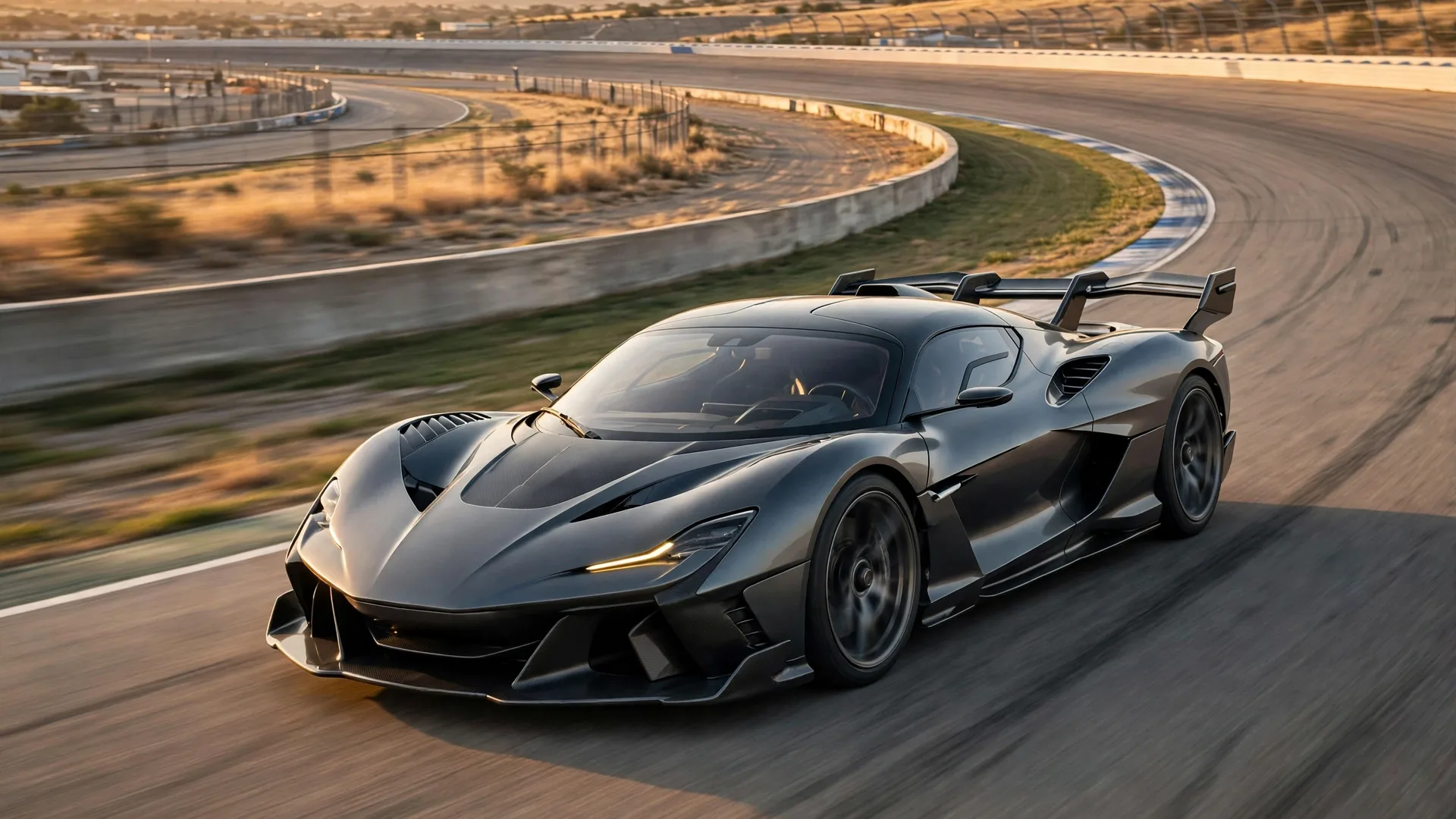
Preview — Yangwang
The First Production Car Past 500 km/h — One Way.
503.17 km/h, one way. 6:59 at the Ring. 30 cars.
BYD Yangwang U9 Xtreme · November 4, 2026 · Updated November 10, 2026 · The Torque Wrench · Preview
503.17km/h
Top speed, Abu Dhabi · one-way run
6:59.157
Nürburgring lap, 20.832 km
2,220kW
Quad-motor output
1,200V
Electrical architecture
2,480kg
Kerb weight
30
Units, global — 28 overseas, 2 in China
Full disclosure: The Torque Wrench hasn't driven it — almost nobody has. BYD is building 30 of them — 28 for overseas markets and 2 for China — and the one the world knows best is currently in pieces after a crash caught on video. This is the verified breakdown, not a road test. On November 2, 2026, footage began circulating of a Yangwang U9 Xtreme destroyed during high-speed testing on a closed track: the car left its line, hit a barrier, and came apart so violently that the front and rear bodywork were ripped away. Footage appears to show the driver exiting the vehicle after the impact. The driver, Jiang Wen, a 23-year BYD test veteran, was cleared unhurt after a hospital check. That image, more than any horsepower figure, is why this car matters this week.
Here is what the car is, before we get to what happened to it. The U9 Xtreme is the track-weapon version of BYD's Yangwang U9 hypercar: four electric motors, one per wheel, each making 555 kW and spinning to 30,000 rpm, for a combined 2,220 kW. BYD quotes 3,019 PS; converted properly it is 2,977 hp. Either way, it is the most powerful production car on the planet. On November 1, 2026, Marc Basseng drove one to 503.17 km/h on a closed section of the E11 public highway in Abu Dhabi — the first production car ever past 500 km/h — beating his own 496.22 km/h mark from Papenburg in Germany on September 14, 2025. On August 22, 2025, Moritz Kranz lapped the Nürburgring in 6:59.157, the first production EV under seven minutes — since beaten outright by the Porsche Taycan Turbo GT with the Manthey Kit, 6:55.533 on April 15, 2026, so the U9 Xtreme's lap stands as the electric super sports car class record. The car already sitting at rank 12 on Torque Authority's Nürburgring full-layout table is this car. What follows is the story of the machine behind those two numbers, the crash that interrupted its next one, and the public road where it finally broke 500.
Here is the honest frame for everything that follows. Confirmed: the power, the voltage, the lap, the speed, the 30-car run, the crash footage, and the Abu Dhabi run — 503.17 km/h, November 1, 2026, FIA-recognised. Unconfirmed: the crash's cause. This preview will not call the crash a failed 500 km/h attempt, because BYD has not said that is what the run was. It will not call the speed record official in the two-way sense, because the Abu Dhabi run was one way, like Papenburg before it. And it will not judge the car, because the only people who have driven the Xtreme in anger are BYD's own drivers and one very careful British television presenter. The numbers are real. The verdict can wait.
R03Chapter 01
Two Records, One Asterisk Each
Start with the lap, because it is the firmer of the two records. On August 22, 2025, German racing driver Moritz Kranz, a man with nearly 10,000 Nürburgring laps in his GT career, lapped the 20.832 km Nordschleife in 6:59.157 in a Yangwang U9 Xtreme. The time sits on the Nürburgring's own official record list in the electric super sports car class, more than five seconds quicker than the previous class mark, and it made the U9 Xtreme the first production EV ever under seven minutes at the Ring. That outright mark has since moved on: the Porsche Taycan Turbo GT with the Manthey Kit lapped in 6:55.533 on April 15, 2026 — the U9 Xtreme's 6:59.157 stands as the electric super sports car class record. No asterisk needed, no manufacturer timing, no hand-waving: one track, one complete lap, one time, on the official list. It is also why this preview exists at all. A car that laps the Ring in under seven minutes is not a curiosity. It is a benchmark.
The speed record is bigger and softer at the same time. On November 1, 2026, Marc Basseng drove a U9 Xtreme to 503.17 km/h (312.66 mph) on a closed section of the E11 highway in Abu Dhabi, past his own 496.22 km/h mark from Papenburg and past the 500 km/h barrier no car had ever crossed. BYD's own wording for it is 'fastest car on the planet,' and that wording is doing careful work. The Abu Dhabi run went one way only, like Papenburg before it, and the record is recognised by the FIA and by Guinness as a single-direction mark: fastest production car, and fastest electric production car, each in a single-direction run. Record lists that require a two-way average still credit SSC's Tuatara, because a one-way run and a two-way average are different records wearing the same name. So the honest sentence is this: the U9 Xtreme is the fastest production car ever timed in one direction, the first ever past 500 km/h, and the fastest electric car ever, full stop. The two-way crown is a different argument, and BYD has not won it yet.
One more number needs untangling before we go further, because you will see two horsepower figures for this car and both are 'right.' The firm number is 2,220 kW, four motors at 555 kW each. Converted from kilowatts that is 2,977 hp. Rounding the output to 3,000 PS and converting that figure gives 2,959 hp, a variant that appears on some leaderboards — but not this site's: our leaderboard lists 2,977 hp. Same car, same motors, different rounding path. This preview uses 2,220 kW as the primary figure and 2,977 hp as its conversion, and flags the 2,959 hp variant wherever it appears, so nobody has to wonder why the numbers disagree by 18 horsepower.
503.17 km/h
First production car past 500 km/h — one way, FIA-recognised.
It's Chinese. It's electric. And it's the first production car ever past 500 km/h.
— The Torque Wrench
R04The Outlook
Preview
BYD Yangwang U9 Xtreme — November 10, 2026
Full verdict after independent testing
The Bottom Line
The U9 Xtreme is the most significant Chinese performance car ever built, and the crash did not change that. It changed the conversation around it, from 'look at these numbers' to 'look at what the numbers survived.' A car that hits a barrier and lets its driver climb out is a striking sight. It is not, by itself, proof of the engineering — the footage shows a cell that held its shape, not a published crash assessment.
But a preview is not a verdict, and this one will not pretend otherwise. The speed record carries a one-way asterisk. The crash carries three unknowns. The two-way run has not happened. And the car itself is a 30-unit, $2.98-million object — 28 of them overseas, 2 in China — that almost no reader of this site will ever see, let alone drive. What can be judged today is the engineering and the evidence, and both are extraordinary. What cannot be judged is the car as a car, because no independent tester has lived with one.
So the U9 Xtreme waits for its verdict, and the wait is no longer about 500 km/h — that barrier is gone. The next chapter is the two-way run BYD has so far declined, and the independent road test no outsider has yet done. Until then, this preview is the prologue to a car that is already the fastest thing with number plates in history, with a crash video that appears to show its safety cell holding. Either way, the Chinese EV story that started with the Denza Z has its first legend. It just happens to be a car that already hit a wall, and whose driver was seen climbing out of it.
What we love
- A 6:59.157 Ring lap that sits on the Nürburgring's own official list, not just in a manufacturer's press release.
- What the footage appears to show: a barrier hit, the safety cell holding its shape, and the driver climbing out.
- 1,200 volts in a production car. The electrical architecture is the real breakthrough, not just the power figure.
- The audacity of the Abu Dhabi run: a 500 km/h record on a closed section of public highway, not a test oval.
- BYD quotes 3,019 PS and lets everyone else argue about the conversion. Confidence.
What could be better
- The 503.17 km/h record is one-way. Two-way lists still credit the SSC Tuatara.
- Thirty cars — 28 overseas, 2 in China — about $2.98 million for the first one. You cannot buy this car.
- No independent road test exists. The only outside drive was Richard Hammond's brief, gentle track taste.
- The crash's cause is still unconfirmed. The footage surfaced November 2; the shakedown happened earlier, in China.
Technical specifications
- Status
- Limited-production track hypercar: records set 2025, production version debuted Beijing Auto Show, April 24, 2026
- Powertrain
- Four electric motors, one per wheel, 555 kW each, 30,000 rpm max; combined 2,220 kW (2,977 hp; BYD quotes 3,019 PS)
- Platform / battery
- 1,200-volt architecture (first in series production); LFP Blade battery, 30C discharge rate
- Nürburgring
- 6:59.157, 20.832 km, August 22, 2025, Moritz Kranz; first production EV under seven minutes; electric super sports car class record — the outright production-EV record is now the Taycan Turbo GT Manthey Kit’s 6:55.533 (April 15, 2026)
- Top speed
- 503.17 km/h (312.66 mph), November 1, 2026, Marc Basseng, E11 Abu Dhabi — one-way run, FIA-recognised; Guinness single-direction records
- Weight
- 2,480 kg kerb weight
- Suspension / tyres
- Revised DiSus-X suspension tuned for 300+ mph; semi-slick tyres (GitiSport e·GTR² PRO on the Ring lap)
- Production / price
- 30 units globally — 28 overseas, 2 in China; first car sold for over ¥20 million (about US$2.98 million, CnEVPost, November 6, 2026) at the April 2026 Beijing Auto Show; no list price published
- Crash
- High-speed testing crash (pre-Abu Dhabi shakedown, China), footage surfaced November 2, 2026: first barrier impact ~360 km/h, rear axle/subframe detached, safety cell intact, driver Jiang Wen cleared unhurt after a hospital check; cause unconfirmed by BYD
- Next
- Two-way average still unclaimed — no return run was attempted, so the SSC Tuatara's 282.9 mph two-way record stands
R05Chapter 02
How You Build a 503 km/h Car
The recipe is not mysterious, it is just extreme in every direction at once. Four motors, one per wheel, on BYD's e4 platform, each spinning to 30,000 rpm, with independent torque vectoring deciding what each tyre does at every millisecond. A 1,200-volt electrical architecture, the first in a series-production car, feeding those motors from a lithium iron phosphate Blade battery built to discharge at 30C. At these speeds the electrical system is not a supporting act. It is the car. A conventional 800-volt system, like the standard U9's, cannot move this much energy this fast without melting its own ambitions.
The chassis work is just as deliberate. Revised DiSus-X suspension, retuned specifically for stability past 300 mph, because a car at 503 km/h covers 140 metres every second and any disturbance becomes a crash in under a second. Semi-slick tyres developed to survive past 500 km/h, with the Ring lap run on GitiSport e·GTR² PRO rubber. Kerb weight 2,480 kg, which is heavy for a two-seat hypercar and irrelevant at full throttle, because 2,220 kW does not care about 2,480 kg the way 800 hp would. The U9 family is famous for a suspension system that can make the car hop and dance on the spot; the Xtreme's version has exactly one job, and it is not dancing. It is keeping a 3,019-PS car pointed straight at speeds where the air itself becomes a structural load.
And do not confuse this car with the standard U9, because the gap between them is the whole story. The standard Yangwang U9, launched in China on February 25, 2024 at ¥1.68 million (raised to ¥1.8 million in October 2025), makes 960 kW (1,287 hp) from four 240 kW motors on an 800-volt system, and tops out at 309 km/h. The Xtreme more than doubles the power (2,220 kW against 960 kW), raises the voltage by half, and adds more than 190 km/h to the top speed (503.17 km/h against 309.19 km/h). It began life as the U9 Track Edition, became a production model in its own right in September 2025, and debuted in production form at the Beijing Auto Show on April 24, 2026. Same silhouette, different species.
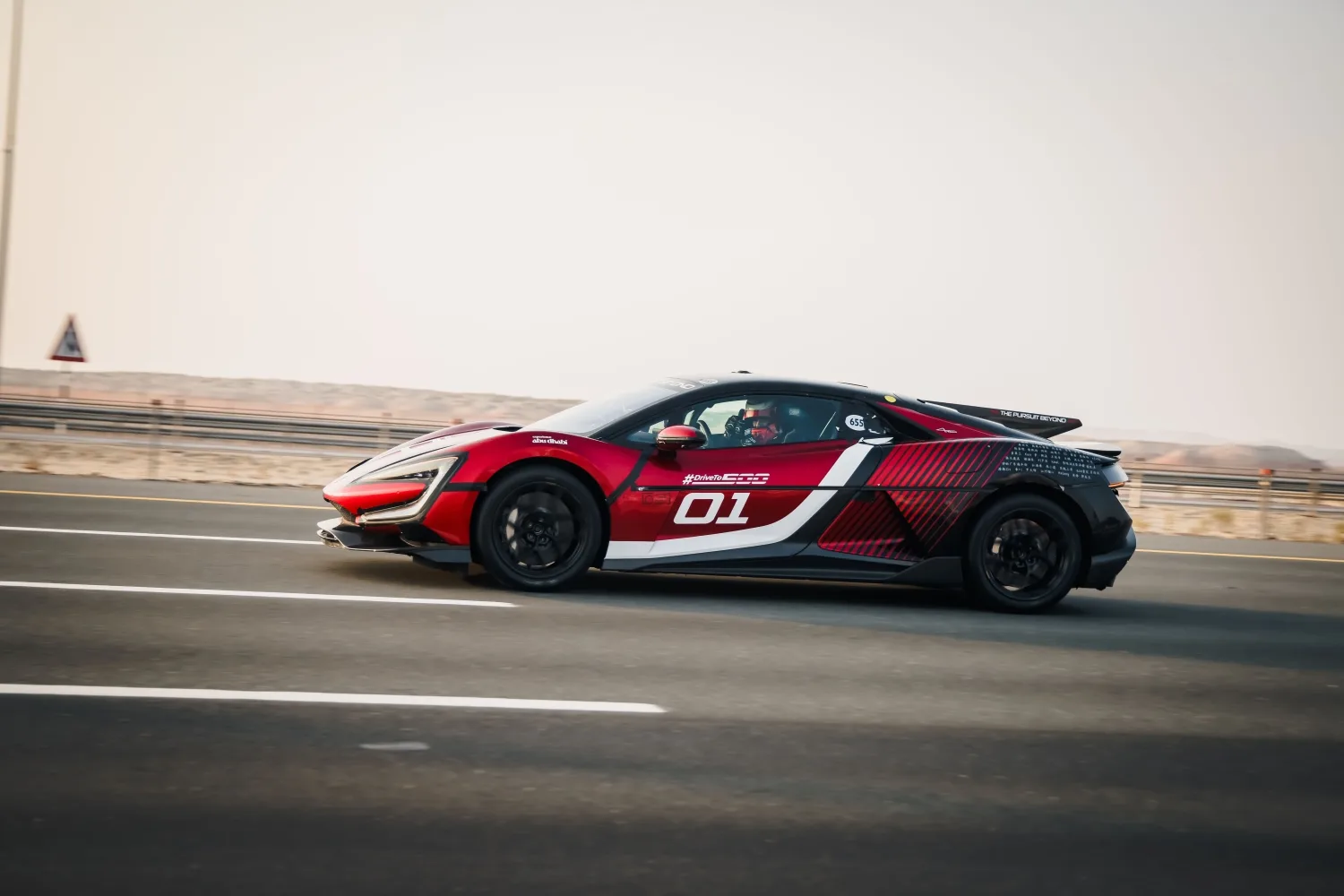
“BYD spent three years chasing a number no car had ever reached. It took a closed stretch of public highway, two days, and one overnight fix to get there.”
R06Chapter 03
The Crash, Exactly As Reported
On November 2, 2026, video and photographs released in China showed a Yangwang U9 Xtreme destroyed during a domestic pre-Abu Dhabi shakedown on a closed track in China, targeting 420–450 km/h. The car deviated from its line at high speed, struck a barrier at around 360 km/h on first impact, and came apart: the rear axle and subframe detached completely, the front and rear bodywork were ripped away, and what remained was essentially the carbon safety cell. There was no fire, and the battery pack appears to have survived. The driver — Jiang Wen, a 23-year BYD test veteran who volunteered for the run — got out of the car on his own and was seen sitting up and smiling in the footage. A hospital check cleared him unhurt. That is the part of the story that is solid, and it is remarkable on its own: a barrier impact that destroyed the car, and the driver was seen climbing out of it.
What is still unconfirmed about the crash is the cause, and this preview will keep it that way. BYD has not said what sent the car off its line. The run was a 420–450 km/h shakedown in China ahead of the Abu Dhabi attempt — not a record attempt. So here is the rule this preview follows, and the rule every outlet covering the story should follow: do not call this a failed 500 km/h record attempt. Nobody authoritative has said that is what the run was, and the difference between a test crash and a failed record attempt is the difference between a setback and a headline.
There is a twist in the crash that BYD did not plan but will absolutely use. A destroyed car with a passenger cell that appears intact on the footage, and a driver who appears to climb out, is striking to watch — but it is not a published crash assessment. No independent engineering evaluation of the cell, the restraints, or the battery has been published. Yangwang's quest for 500 km/h took a visible hit when the crash footage surfaced on November 2, the day after the record was set — the shakedown itself happened earlier, in China, before the Abu Dhabi run. Its safety story got the best advertisement it could never have bought. BYD has not said whether the crash affects any future two-way attempt, and until it does, the honest position is that the questions stand with it.
R07Chapter 04
Abu Dhabi, and 6.95 km/h
The gap between the U9 Xtreme and history was 3.78 km/h. That was the distance between its 496.22 km/h record and the 500 km/h barrier no car had ever crossed. The 6.95 km/h in this chapter's title is the second margin: the new record beat Basseng's own 496.22 km/h mark by 6.95 km/h. BYD executive vice president Stella Li said in a July 2026 interview that the car would attempt a world record in Dubai in November 2026, on a street of about 15 kilometres chosen with local police. She called the target 'ambitious' without naming a number in that interview; every outlet reading her comments understands the target to be 500 km/h. At 503.17 km/h the car covers roughly 140 metres per second, which is why the run needed a long, straight road: most of the distance is acceleration and braking, not top speed.
Dubai was the plan. Abu Dhabi is where it happened. The venue moved, for reasons BYD has not disclosed, to a closed section of Sheikh Khalifa Bin Zayed International Road — the E11 — in Abu Dhabi's Al Dhafra region, with 10 kilometres of road closed and a seven-kilometre straight for the top-speed runs. Two runs on October 31 topped out at 490 km/h. The engineers worked overnight: they adjusted the rear-wing angle for more rear downforce, reprofiled the suspension software for the road's subtle undulations, and fine-tuned the tyre pressures. On November 1, two more runs. The first confirmed the gains. The second hit 503.17 km/h. A public road is a stranger and harder stage than a test oval: no banking, no run-off designed for the job, a real-world surface swept clean of debris — BYD says every metre was checked for rogue wire particles from the cleaning brushes — and a road closure negotiated with local authorities rather than booked with a test facility. It is the first 500 km/h run ever, and it happened on a closed section of public highway, in front of the world.
What the Abu Dhabi run does not settle is the two-way question. Guinness lists the U9 Xtreme for the single-direction production and electric production records, and the FIA recognises the speed. But a two-way average — the standard the Tuatara's 282.9 mph still holds — would need a return run in the opposite direction, and no return run was attempted. The same honesty applies to the car's commercial life: no list price has ever been published, the production version's first sale went for over ¥20 million (about US$2.98 million, per CnEVPost, November 6, 2026) at the April 2026 Beijing Auto Show, and of the 30 cars, 28 are going overseas and 2 are staying in China. Thirty cars, one crash video, two records, and a 500 km/h barrier that no longer exists. That is the whole story so far, and it is already the most interesting thing BYD has ever built.