Issue Nº 02 — Autumn 2026
Verified — Yangwang
The World's Fastest Production Car Crashed. The Driver Walked Away.
BYD Yangwang U9 Xtreme · November 4, 2026 · Preview
Preview, no score. BYD's 2,220 kW quad-motor hypercar: 496.22 km/h top speed, 6:59.157 Nürburgring lap, 30 units; crash footage surfaced November 2, 2026 with speed, date and cause unconfirmed by BYD; Dubai 500 km/h attempt planned for November 2026, date and venue unconfirmed.
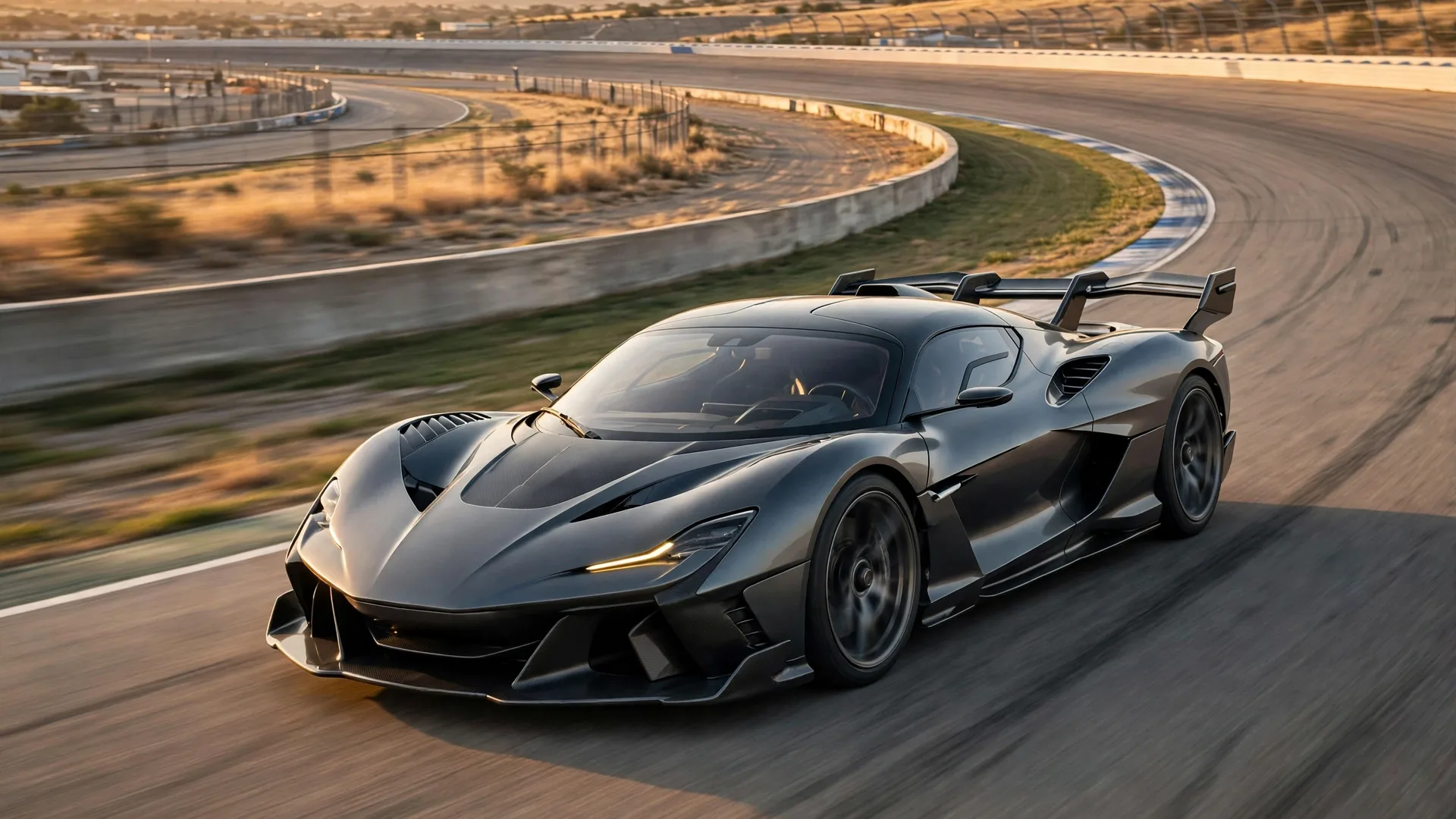
Full disclosure: The Torque Wrench hasn't driven it — almost nobody has. BYD is building 30 of them, most of them in China, and the one the world knows best is currently in pieces on a Chinese test track. This is the verified breakdown, not a road test. On November 2, 2026, footage began circulating of a Yangwang U9 Xtreme destroyed during high-speed testing in China: the car left its line, hit a barrier, and came apart so violently that the front and rear bodywork were ripped away. The driver got out on his own and walked away. That sentence, more than any horsepower figure, is why this car matters this week.
Here is what the car is, before we get to what happened to it. The U9 Xtreme is the track-weapon version of BYD's Yangwang U9 hypercar: four electric motors, one per wheel, each making 555 kW and spinning to 30,000 rpm, for a combined 2,220 kW. BYD rounds that as 3,000 PS; converted properly it is 2,977 hp. Either way, it is the most powerful production car on the planet. On September 14, 2025, Marc Basseng drove one to 496.22 km/h at Papenburg in Germany. On August 22, 2025, Moritz Kranz lapped the Nürburgring in 6:59.157, the first production EV under seven minutes. The car already sitting on Torque Authority's Nürburgring leaderboard at rank 18 is this car. What follows is the story of the machine behind those two numbers, and the crash that interrupted its next one.
Here is the honest frame for everything that follows. Confirmed: the power, the voltage, the lap, the speed, the 30-car run, the crash footage, and the Dubai plan. Unconfirmed: the crash's speed, date, and cause, and Dubai's date and venue. This preview will not call the crash a failed 500 km/h attempt, because BYD has not said that is what the run was. It will not call the speed record official in the two-way sense, because the Papenburg run was one way. And it will not score the car, because the only people who have driven the Xtreme in anger are BYD's own drivers and one very careful British television presenter. The numbers are real. The verdict can wait.
01
Two Records, One Asterisk Each
Start with the lap, because it is the firmer of the two records. On August 22, 2025, German racing driver Moritz Kranz, a man with nearly 10,000 Nürburgring laps in his GT career, lapped the 20.832 km Nordschleife in 6:59.157 in a Yangwang U9 Xtreme. The time sits on the Nürburgring's own official record list in the electric super sports car class, more than five seconds quicker than the previous class mark, and it made the U9 Xtreme the first production EV ever under seven minutes at the Ring. No asterisk needed, no manufacturer timing, no hand-waving: one track, one complete lap, one time, on the official list. It is also why this preview exists at all. A car that laps the Ring in under seven minutes is not a curiosity. It is a benchmark.
The speed record is bigger and softer at the same time. On September 14, 2025, Marc Basseng drove a U9 Xtreme to 496.22 km/h (308.4 mph) on the high-speed oval at ATP Papenburg in Germany, past the Bugatti Chiron Super Sport 300+'s 490.48 km/h and into territory no production car had ever reached. BYD's own wording for it is 'fastest car on the planet,' and that wording is doing careful work. The Papenburg run went one way only, organized by BYD, with no independent timing company named. Record lists that require a two-way average still credit SSC's Tuatara, because a one-way run and a two-way average are different records wearing the same name. So the honest sentence is this: the U9 Xtreme is the fastest production car ever timed in one direction, and the fastest electric car ever, full stop. The two-way crown is a different argument, and BYD has not won it yet. Dubai is where it intends to try.
One more number needs untangling before we go further, because you will see two horsepower figures for this car and both are 'right.' The firm number is 2,220 kW, four motors at 555 kW each. Converted from kilowatts that is 2,977 hp. BYD also rounds the output as 3,000 PS, and converting that rounded figure gives 2,959 hp, which is the number on some leaderboards including this site's. Same car, same motors, different rounding path. This preview uses 2,220 kW as the primary figure and 2,977 hp as its conversion, and flags the 2,959 hp variant wherever it appears, so nobody has to wonder why the numbers disagree by 18 horsepower.
02
How You Build a 496 km/h Car
The recipe is not mysterious, it is just extreme in every direction at once. Four motors, one per wheel, on BYD's e4 platform, each spinning to 30,000 rpm, with independent torque vectoring deciding what each tyre does at every millisecond. A 1,200-volt electrical architecture, the first in a series-production car, feeding those motors from a lithium iron phosphate Blade battery built to discharge at 30C. At these speeds the electrical system is not a supporting act. It is the car. A conventional 800-volt system, like the standard U9's, cannot move this much energy this fast without melting its own ambitions.
The chassis work is just as deliberate. Revised DiSus-X suspension, retuned specifically for stability past 300 mph, because a car at 496 km/h covers 138 metres every second and any disturbance becomes a crash in under a second. Semi-slick tyres developed to survive 500 km/h, with the Ring lap run on GitiSport e·GTR² PRO rubber. Kerb weight 2,480 kg, which is heavy for a two-seat hypercar and irrelevant at full throttle, because 2,220 kW does not care about 2,480 kg the way 800 hp would. The U9 family is famous for a suspension system that can make the car hop and dance on the spot; the Xtreme's version has exactly one job, and it is not dancing. It is keeping a 3,000-horsepower car pointed straight at speeds where the air itself becomes a structural load.
And do not confuse this car with the standard U9, because the gap between them is the whole story. The standard Yangwang U9, on sale in China from early 2024 at ¥1.8 million, makes 960 kW (1,287 hp) from four 240 kW motors on an 800-volt system, and tops out at 309 km/h. The Xtreme doubles the power, raises the voltage by half, and adds nearly 190 km/h to the top speed. It began life as the U9 Track Edition, became a production model in its own right in September 2025, and debuted in production form at the Beijing Auto Show on April 24, 2026. Same silhouette, different species.
03
The Crash, Exactly As Reported
On November 2, 2026, video and photographs released in China showed a Yangwang U9 Xtreme destroyed during high-speed testing on a closed track. The car deviated from its line at high speed, struck a barrier, and came apart: the rear axle detached completely, the front and rear bodywork were ripped away, and what remained was essentially the carbon safety cell. There was no fire, and the battery pack appears to have survived. The driver got out of the car on his own and was seen sitting up and smiling while undergoing hospital checks. He survived without serious injury. That is the part of the story that is solid, and it is remarkable on its own: a barrier impact at speeds most cars never reach, and the person inside walked away from it.
Everything else about the crash is unconfirmed, and this preview will keep it that way. BYD has not confirmed the speed, the date, or the cause. Reports differ on the purpose of the run: one outlet, reading BYD's own video, describes a 420-450 km/h evaluation run; another says the car was possibly testing toward 500 km/h. One outlet notes the incident may even predate the 2025 record run, since the footage's date is itself unconfirmed. Only the footage's release date, November 2, 2026, is certain. So here is the rule this preview follows, and the rule every outlet covering the story should follow: do not call this a failed 500 km/h record attempt. Nobody authoritative has said that is what the run was, and the difference between a test crash and a failed record attempt is the difference between a setback and a headline.
There is a twist in the crash that BYD did not plan but will absolutely use. A destroyed car with an intact safety cell and an unharmed driver is, whether anyone likes it or not, a safety demonstration at speeds no crash-test laboratory can reproduce. Yangwang's quest for 500 km/h took a visible hit on November 2. Its safety story got the best advertisement it could never have bought. BYD has not said whether the crash affects the Dubai plan, and until it does, the honest position is that the plan stands and the questions stand with it.
04
Dubai, and 3.78 km/h
The gap between the U9 Xtreme and history is 3.78 km/h. That is the distance between its 496.22 km/h record and the 500 km/h barrier no car has ever crossed. BYD executive vice president Stella Li said in a July 2026 interview that the car would attempt a world record in Dubai in November 2026, on a street of about 15 kilometres chosen with local police. She called the target 'ambitious' without naming a number in that interview; every outlet reading her comments understands the target to be 500 km/h. At 496.22 km/h the car covers roughly 138 metres per second, which is why the street needs to be 15 kilometres long: most of that distance is acceleration and braking, not top speed.
Dubai is also a change of plan, and the change matters. Earlier reporting in July 2026 pointed to a return to Papenburg in Germany, the same oval where the record was set. The venue then moved to Dubai for undisclosed reasons. A public street is a stranger and harder stage than a test oval: no banking, no run-off designed for the job, real-world surface, and a road closure negotiated with police rather than booked with a test facility. If BYD pulls it off, it will be the first car past 500 km/h, on a public road, in front of the world. If it does not, the attempt still puts the U9 Xtreme in a category of one: the only production car even trying.
What remains unconfirmed about Dubai is almost everything a reader would want to know. No road has been named. No permissions have been publicly confirmed. No firm date has been announced. As of early November 2026, Dubai is the stated target, not a confirmed event, and this preview will update the moment BYD confirms more. The same honesty applies to the car's commercial life: no list price has ever been published, the production version's first sale went for over ¥20 million (about US$2.9 million) at the April 2026 Beijing Auto Show, and the car is sold in China only. Thirty cars, one crash video, two records, and a 500 km/h attempt on a street in Dubai. That is the whole story so far, and it is already the most interesting thing BYD has ever built.
“BYD built a 3,000-horsepower car to break physics. Physics pushed back. The driver walked away.”
Technical specifications
- Status
- Limited-production track hypercar: records set 2025, production version debuted Beijing Auto Show, April 24, 2026
- Powertrain
- Four electric motors, one per wheel, 555 kW each, 30,000 rpm max; combined 2,220 kW (2,977 hp; BYD rounds it as 3,000 PS)
- Platform / battery
- 1,200-volt architecture (first in series production); LFP Blade battery, 30C discharge rate
- Nürburgring
- 6:59.157, August 22, 2025, Moritz Kranz; first production EV under seven minutes; electric super sports car class record
- Top speed
- 496.22 km/h (308.4 mph), September 14, 2025, Marc Basseng, ATP Papenburg — one-way run, BYD-organized
- Weight
- 2,480 kg kerb weight
- Suspension / tyres
- Revised DiSus-X suspension tuned for 300+ mph; semi-slick tyres (GitiSport e·GTR² PRO on the Ring lap)
- Production / price
- 30 units globally; first car sold for over ¥20 million (about US$2.9 million) at the April 2026 Beijing Auto Show; no list price published; China-only
- Crash
- High-speed testing crash, footage surfaced November 2, 2026: barrier impact, rear axle detached, safety cell intact, driver unharmed; speed, date and cause unconfirmed by BYD
- Next
- 500 km/h attempt planned for November 2026 in Dubai (15 km street, police-chosen road); date, venue and permissions unconfirmed
Preview
BYD Yangwang U9 Xtreme — November 4, 2026
No score yet — the car hasn't debuted. Full verdict after launch.
What we love
- A 6:59.157 Ring lap that sits on the Nürburgring's own official list, not just in a manufacturer's press release.
- The crash as safety evidence: a barrier hit at speeds most cars never reach, and the driver climbed out.
- 1,200 volts in a production car. The electrical architecture is the real breakthrough, not just the power figure.
- The audacity of the Dubai plan: a 500 km/h run on a public street, not a test track.
- BYD rounds its own power as 3,000 PS and lets everyone else argue about the conversion. Confidence.
What could be better
- The speed record is one-way and BYD-organized. Two-way lists still credit the SSC Tuatara.
- Thirty cars, China-only, about $2.9 million for the first one. You cannot buy this car.
- No independent road test exists. The only outside drive was Richard Hammond's brief, gentle track taste.
- The crash's speed, date, and cause are all unconfirmed. The footage is from November 2; the event may be older.
- Dubai is a plan, not a booking: no road, no permissions, no date confirmed.
Verdict
The U9 Xtreme is the most significant Chinese performance car ever built, and the crash did not change that. It changed the conversation around it, from 'look at these numbers' to 'look at what the numbers survived.' A car that hits a barrier at speeds most cars never reach, and gives its driver back unharmed, has proved something no lap time can: the engineering is not just fast, it is honest.
But a preview is not a verdict, and this one will not pretend otherwise. The speed record carries a one-way asterisk. The crash carries three unknowns. The Dubai run has not happened. And the car itself is a 30-unit, China-only, $2.9-million object that almost no reader of this site will ever see, let alone drive. What can be judged today is the engineering and the evidence, and both are extraordinary. What cannot be judged is the car as a car, because no independent tester has lived with one.
So the U9 Xtreme waits for its score, and the wait is short: Dubai, this month, is the next chapter. If the car goes past 500 km/h on a public street, it becomes the fastest thing with number plates in history, and this preview becomes the prologue. If it does not, it remains the fastest production car on paper, with a crash video that proved its safety cell. Either way, the Chinese EV story that started with the Denza Z has its first legend. It just happens to be a car that already hit a wall, and kept its driver safe doing it.
Quick answers
Asked, answered.
What is the BYD Yangwang U9 Xtreme?
The track-focused, limited-production version of BYD's Yangwang U9 electric hypercar. Four motors, one per wheel, make a combined 2,220 kW (2,977 hp; BYD rounds it as 3,000 PS) on a 1,200-volt architecture. It holds a 6:59.157 Nürburgring lap (August 22, 2025, Moritz Kranz) and a 496.22 km/h top speed (September 14, 2025, Marc Basseng, ATP Papenburg). Production is capped at 30 units, sold in China.
How fast is the U9 Xtreme, really?
496.22 km/h (308.4 mph) at Papenburg on September 14, 2025, and 6:59.157 around the Nürburgring on August 22, 2025. The Ring lap is on the Nürburgring's official record list. The speed run carries an asterisk: it was a one-way, BYD-organized run, so two-way-average record lists still credit the SSC Tuatara.
What happened in the U9 Xtreme crash?
Footage released in China on November 2, 2026, shows a U9 Xtreme leaving its line during high-speed testing on a closed track, hitting a barrier, and coming apart: the rear axle detached and the front and rear bodywork were ripped away. The safety cell stayed intact, there was no fire, and the driver got out on his own, unharmed. BYD has not confirmed the crash's speed, date, or cause, and it must not be called a failed 500 km/h record attempt.
Will the U9 Xtreme attempt 500 km/h in Dubai?
That is the plan. BYD executive vice president Stella Li said in July 2026 that the car would attempt a world record in Dubai in November 2026, on a street of about 15 kilometres chosen with local police. No road, permissions, or firm date have been publicly confirmed, and an earlier plan pointed to a return to Papenburg in Germany.
How much does the U9 Xtreme cost, and can you buy one?
No list price has been published. The production version debuted at the Beijing Auto Show on April 24, 2026, where the first car sold for over ¥20 million (about US$2.9 million). Production is capped at 30 units globally, and the car is sold in China only.
Related reviews
Latest review
McLaren McL 6GTPreview
The Supercar With a Clutch Pedal and a 56-Year-Old Dream
Read the review →
Verified Nürburgring lap
2026 Hyundai Ioniq 6 N
2026 Hyundai Ioniq 6 N Review: 641 HP, 7:35.42 Lap & Verdict
Read the review →
More from the garage
McLaren McL 820Preview
The Supercar McLaren Named Before It Showed
Read the review →