Preview — Alpine
Alpine Killed Its 1,102-kg Car. The EV Targets 1,450 kg — Petrol Not Ruled Out.
1,102 kg. 1,450 kg target. Petrol not ruled out.
2027 Alpine A110 EV · October 22, 2026 · Updated November 7, 2026 · The Torque Wrench · Preview
1,450kg
Weight target
21,500rpm
Motor speed
600km
Range, quoted by Krief as a target (not yet homologated)
Under 15min
10–80% charge (Alpine claim)
40:60
Weight distribution, target
1,102kg
Petrol car it replaces
Full disclosure: The Torque Wrench hasn’t driven it — nobody has. The production car hasn’t even been shown. What exists is a bespoke platform, a development mule that has already run at Goodwood, a set of on-record targets from the man running Alpine, and a sculpture under a sheet. This is the verified breakdown, not a road test.
On July 1 this year, the last petrol Alpine A110 rolled out of Dieppe. 28,701 cars. The lightest, sweetest sports car of its generation (1,102 kilos of aluminium and good decisions) ended production the same week Europe’s new safety rules arrived, which tells you most of what you need to know about the economics of small sports cars now.
Its replacement is electric, and Alpine knows exactly what you’re thinking, because its CEO keeps answering the question before journalists finish asking it. The new A110 runs a battery split in two, targets 1,450 kilos, revs its motors to 21,500 rpm, and sits on a platform that can still take a petrol engine, just in case. This is either the most carefully engineered electric sports car brief ever written, or the most elaborate hedge in automotive history. Possibly both.
R03Chapter 01
The Reveal Was a Statue
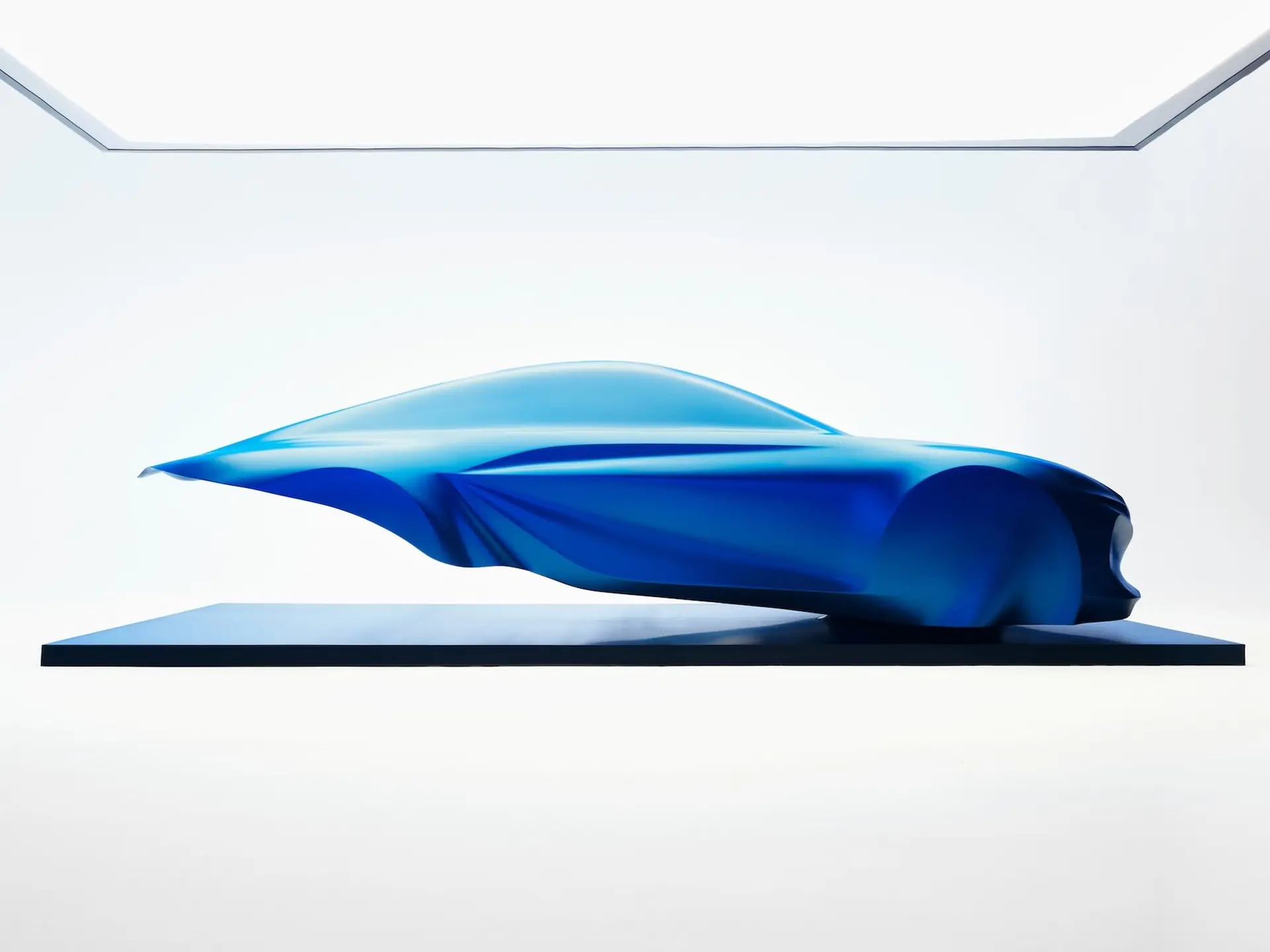
Paris, September 28. Alpine’s big moment for the most important car in its modern history was not a car. It was a full-size sculpture: the new A110’s proportions under a draped blue veil, floating off the ground, styled, design chief Antony Villain said, after Concorde at the moment it breaks the sound barrier. Two weeks later, at the Paris Motor Show on October 12, Formula 1 driver Pierre Gasly helped pull the metaphorical covers off a car that stayed literally covered.
Read it as stalling if you like. But a sculpture is also a promise about shape, and the shape is specific: a V-shaped “shark” nose, a teardrop cabin, four pronounced wheel arches, and, critically, a roofline at essentially the same height as the current car, around 1.25 metres. In an era when electric cars grow tall to hide their batteries, Alpine put a full-size silhouette in Paris and bet the proportions would do the talking.
One fight is already over, and the traditionalists lost it. The A110’s quad round headlights (the face the car has worn since 1962) are gone, replaced by hexagonal light units under a ribbed bonnet. The consolation, and it is a real one: the arrangement survives. Two light units per side, a modernised nod to the four-lamp face rather than a literal recreation. The shape of the lamps changed. The count didn’t. Decide for yourself whether that’s evolution or surrender — the comments section opens soon.
For context, the October 12 Paris show also brought the A310 Vision, a one-off concept reinterpreting the 1971 A310 on the same new platform. It is a design study, not the production 2+2 that’s planned from 2028. Anyone telling you it’s the next A310 is selling you a headline.
21,500 rpm
The motors rev higher than most engines. And they make their own sound.
It's electric. It's heavier. And it's still chasing the lightest car Alpine ever built.
— The Torque Wrench
R04The Outlook
Preview
2027 Alpine A110 EV — November 7, 2026
Full verdict after debut and independent testing
The Bottom Line
Start with what Alpine got right, because it is the list nobody else writes. A bespoke aluminium platform instead of a shared skateboard. A battery split so the driver sits on the floor instead of on the pack. Double wishbones. Two motors with real torque vectoring. A weight target the CEO says out loud, with a number attached, so he can be measured against it. If the electric sports car has a correct answer, it looks a great deal like this spec sheet.
Now the asterisks, because there are several and they are large. The target weight has reportedly not been met. There is no power figure, no confirmed battery size and no price. The reveal was a statue. And hanging over all of it is the platform’s secret: it was designed to take a petrol engine, with the decision due by the end of this year. Alpine is building the future with one hand on the past, because it has read the same sales charts you have.
The petrol A110 was the benchmark: 1,102 kilos and the purest brief of its era. Its replacement will be judged against exactly one number, the one on the homologation sheet. Land at 1,450 and Alpine has built the first electric sports car that understands the assignment. Land at 1,600 and it’s a very clever MG Cyberster. Our money is on Dieppe, but there is no verdict until the car exists.
What we love
- The split battery. Instead of accepting the skateboard’s tall seat, Alpine put 75 percent of the pack behind the driver: the car stays as low as the petrol one.
- Double wishbones all round, kept. In the EV era of struts and excuses, that is a statement of intent.
- Two genuinely independent rear motors with torque reallocation every 10 milliseconds. The rotation toolkit is real.
- Motors that rev to 21,500 rpm and generate their own sound. Somebody in Dieppe still cares about theatre.
- The petrol escape hatch. A CEO saying the platform can take an engine is the most honest sentence in the EV business.
What could be better
- The target is not the car. Alpine wants 1,450 kg; French reporting says it hasn’t been hit yet. The whole verdict waits on that sheet.
- No power figure, no confirmed battery capacity, no price. The three numbers buyers ask about first are all still blank.
- The round headlights are gone. The two-per-side layout survives, but the four-lamp face was the A110’s signature since 1962.
- Due end of 2027, possibly slipping to early 2028, while the petrol car it replaces has been dead since July. That’s a long silence from Dieppe.
- America gets crash tests and a maybe. Alpine’s US plans are frozen everywhere else; the A110 gets believed when it’s announced.
Technical specifications
- Platform
- Alpine Performance Platform (APP) · bonded aluminium · die-cast battery casing
- Battery
- Split pack, ~25% front / ~75% rear · 800V · cell-to-pack · capacity unconfirmed (71.2 kWh reported, single source)
- Powertrain
- Two rear motors, one per wheel · 3-in-1 e-axle · RWD · silicon-carbide inverters
- Motor Speed
- Up to 21,500 rpm
- Power
- Not announced: Krief said “over 500 bhp” at the A390 launch (May 2025, EV Powered); aim reported above 450 bhp; the 345 PS (340 hp) R Ultime “will be comfortably eclipsed” (Krief)
- Torque Vectoring
- Active Torque Vectoring 2.0, reallocates torque every 10 ms
- Chassis
- Double-wishbone suspension all round · 40:60 weight distribution target
- Weight
- Target 1,450 kg · Alpine promises under 1,500 kg (petrol car: 1,102 kg)
- Range
- 600 km (373 miles) range, quoted by CEO Philippe Krief as a target (not yet homologated)
- Charging
- 10–80% in under 15 minutes (Alpine claim) · 400V boost charging
- Body
- Coupé first · roadster follows, the first A110 convertible of the modern generation
- Reveal & Sales
- Full reveal 2027 · due end of 2027 (French reporting expects sales early 2028) · US under evaluation, no decision
- Price
- Not announced: press estimates from ~£60,000 (unconfirmed)
R05Chapter 02
The Battery Is in Two Pieces
Here is the engineering decision the whole car hangs on. Every mainstream EV sits on a skateboard: one flat battery slab under the floor, which forces the seats (and therefore the roof) upward. Alpine refused. The new Alpine Performance Platform, a bespoke bonded-aluminium architecture with a high-pressure die-cast battery casing, splits the pack: roughly 25 percent ahead of the driver, 75 percent behind. A cell-to-pack, 800-volt layout with no module middlemen.
Philippe Krief’s explanation to Autocar was disarmingly simple: the split pack “lets the electric A110 sit as low as the petrol car.” The driver sits in the car, not on it. Weight distribution is targeted at 40:60 front to rear, rear-biased, like a proper mid-engined car, which is what the packaging mimics: the rear battery sits roughly where the petrol engine used to live.
Charging claims are equally un-EV-like in their ambition: 10 to 80 percent in under 15 minutes, Alpine says, with 400-volt boost charging alongside the 800-volt system. One honest blank: capacity. Alpine has confirmed nothing. A single French report (L’Automobile Magazine) claims 71.2 kWh gross with cells from Gotion High-Tech. One source is not a spec, so on this site it stays labelled unconfirmed until Alpine says it out loud.
“Every electric sports car is a weight problem with a motor attached. Alpine is the first company treating the weight as the whole assignment.”
R06Chapter 03
The Weight Audit
Everything about this car is downstream of one number, so let’s audit it properly. The petrol A110 weighed 1,102 kg in base DIN form, the lightest sports car of its generation, the entire point of the car. The electric one targets 1,450 kg, per Krief himself, with an Alpine promise to land under 1,500. That is roughly 350 to 400 kilos of added mass, and no amount of French charm changes the arithmetic.
Two asterisks, both load-bearing. First, L’Automobile reports the 1,450–1,500 kg target has not yet been met, targets are not homologation sheets. Second, Krief is simultaneously quoting 600 km (373 miles) of range as a target (not yet homologated), with the reasoning that “customers won’t accept the easy trade-off of a small battery.” Those two ambitions (1,450 kilos and 600 kilometres) are in a knife fight with each other. Every kilometre of range is paid for in kilograms. Something has to give, and what gives will define the car.
Context, though, because the audit cuts both ways. If Alpine lands anywhere near 1,450 kg, the A110 will weigh some 450 kg less than an MG Cyberster, currently the lightest electric sports car actually on sale, at around 1.9 tonnes. The field isn’t close. The question was never whether the EV would be heavier than the petrol car. Physics settled that. The question is whether 1,450 is real, and Alpine has been unusually willing to say the number out loud, which means it can be held to it.
R07Chapter 04
Two Motors and a 10-Millisecond Referee
The hardware, where it’s confirmed, is the right hardware. Two electric motors at the rear, one per wheel, in a three-in-one e-axle, rear-wheel drive, with the platform also able to support all-wheel drive for bigger siblings. The motors are permanent-magnet units spinning to 21,500 rpm, fed by silicon-carbide inverters, and they generate their own sound. Suspension is double wishbones all round, carried over in philosophy and in fact from the petrol car, in an era when most EVs get struts and an apology.
The referee between the two rear motors is Active Torque Vectoring 2.0, reallocating torque every 10 milliseconds, working with wheel-slip torque control under a central brain Alpine calls the Dynamic Model, which coordinates motors, battery, brakes, steering and aero. On paper, that is the correct shopping list for making 1,450-plus kilos rotate like less.
And this is not a slide deck. The platform has already run: a development mule (new hardware under stretched current-generation bodywork) made its dynamic debut at Goodwood in July, driven up the hill by Gasly. What Alpine has not given anyone is a power figure — with one exception. Reporting from Les Alpinistes puts the aim above 450 bhp, and Krief himself said at the A390 launch in May 2025 that the electric A110 “would produce over 500bhp” (EV Powered). That is the most specific power figure on record, and it is a year old, from a launch event for a different car, so it stays labelled as Krief’s word, not a spec. Krief would otherwise only say there’s “plenty — more than enough,” and that the 345 PS (340 hp) R Ultime, the petrol car’s swansong, “will be comfortably eclipsed.” The 300-to-500 hp range floating around social media is exactly that, floating. It isn’t here.
R08Chapter 05
The Petrol Question
Now the strangest, most honest fact in the modern car industry. Krief again, to Autocar: “Before you ask, yes — the platform is designed to accommodate an internal combustion engine.” The electric A110’s bespoke platform can take petrol. The packaging gives it away: that rear battery sits where an engine used to, and an engine could sit there again. A decision is due by the end of 2026; if it’s yes, a petrol or hybrid A110 follows roughly two years later.
Read the hedge two ways. The cynical read: Alpine doesn’t believe its own EV case. The fairer read: Alpine has looked at the same market as Porsche (whose electric 718 programme has slipped and slipped) and built optionality into the metal instead of the press release. The platform is also planned to serve at least two generations of A110, be joined by the first A110 roadster of the modern generation, and has been through US crash testing as part of a market evaluation. Evaluation, note: there is no US decision, and Alpine’s wider American plans are frozen. Believe an American A110 when it’s announced, not before.
Timeline, pinned down: the full reveal happens in 2027. Alpine says the car is due at the end of 2027; L’Automobile expects first sales to slip into early 2028. The press estimate for price is around £60,000 to start, against £55,000 for the last petrol cars, an estimate, labelled as such, until Alpine publishes a number.