Preview — Renault
Renault Built a 555-HP Electric Rally Car. Then It Charged Supercar Money.
555 hp. Rear-drive. 1,980 numbered cars.
2027 Renault 5 Turbo 3E · October 21, 2026 · Updated November 4, 2026 · The Torque Wrench · Preview
Two in-wheel motors
Powertrain
555hp
Power (410 kW)
4,800Nm
Torque — at the wheels (in-wheel measurement, not crank)
Under 3.5s
0–100 km/h
270km/h
Top Speed (on track)
~1,450kg
Weight (some Renault regional pages list 1,400 kg)
Full disclosure: The Torque Wrench hasn’t driven it — nobody outside Renault has. What exists today is a near-production prototype, an official spec sheet, and a reservation list that is already more than half full. This is the verified breakdown, not a road test.
Renault has done something nobody else in the business would dare do. It took its most beloved rally car (the wide-hipped, mid-engined, sideways-everywhere Renault 5 Turbo) and rebuilt it as an electric car with the motors bolted inside the rear wheels, a handbrake lever standing upright like a rally car’s, and a price tag that starts where Porsche 911s live. Then it limited production to 1,980 numbered cars and watched the order book fill up anyway.
This is either the most cynical nostalgia cash-in of the decade, or the most honest electric performance car ever built. The evidence, so far, points firmly at the second one.
R03Chapter 01
The Motors Live in the Wheels
Start with the hardware, because the hardware is the heresy. The 3E doesn’t have one motor, or two motors on an axle. It has two in-wheel motors (one inside each 20-inch rear wheel) each rated at 200 kW. Combined, Renault’s October 2025 technical sheet lists 410 kW and 555 hp — up from 540 hp at the March 2025 launch. Note the arithmetic: two 200 kW motors make 400 kW (544 PS), so the sheet’s 410 kW is Renault’s own rounding; 410 kW is 557 PS, which Renault quotes as 555 hp. Drive goes to the rear wheels only. There are no driveshafts, no differential, no gearbox. Just two motors, bolted where the wheels are, told what to do by software.
That layout is why the torque figure looks like a typo. Renault quotes 4,800 Nm, but that is torque measured at the wheels, after the in-wheel motors’ gearing, not at a crankshaft. It is not comparable to the 730 Nm of a conventional supercar, and anyone quoting it without that asterisk is either confused or selling something. What it does mean is instantaneous response: no drivetrain between the motor and the tarmac, and each rear wheel controlled independently for torque vectoring.
The platform is bespoke. Alpine’s engineers developed a dedicated aluminium architecture (not a stretched Renault 5 E-Tech floorpan) with a carbon-fibre superstructure on top and the 70 kWh battery under the floor, lowering the centre of gravity. Total weight: around 1,450 kg including the battery — about 170 kg more than a GR Yaris — and it gives the 3E a power-to-weight ratio of 2.6 kg per hp, genuine supercar territory, in a car 4.08 metres long.
One wrinkle, flagged honestly: the power figure looks like it is wobbling, and half the internet is arguing about it: 533, 536, 540, 547, 555, 562 and 563 hp are all in circulation for the same car. Straighten it out and most of the soup is units — and Renault’s own rounding. 400 kW is 536 hp, or 544 PS, which Renault rounded up to ‘540 hp’ at launch; 540 PS is 533 hp; 555 PS is 547 hp; and 563 PS is 555 hp, the current figure. Renault’s October 2025 technical sheet lists 410 kW as ‘555 hp’, but 410 kW is really 550 hp (557 PS) — Renault is quoting PS and calling it hp. The 562 bhp figure in some coverage matches no Renault number and looks like a garbled 563 PS. The final figure lands with homologation: treat 540 as the launch claim and 555 (410 kW) as the current one.
The honest objection is a real one: motors in the wheels means heavy wheels, and unsprung mass is the enemy of ride and response. Analysis pieces since the Paris show have pressed exactly that point, can a wheel carrying its own motor still dance over a broken road? Renault’s counter is control: no driveshaft lag, and torque adjusted at each wheel independently. The 20-inch wheels raise the same eyebrow, until you remember nobody complains about 20s on a GT3 RS. Genius or gimmick stays genuinely open until the first independent drives, and it is the question this car will be judged on.
~1,450 kg
An EV with a 70 kWh battery — some Renault pages list 1,400 kg.
It's a Renault. It's four metres long. And it costs 911 money.
— The Torque Wrench
R04The Outlook
Preview
2027 Renault 5 Turbo 3E — November 4, 2026
Full verdict after debut and independent testing
The Bottom Line
The 5 Turbo 3E is the bravest car Renault has built since the original, and possibly the bravest electric car anyone has built, full stop. In-wheel motors, a rally handbrake, a drift mode, carbon bodywork, 1,450 kg, and a shape that makes grown adults point in the street. Renault didn’t just reboot a legend. It built the electric car the electric era was supposed to produce and then somehow didn’t.
The caveats are real, and they are all the same caveat: nothing here is independently verified yet. No road test, no homologated range, no final power figure, no confirmed delivery date. The price has already climbed from the £135,000 introductory offer toward €160,000, and the options list is where the real damage happens. This is a preview of a promise, not a verdict on a car.
But the promise is the right one. The original 5 Turbo proved a tiny French hatchback could beat the world on the Monte Carlo stages. The 3E’s job is harder: prove the electric era can still do unhinged. If the first drives say it can, the 1,980 cars will look cheap in hindsight. Our money’s on the car, but we’re waiting for the homologation sheet before we judge it.
What we love
- In-wheel motors, rear-drive only, no driveshafts: the most radical drivetrain of any EV on sale or announced.
- 1,450 kg. In an EV. With a 70 kWh battery. The carbon superstructure earns its keep.
- A real vertical rally handbrake and a drift-assist mode. Renault built the toy, not the costume.
- It shares almost nothing with the ordinary Renault 5: tail lights, mirrors, door handles, a cut-down windscreen and the infotainment system.
- The 1982 Tour de Corse livery, available from the factory. Heritage you can actually order.
What could be better
- €160,000 standard, and Renault’s own Group CEO floats €350,000+ for fully personalised builds. Supercar money for a 4-metre Renault.
- Deliveries have slipped from 2027 to early 2028; homologation is still the final hurdle.
- Final power is unconfirmed: 540 hp at launch, 555 hp (410 kW) on Renault’s current technical sheet. Two 200 kW motors make 400 kW (544 PS), so the sheet’s 410 kW is Renault’s own rounding; 410 kW is 557 PS, about 550 hp mechanical. The figure to quote is 555, with Renault’s rounding noted.
- Several hot laps, then a 15-minute charge: track-day rhythm is a charging schedule, not splash-and-go.
- No US sale. Europe, UK, Middle East, Japan, Australia only, Americans get to watch.
Technical specifications
- Powertrain
- Two in-wheel motors, one in each rear wheel · RWD
- Power
- 555 hp (410 kW) per Renault’s October 2025 technical sheet; 540 hp at March 2025 launch; final figures pending homologation
- Torque
- 4,800 Nm at the wheels (in-wheel measurement, not crank)
- 0–100 km/h
- Under 3.5 s
- Top Speed
- 270 km/h (on track)
- Weight
- ~1,450 kg incl. 70 kWh battery (some Renault regional pages list 1,400 kg)
- Battery & Charging
- 70.3 kWh net · 800V · 330 kW DC (15–80% <15 min) · 11 kW AC (~8 h)
- Range
- Over 400 km WLTP (pending homologation)
- Dimensions
- 4,080 × 2,030 × 1,380 mm · wheelbase 2,570 mm · 2-door, 2-seater
- Price & Production
- £135,000 intro (UK) / €155,000 provisional (EU first 500) / €160,000 standard · 1,980 numbered · deliveries early 2028
R05Chapter 02
Built to Go Sideways
Renault’s brief for this car, in its own words, was “a beast of a car built for rallying, drift and track performance, adapted for the road.” The equipment list reads like a rally team’s shopping list: a dedicated drift-assist function inside the Race drive mode, and a tall vertical handbrake lever standing proud between the seats, the kind of lever you pull to lock the rear wheels and rotate the car, not the kind you thumb to hold it on a hill.
The rest of the driver’s toolkit: four drive modes via MULTI-SENSE (Snow, Regular, Sport, and Race), a power-boost button on the steering wheel for overtaking, and four levels of regenerative braking on another button. On track, Renault says the car will run several hot laps at up to 270 km/h before needing a charge. On the road, the WLTP range is quoted at over 400 km, pending homologation, a figure to treat as optimistic until the certificate lands.
Charging is properly quick: an 800-volt architecture, up to 330 kW DC, 15 to 80 percent in about 15 minutes. Renault’s consumer pages still list 350 kW; the October 2025 technical sheet says 330 kW. AC charging is a more ordinary 11 kW, around eight hours for a full charge. Bidirectional charging (V2L and V2G) comes via Mobilize. The honest asterisk is the track-day one: several hot laps, then a 15-minute charge is a different rhythm from a petrol track car’s five-minute splash-and-go. The 3E is a track toy with a charging schedule, and buyers should know that going in. Renault, via What Car?’s March 2025 launch coverage, put flat-out track running at roughly 15 to 20 minutes before the battery calls time, reported, not certified, but plan your track day around it either way.
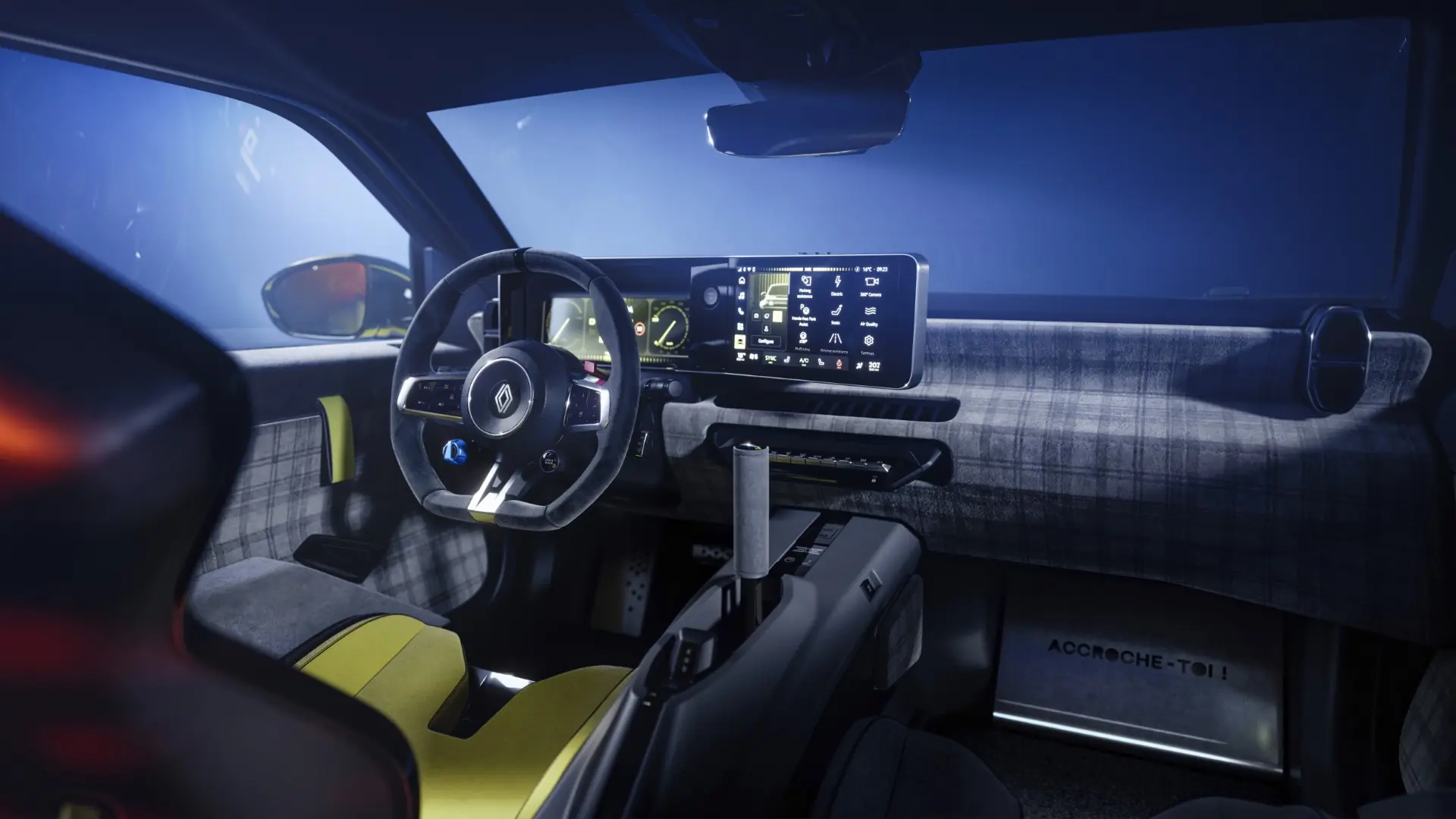
Inside, it is a two-seater with bucket seats and six-point harnesses, carbon and Alcantara trim, and a pair of OpenR screens (10.1 and 10.25 inches) running an interface inspired by the original Turbo’s dashboard, with Google built in. The boot, Renault insists, still holds luggage. For a car shaped like this, that counts as a practicality flex.
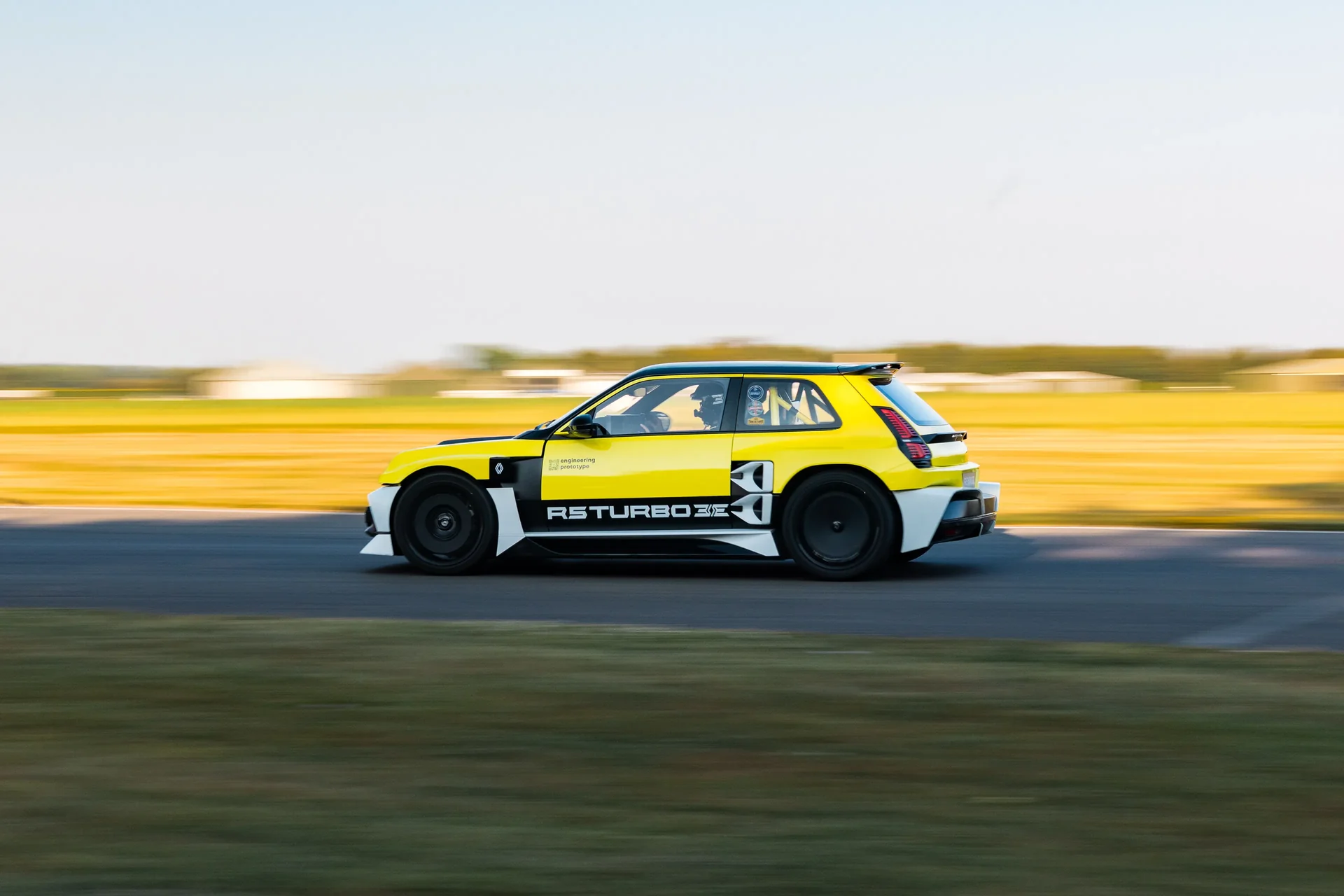
“Renault didn’t build an electric hot hatch. It built a rally car with a charging port.”
R06Chapter 03
The Ghost of 1980
The original Renault 5 Turbo arrived in 1980 as a homologation special: Renault took a front-engine, front-drive city car, threw the engine behind the seats, and built a mid-engined, rear-drive rally weapon with box wheel-arch flares wide enough to park a bicycle in. The road car made 160 PS from a 1,397 cc turbo four. The rally cars made up to 350 PS in Maxi Turbo form. On its very first World Rally Championship outing, Jean Ragnotti won the 1981 Monte Carlo Rally, then won the Tour de Corse in 1982 and again in 1985, that time in the Maxi Turbo. Renault built 4,987 road cars, and every one of them is a collector’s item now.
And yes — the name. Half the internet is currently shouting “how can an EV be called Turbo?” into comment threads, so settle it the way this site settles everything: with the record. Turbo on this car is not a parts description; it is a surname. The 1980 Turbo and the Turbo 2 after it are the lineage, and Renault is hardly the first to carry a badge past its literal meaning, Porsche sells an electric Taycan Turbo and nobody pickets Stuttgart. If the name still bothers you, the comments are coming soon — when they open, argue with the Wrench.
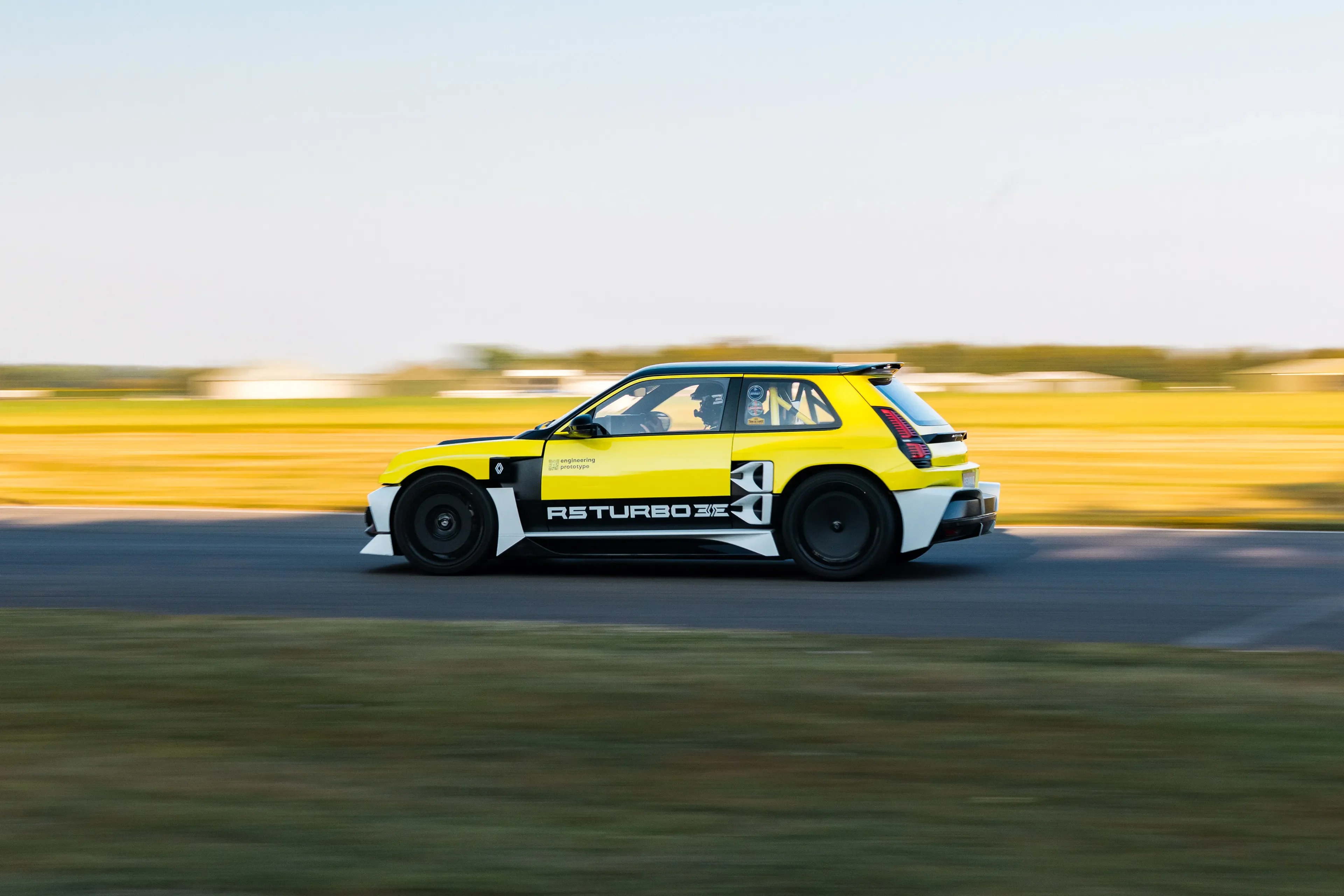
The 3E wears that history openly. The square headlights fused to the bonnet edge, the side scoops in the rear wings, the surround running from the windscreen pillars into the rear spoiler, all of it is the 1980 car, redrawn for the electric era. The historic liveries return too, including the black, yellow, and white racing colours from the 1982 Tour de Corse car, plus the Rouge Grenade red of the production originals. Buyers who want something nobody else has can sit with Renault’s designers and spec a fully bespoke livery, a process Renault is happy to charge for.
But the 3E is not a restomod. It shares just its tail lights, exterior mirrors, door handles, a cut-down windscreen and the infotainment system with the ordinary Renault 5 E-Tech. Everything else (the platform, the body, the motors, the mission) is its own. The original Turbo existed because Renault needed a rally car. The 3E exists because Renault wanted to prove the electric era could still produce something unhinged. The lineage is real, and so is the difference.
R07Chapter 04
The Price of Nostalgia
Here is where the romance meets the spreadsheet. The first 500 reservation holders were offered a provisional introductory price (£135,000 in the UK, €155,000 in Europe) before options. The standard price is €160,000. And the personalisation programme (which opens in mid-2027) is where the numbers get silly: Renault Group CEO François Provost himself expects fully personalised examples to exceed €350,000. That figure is a ceiling for bespoke builds, not the car’s price, whatever the comment threads say. For a Renault. For a car 4 metres long. Let that sink in.
And before the outrage hardens: this complaint is 46 years old. In 1980, a normal Renault 5 cost about 33,000 francs. The Turbo cost 115,000, three and a half times the price of the car it was based on. Renault has always charged supercar money for the tiny car with the wide hips. The 3E is the tradition, not the betrayal.
The scarcity is genuine. Production is capped at 1,980 numbered cars (a tribute to the original’s 1980 launch year) built at Alpine’s Dieppe plant, and buyers can choose their number. By the Paris show in October 2026, Renault executives were quoting over 1,100 reservations, and project leader Michael Grosjean has described the car as effectively sold out until 2028, a deep order book, even if the “sold out” headlines are running ahead of the facts. The first 500 signatories got the introductory price; everyone else pays whatever the market (and the options list) decides.
And the timeline has slipped. Renault’s original release promised showrooms in the course of 2027. October 2026 reporting says the full tailor-made configuration programme doesn’t start until mid-2027, with first deliveries now expected from early 2028, homologation is the final hurdle. The 2027 in the name is the model year; the cars themselves land in 2028. That is not a disaster for a car like this; it is the normal rhythm of low-volume exotica. But anyone who reserved one expecting a 2027 delivery should read the small print again.
What would change the read? Two things. First, homologation: until the WLTP range and the final power figure are certified, every number in this preview is Renault’s word, not a test. Second, the first independent drives. The 3E’s whole case rests on feel (the in-wheel motors, the handbrake, the drift mode) and feel is the one thing a spec sheet cannot prove. If the first drives say it drives like a rally car, the price will look like a bargain in hindsight. If they say it drives like a fast appliance with a costume, the nostalgia premium collapses.