Preview — Porsche
Porsche Deleted the Engine. The Boxster Got a Fake One.
Sub-3 seconds. 800 volts. No engine — and a button that fakes one.
Porsche 718 Boxster EV · November 24, 2026 · The Torque Wrench · Preview
< 3 s
0–100 km/h, top model (Porsche)
250+ km/h
Top speed (Porsche)
800 V
E-Core battery, behind the seats
40/60
Weight distribution, front/rear
7
Virtual PDK gears in E-Shift
Q1 2027
World premiere
Full disclosure: The Torque Wrench hasn't driven it — nobody outside Porsche has. The prototype drives went live on November 24, 2026, the moment the embargo lifted, and the production car doesn't premiere until the first quarter of 2027. What follows is the verified breakdown: which numbers are Porsche's word, which are reported, and which are still just estimates.
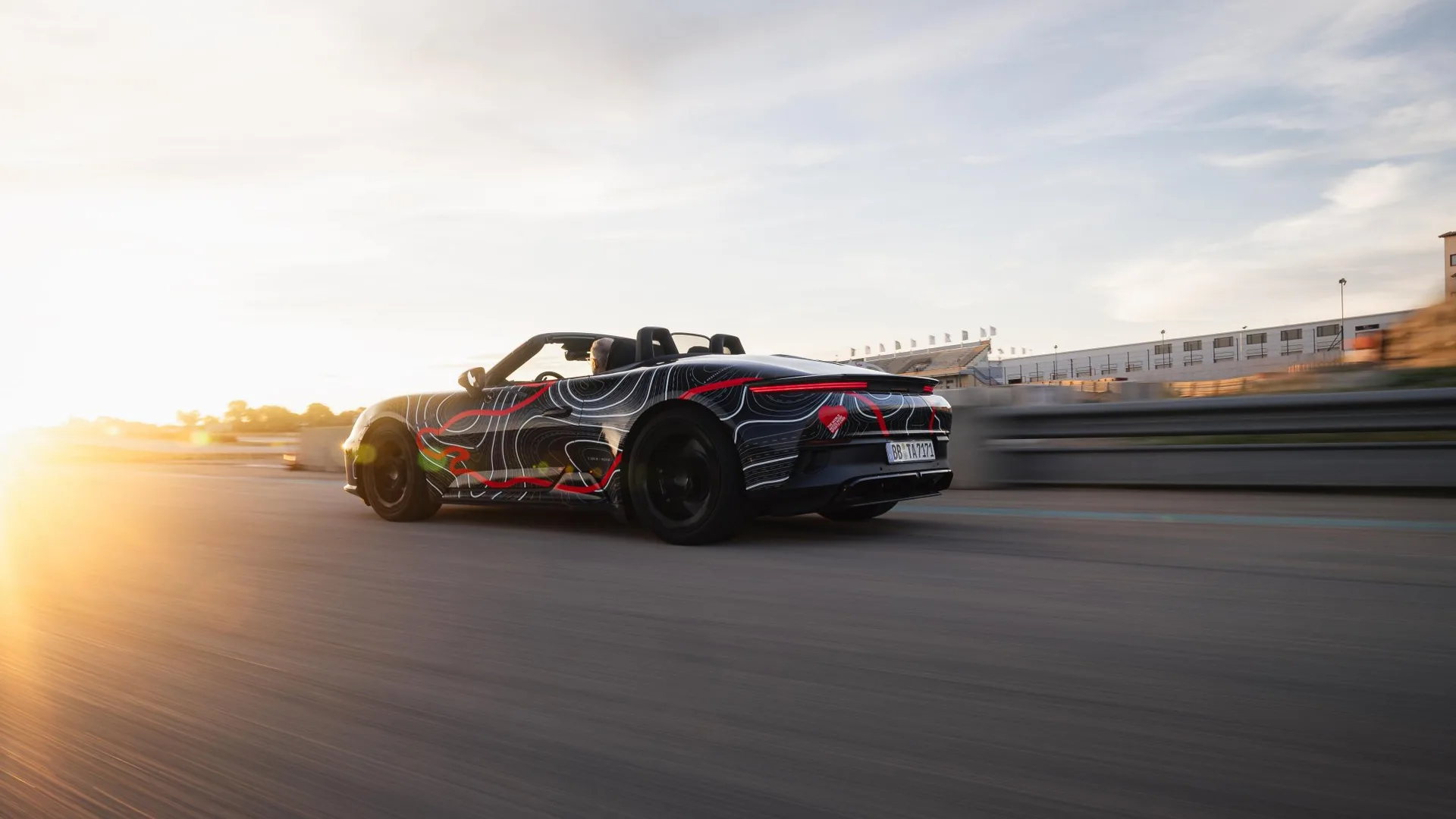
The news, straight: Porsche has built its first all-electric two-door sports car, and it is a Boxster — the 983 generation, rear-wheel drive on every version, with an 800-volt battery mounted behind the seats where the engine used to live. The top model does 0–100 km/h in under three seconds and tops out at over 250 km/h, and Porsche says it will be the most powerful 718 ever. Then there is the part everyone is arguing about: E-Shift, standard on every car, a virtual seven-speed PDK with steering-wheel paddles and a faithfully recreated flat-six soundtrack, modelled on the 981 Boxster GTS. Porsche deleted the engine. Then it faked one.
And the question that makes this car worth a whole story: is the fake engine the cleverest thing Porsche has ever done, or the first time the company blinked? The answer is in what the drivers said — including the ones who went in as sceptics. The boss of Porsche didn't believe it until he drove it. Walter Röhrl told them to build it. When the doubters inside the building fold, the rest of us should pay attention.
R03Chapter 01
The Battery Where the Engine Used to Be
Start with the packaging, because it is the whole car. Every other electric sports car puts the battery under the floor, and every one of them sits too high and weighs too much in the wrong places. Porsche refused. The 718's 800-volt pack sits directly behind the seats, in the space the combustion engine used to occupy — an architecture Porsche calls E-Core, built specifically for this car. The result is a 40/60 weight distribution, a low seating position, and a centre of gravity Porsche says is lower than the old Boxster's and lower than the Taycan's. The weight is concentrated towards the middle of the vehicle, exactly where a mid-engined car wants it.
The numbers Porsche will actually say out loud: about four million test kilometres across more than 20 countries, in temperatures from minus 30 in Sweden to 51 degrees in Death Valley, from 86 metres below sea level to 2,750 metres up, charging on five different standards. The weight is the number Porsche won't say — only that intelligent lightweight construction keeps it similar to the current 911 Cabriolet models with the T-Hybrid powertrain. One drive report estimates around 1,700 kg kerb. That is the honest version: a Boxster that weighs about as much as a 911, which is either a triumph of packaging or the end of the Boxster being the light one.
The chassis is where Porsche spent the money it saved on the engine. The steering comes from the 911 Carrera GTS. Rear-axle steering arrives on a 718 for the first time. The electronically controlled PTV+ limited-slip differential, the wheel-and-tyre dimensions and the braking system are all 911 parts. Up front, MacPherson struts remain; at the rear, the suspension was redesigned with GTS components. Porsche also claims greater structural rigidity than any convertible it has previously produced. The message is unsubtle: the electric Boxster is not a science project bolted to a 718 body. It is a 911 underneath, wearing a Boxster's shape.
800 V
E-Core battery behind the seats — where the engine used to live, and why the Boxster still sits low and mid-engined.
Porsche deleted the engine. The Boxster got a fake one. The drivers came back grinning.
— The Torque Wrench
R04The Outlook
Preview
Porsche 718 Boxster EV — November 24, 2026
Full verdict after debut and independent testing
The Verdict Before the Verdict
So what would make the electric Boxster a success? Three things, and they are all still unproven. First, the range: an electric sports car that can't do a road trip is a track toy with a charging cable, and Porsche hasn't said a word about it. Second, the price: under $100,000 to start is a promise, and the top model's real sticker is the test — past $120,000 with options, it starts competing with the 911 it borrows its chassis from. Third, the sound: whether owners keep E-Shift on after the first month, or turn it off, forget the button exists, and drive the car as the quiet electric sports car it actually is.
And what would sink it? The same list, read backwards. A range number that embarrasses the spec sheet. A price that makes the 911 look like value. A fake soundtrack that ages like a ringtone. And the quietest risk of all: that Porsche built the car its engineers wanted and its customers only admire — the fate of every clever EV that forgot people buy sports cars with their ears as well as their feet.
What Torque Authority will track, in order: the Q1 2027 premiere, the official power, battery, range and weight figures, the first independent test, and the Cayman. Until then, this is a preview of a promise — a Boxster with no engine, a battery where the engine lived, a fake flat-six on a button, and a chassis borrowed from the 911. Porsche deleted the engine and faked the noise. The drivers came back grinning. Tighten it 'til it sings.
What we love
- The battery placement. Behind the seats, not under the floor — 40/60, a low seating position, and a mid-engined Boxster that happens to be electric.
- E-Shift, done properly. Seven virtual gears, real paddles, and performance identical whether it is on or off — a toy that doesn't cost you speed.
- The chassis is a 911's. GTS steering, rear-axle steering for the first time on a 718, PTV+ diff — Porsche raided the parts bin that matters.
- The sceptics converted. Leiters didn't believe it until he drove it. Röhrl told them to build it. When the doubters inside Porsche fold, pay attention.
- Two models, under $100,000 to start. The entry point to Porsche's two-door world stays reachable — on Porsche's word, via Edmunds.
What could be better
- The sound is a recording. A faithfully recreated 981 flat-six is still a recording — and the day someone makes E-Shift play something else is the day the joke writes itself.
- No power figure. 'Most powerful 718 ever' is a claim, not a number. Porsche knows the output. It just isn't telling.
- No range, no battery size, no weight. The three numbers every EV buyer asks first are all still blank.
- The weight question. 'Similar to a 911 Cabriolet' is doing a lot of work — a Boxster that weighs as much as a 911 is a Boxster that gave up its lightest trick.
- The Cayman question. The Boxster goes first; the coupe follows on the same platform — and nobody has said what the coupe gives up or gains.
Technical specifications
- Powertrain
- Single electric motor, rear-wheel drive — all models (Porsche)
- Power
- Not published — Porsche says the most powerful 718 ever; one prototype test (ADAC, via Notebookcheck) reports over 500 hp
- Performance
- 0–100 km/h under 3 s (top model), top speed over 250 km/h (155 mph) (Porsche)
- Battery
- 800-volt E-Core pack mounted behind the seats — capacity not announced (Porsche)
- Weight
- Not published — Porsche says similar to a 911 Cabriolet with T-Hybrid; WhichCar estimates around 1,700 kg kerb
- Chassis
- Steering from the 911 Carrera GTS; rear-axle steering (first on a 718); PTV+ limited-slip differential; wheels, tyres and brakes from the 911 (Porsche)
- E-Shift
- Standard on all models — virtual seven-speed PDK with steering-wheel paddles and a recreated 981 Boxster GTS flat-six sound; paddles select three recuperation stages when E-Shift is off (Porsche)
- Price
- Under $100,000 starting (Porsche, via Edmunds); top model estimated $110,000–$120,000 (MotorTrend estimate)
- Range
- Not announced (Porsche)
- Availability
- World premiere Q1 2027; built at Stuttgart-Zuffenhausen; two models at launch (Porsche; Edmunds)
R05Chapter 02
The Fake Flat-Six
Now the part everyone is shouting about. E-Shift is standard on every electric 718 Boxster, and it does two things at once. At the touch of a button it activates a virtual seven-speed PDK transmission — steering-wheel paddles, simulated gear changes, the characteristics varying by driving mode — and it plays the faithfully recreated sound of a six-cylinder boxer engine, based on the 981-generation Boxster GTS. Porsche's own condition for the trick: performance is identical whether E-Shift is on or off. The fake gears cost you nothing. When E-Shift is off, the paddles do something honest instead — three stages of recuperation.
In its standard setting the car is remarkably quiet, with a selectable E-Sound that hums like the Taycan's futuristic soundtrack. The 981 impression only arrives when you ask for it. That distinction matters, because it is the difference between a car that lies to you and a car that offers you a joke. The people who drove it keep saying the same thing: the paddles, the torque interruption between virtual gears, the sound rising with the revs — it feels like shifting. Walter Röhrl, who has forgotten more about driving than most of us will ever learn, said the car gives him more feedback than he has ever experienced in any other all-electric car. Röhrl is not easily impressed. He is also not paid to be.
Here is the honest objection, and it is a good one: a recording is a recording. The day someone works out how to make E-Shift play something else — a V8, a ringtone, a laugh track — the whole idea becomes a meme. Porsche knows this. That is why the fake sound is optional, why the performance doesn't depend on it, and why the car underneath is engineered to be good with the button off. The sound is the argument. The chassis is the answer.
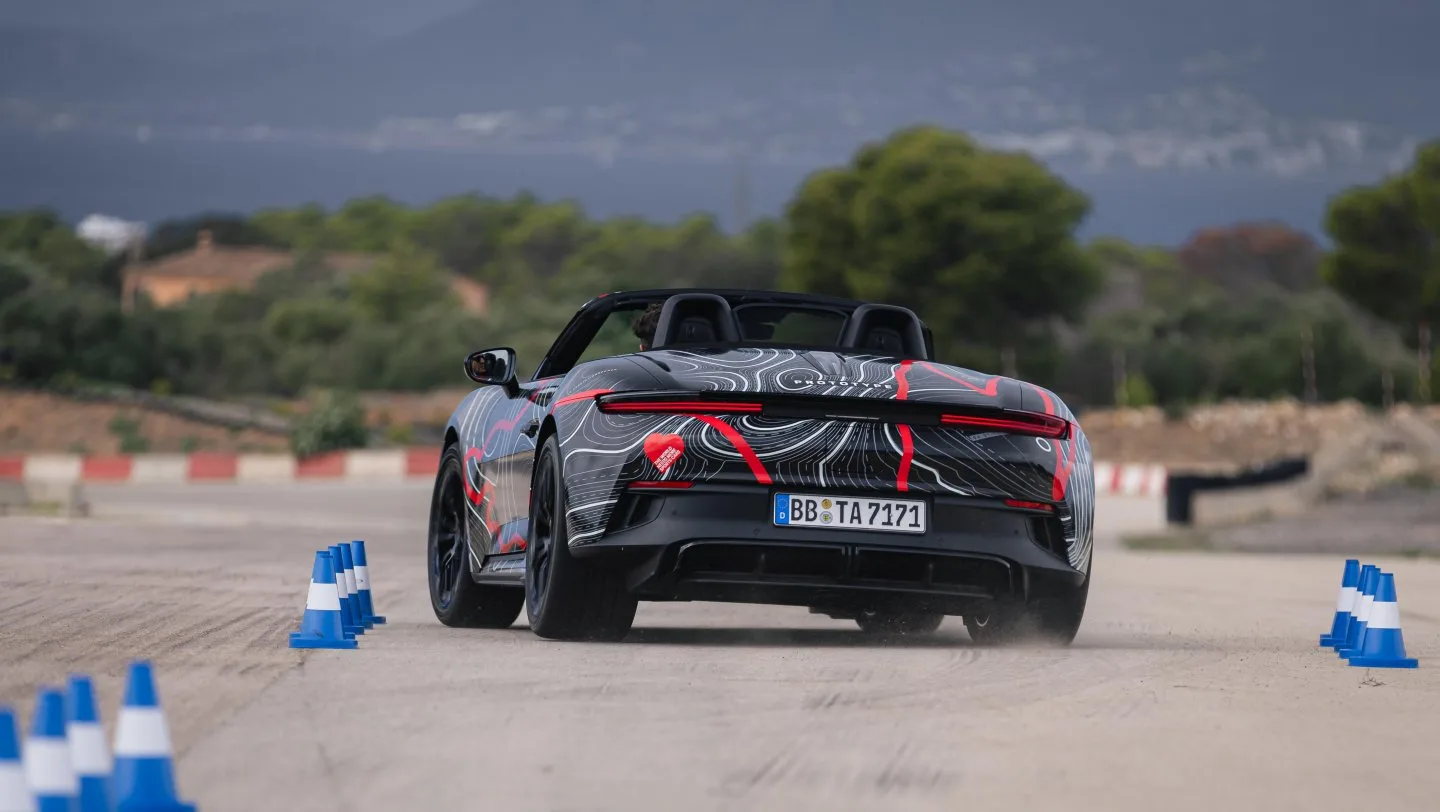
“Porsche took the engine out and put a recording in. The scandal is that it works.”
R06Chapter 03
The EV That Almost Wasn't
This car nearly didn't happen — at least, not like this. The 983-generation 718 was originally due last year, when the combustion cars went out of production. It slipped: battery-cell supply problems, uncertain demand for electric sports cars, and a plan inside Porsche to hedge the bet by offering combustion power in the top variants, adapting the new architecture to fit an engine. Then Michael Leiters took over as chief executive, drove a development car for validation, and killed the hedge. The 718 launches as purely electric. Leiters put it plainly: 'Being very honest, I was very, very sceptical about this vehicle. But that only lasted until I drove a development car for validation. Since then, I've been thrilled. It is an absolutely fantastic sports car.'
That U-turn is the real story of this car, and it is why the prototype drives matter more than usual. Porsche didn't just build an electric Boxster. It built one, doubted it, nearly diluted it, then bet the nameplate on it. The drives in Mallorca and Los Angeles were the first time anyone outside the company got to test whether the bet pays — six laps at the Porsche Experience Center in Carson, four laps at Llucmajor, a 75-minute passenger ride down a canyon road. The verdict from the seats so far is consistent: the steering, the braking, the weight transfer — it feels like a Boxster. The only trick is the optional rear-axle steering, and the only argument is the sound.
There is a second car hiding in this story, too. The Cayman shares the platform — Autocar reports both 718 models arrive in 2027 on the same bespoke PPE Sport architecture, which will also underpin the production version of the Audi Concept C. The Boxster goes first, roof down, in the spotlight. The coupe follows. What the Cayman gains or loses on the same bones is a story for the premiere.
R07Chapter 04
What We Still Don't Know
Here is the list that should make any buyer pause, and it is a long one. Porsche has not published a power figure — only that the car will be the most powerful 718 ever. One prototype test, by ADAC and reported by Notebookcheck, puts peak output above 500 hp. The previous most powerful 718, the Cayman GT4 RS, made 493 hp. So the new car is quicker than the GT4 RS and nobody outside Porsche knows by how much. The battery capacity is unpublished. The range is unpublished. The weight is unpublished. The three numbers every EV buyer asks first are all blank, and they stay blank until the premiere.
The price is half-known. Porsche says the car will start at under $100,000, with two models at launch — the cheaper one under six figures, the more powerful one above it. MotorTrend, which drove the more powerful car, estimates $110,000 to $120,000 for it, based on what the last combustion Boxster GTS cost plus inflation. That is an estimate, not a price, and it is labelled as one. The full numbers — power, battery, range, weight, price — arrive with the world premiere in the first quarter of 2027, at Porsche's main plant in Stuttgart-Zuffenhausen, where the car is built.
Until then, this is a preview of a promise — a Boxster with no engine, a battery where the engine lived, a fake flat-six on a button, and a chassis borrowed from the 911. The drivers who tried it came back grinning, including the ones who arrived as sceptics. The numbers that would settle the argument are still in Stuttgart. Spring 2027 will tell us whether the grin survives the spec sheet.