
Explainer — Porsche vs Ford
The GTD Is Faster. The GT3 Is Better.
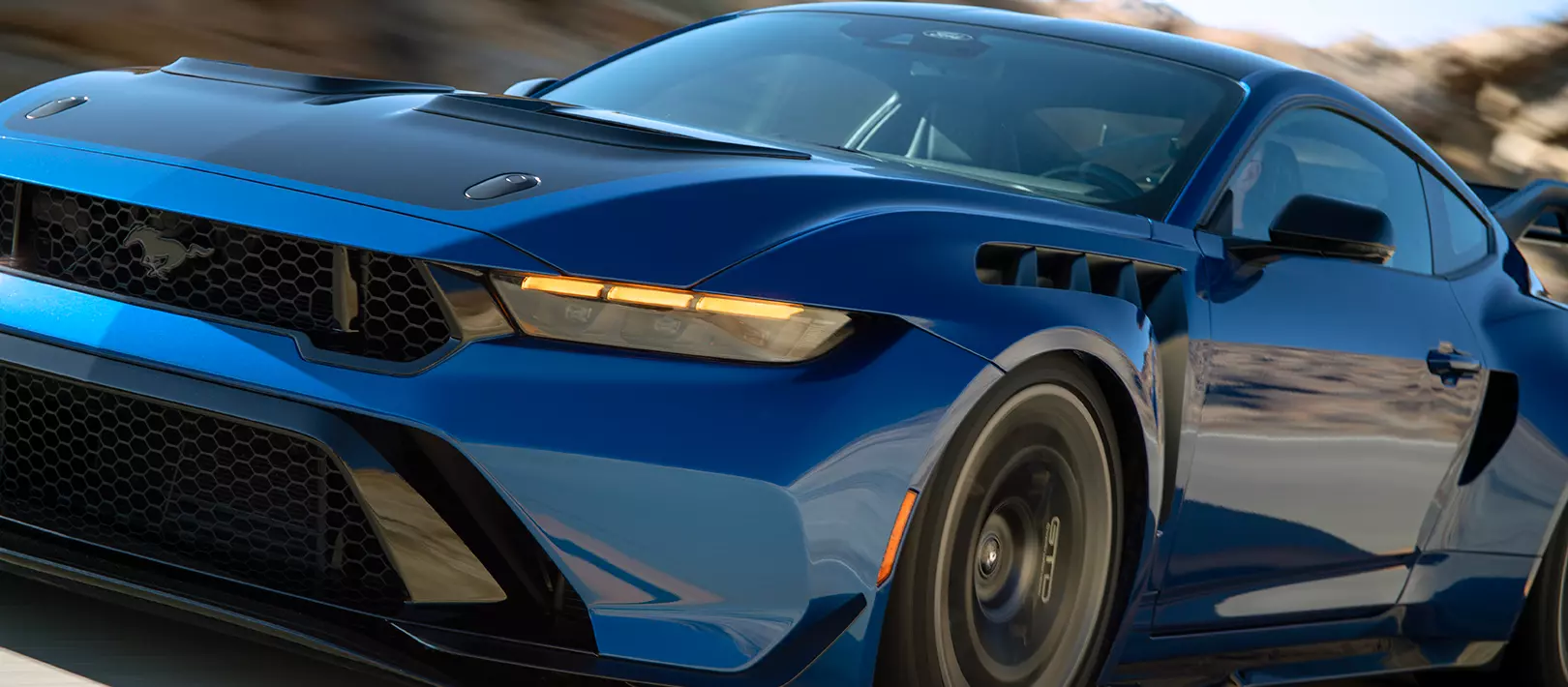
The GTD wins the lap. The GT3 wins the car.
Porsche 911 GT3 S/C vs Ford Mustang GTD · November 16, 2026 · Updated November 17, 2026 · The Torque Wrench · Explainer
502 hp
GT3 S/C · 4.0L flat-6
815 hp
GTD · 5.2L supercharged V8
6:52.072
GTD Nürburgring
6:56.294
GT3 coupe Nürburgring
3,322 lbs
GT3 S/C weight
$52,610
Sticker gap — $92,610 as-tested
Full disclosure: The Torque Wrench hasn't driven either of these cars — this is the verified head-to-head, not a road test. Every number below is sourced, every lap time is an official Nürburgring figure, and the places where the record books refuse to give a straight answer are the whole point of the piece.
Here is the fight in one paragraph. The Ford Mustang GTD has 815 hp, a supercharged V8, a dual-clutch transaxle, and a 6:52.072 at the Nürburgring. The Porsche 911 GT3 S/C has 502 hp, a naturally aspirated flat-six that revs to 9,000 rpm, a six-speed manual, no roof, and a 6:56.294 — set by its hardtop brother, because the convertible has never lapped the Ring at all. The Ford is faster on the stopwatch, quicker to 60, faster at the top end, and $52,610 more expensive. The Porsche is 1,064 lbs lighter and, by this site's verdict, the better car.
So this is not a close call on paper. It is a close call in the real world, where the stopwatch is not the whole argument. This is the duel, the asterisk, and the verdict.
R03Chapter 01
The Numbers, Before the Noise
Get the scoreboard out of the way first, because it is lopsided and it matters. The GTD wins almost every line of it. Then we will talk about the two lines it loses, because those are the ones that decide the verdict.
01
Power
GTD 815 hp · GT3 S/C 502 hp. The Ford has 313 more horses.
02
0–60 mph
GTD 2.8 s (Car and Driver, tested) · GT3 S/C 3.7 s (Porsche). Nine tenths.
03
Top speed
GTD 202 mph (manufacturer claim) · GT3 S/C 194 mph.
04
Nürburgring
GTD 6:52.072 · GT3 6:56.294 (coupe). The Ford is 4.222 seconds quicker around 20.832 km.
05
Weight
GT3 S/C 3,322 lbs · GTD 4,386 lbs. The Porsche is 1,064 lbs lighter.
06
Price
GT3 S/C $275,350 including delivery · GTD $327,960 on the Monroney. The Porsche is $52,610 cheaper.
1,064 lbs
The weight gap. The GTD carries more than half a ton extra into every corner — the whole argument, in one number.
The GTD wins the stopwatch. The GT3 wins the car. And the stopwatch was never the whole argument.
— The Torque Wrench
R04The verdict
Verdict
Porsche 911 GT3 S/C vs Ford Mustang GTD — November 17, 2026
Comparison
The Verdict
On the stopwatch, the Ford wins. The GTD's 6:52.072 is 4.222 seconds clear of the GT3's best lap, it hits 60 mph nine tenths sooner, and it tops out 8 mph higher. If the only question is which car is faster, the answer is the Mustang, and it is not close.
But the stopwatch was never the only question, and this is where the Porsche takes the verdict. The GT3 S/C is 1,064 lbs lighter, $52,610 cheaper — $92,610 cheaper against the GTD as tested — and it is the only car here with a manual gearbox and a naturally aspirated engine that revs to 9,000 rpm with no roof between you and it. The GTD wins the numbers. The GT3 wins the car.
Four seconds on a 13-mile lap is real, and it is also the smallest gap in this whole fight. The weight gap is there on every corner of every road you will ever drive. The price gap is there on the day you sign. The manual and the flat-six are there every time you start the engine. The lap time is there once, on a track in Germany, in a car you do not own.
And that is the verdict: the GT3 S/C is the car you buy with your ears — the one we would still take the keys to. The stopwatch says Ford. The scales say Porsche. The chequebook says Porsche. The gearbox says Porsche. The engine says Porsche.
Winner: the Porsche 911 GT3 S/C. Buy the GTD because it is the maddest Mustang ever built. Buy the GT3 S/C because it is the better car — and because when the last naturally aspirated flat-six with a manual and no roof is gone, no lap time will bring it back.
What we love
- A 502-hp manual convertible against an 815-hp supercharged Mustang — and the stopwatch can't settle it.
- The GTD's 6:52.072 is a genuine production-class lap, not a prototype special.
- The GT3's 6:56.294 is the fastest manual production lap ever recorded.
- 1,064 lbs apart, $52,610 apart, and still an argument worth having.
- Both cars are the last of something — the GT3's engine is living on borrowed time, the GTD is the maddest Mustang ever built.
What could be better
- The S/C has never lapped the Nürburgring — the 6:56.294 belongs to the hardtop coupe, and the convertible is heavier.
- The GTD Competition's 6:40.835 sits in the prototype class and is excluded from the production comparison by our own rules.
- The $40,000 Performance Package was developed for the record attempt, but Ford has not confirmed whether the Nürburgring lap car was equipped with it.
- No head-to-head on the same day in the same conditions — the duel is fought on paper, not on track.
- The GTD is the most expensive way to go this fast — the Corvette ZR1X is quicker than the standard GTD for about $100,000 less.
Technical specifications
- Power
- GT3 S/C 502 hp · GTD 815 hp
- Torque
- GT3 S/C 331 lb-ft · GTD 664 lb-ft
- 0–60 mph
- GT3 S/C 3.7 s · GTD 2.8 s (Car and Driver)
- Top speed
- GT3 S/C 194 mph · GTD 202 mph (mfr claim)
- Nürburgring
- GT3 6:56.294 (coupe, manual) · GTD 6:52.072
- Weight
- GT3 S/C 3,322 lbs · GTD 4,386 lbs
- Gearbox
- GT3 S/C 6-speed manual only · GTD 8-speed DCT transaxle
- Price
- GT3 S/C $275,350 list · GTD $367,960 as-tested ($327,960 Monroney; $92,610 gap, Ford as-tested vs Porsche list)
R05Chapter 02
The Lap: 4.222 Seconds, and an Asterisk of Our Own
The GTD's 6:52.072 is real, official, and production-class — Dirk Müller, April 9, 2025, second attempt, on the full 20.832 km layout. It is the fastest American production lap in the Nürburgring's Sports category, and it deserves the respect it gets. The GT3's 6:56.294 is equally real — Jörg Bergmeister, April 8, 2025, notary-supervised, in a manual GT3 coupe with the Weissach package, the fastest lap ever recorded by a production car with a manual gearbox. The gap is 4.222 seconds.
Now the asterisk of our own, because honesty cuts both ways. The 6:56.294 belongs to the hardtop GT3 coupe. The S/C convertible has never set an official Nürburgring lap — Porsche has not run one, and nobody else has either. The S/C is 44 lbs heavier than the base GT3 coupe — 79 lbs heavier than the manual coupe that set the lap — and has no roof, so its lap would be slower than 6:56.294, not faster. We are comparing the GTD against the GT3's best lap, not the S/C's lap, because the S/C does not have one. The 4.222-second gap is the most generous reading of the Porsche's case, and the GTD still wins it.
And the lap you are thinking of — the GTD Competition's 6:40.835 — does not count here, by our own rules. It sits in the Nürburgring's Prototype / Pre-Production class, because the Competition is a limited, serialized special edition, not a full-production car. Ford will not say what it makes beyond 815 hp or what it costs. The full duel over that lap, stopwatch and argument both, is in our America at the Ring head-to-head. This piece compares the cars you can actually buy, on the laps they actually set as production cars.
One more number, because it nearly breaks the Ford's case on its own. In November 2025, the 992.2 GT3 with the Manthey Kit — a dealer-fitted aero and suspension package, same 502 hp — lapped the Ring in 6:52.981 with DTM champion Ayhancan Güven, in damp conditions, with Porsche saying it will go back in better weather. It went back: on April 15, 2026, in better conditions, Güven lapped in 6:50.863 — 1.209 seconds quicker than the GTD. A bolt-on kit on the cheaper, lighter, manual car now beats Ford's 815-hp flagship outright. The GTD's lap is a great number. It is not an untouchable one.
“The GTD wins the stopwatch. The GT3 wins the car.”
R06Chapter 03
The Weight: 1,064 lbs Is Not a Number, It's a Personality
The GTD carries 4,386 lbs. The GT3 S/C carries 3,322. That is 1,064 lbs — more than half a ton, roughly the weight of a grand piano, or a very large motorcycle, or four adult passengers the Porsche simply does not have to haul around.
Yes, the GTD's power-to-weight is still better on paper: 5.38 lbs per horsepower against the Porsche's 6.62. That is why it wins the straights, the 0–60, and the lap. But power-to-weight only describes acceleration. Weight describes everything else: how the car changes direction, how it stops, how it talks to you through the wheel, how tired the tyres get by lap three. The GTD hides its mass brilliantly — Multimatic pushrod suspension, DSSV dampers, 885 kg of downforce at 180 mph — but 4,386 lbs is still 4,386 lbs, and the bill for it comes due in the slow corners, exactly where the GTD's own review admits the second lap found its gains everywhere except.
The Porsche's weight is not an accident. It is the entire design brief. Carbon-fibre bonnet, wings and doors from the S/T. Magnesium roof parts, magnesium centre-lock wheels, carbon-ceramic brakes as standard. Porsche fought for every pound and then took the roof off anyway. The GTD's weight is the price of its ambition: a supercharged V8, a transaxle, active aero hydraulics, cooling for all of it. One car was built to be light. The other was built to be fast despite being heavy. Only one of those briefs survives contact with a mountain road.
R07Chapter 04
The Engines: Screaming vs Supercharged
The GT3 S/C's engine is the same 4.0-litre naturally aspirated flat-six Porsche fits to the GT3 RS and the 911 S/T. In the S/C it makes 502 hp, down from the RS's 518, because emissions rules forced two particulate filters and four catalytic converters onto it. It still revs to 9,000 rpm. That is the whole point, and Porsche's own GT boss has said this engine is living on borrowed time in Europe. Cars like this do not get replaced. They get remembered.
The GTD's engine is the 5.2-litre Predator V8 from the GT500, revised with a new intake, a smaller supercharger pulley, a titanium Akrapovič exhaust, and — a first for any Mustang — a dry-sump oil system. 815 hp at 7,400 rpm, 664 lb-ft, revving to 7,650 rpm. It is a hammer, and it is magnificent, and it is also the reason the car weighs what it weighs and costs what it costs.
Here is the difference that matters. The Ford's engine wins the argument you have with a stopwatch. The Porsche's engine wins the argument you have with yourself at 8,500 rpm with the roof down and nothing between you and the noise except air. One of those arguments ends. The other one is the reason you bought the car.
And the gearbox settles it. The S/C is manual-only — six speeds, short ratios from the S/T, no PDK offered at any price. The GTD is an eight-speed dual-clutch transaxle, and it is brilliant at its job, and it will never ask you to do anything. The Porsche demands your left foot and your attention. The Ford demands your wallet. Only one of those is a compliment.
R08Chapter 05
The Money: $52,610 Buys a Lot of Argument
Base price is $273,000 plus $2,350 delivery for the Porsche — $275,350 including delivery, before a single option. The Ford's Monroney says $327,960: a $318,760 base plus $5,500 destination and a $3,700 gas-guzzler tax. The gap is $52,610, and that is before the GTD's options start.
The option that matters on the Ford is the $40,000 Performance Package — active aero and magnesium wheels — and Car and Driver's test car had it, priced at $367,960 as tested. The package was developed for the record attempt, per Ford CEO Jim Farley, and Ford has never published the Ring car's option spec. So the honest price to quote next to the 6:52.072 is $367,960, not $327,960 — and against that number, the Porsche is $92,610 cheaper.
The Porsche's build sheet is kinder. The expensive hardware — magnesium wheels, carbon-ceramic brakes, carbon bodywork — is standard, not optional. Price the equivalent hardtop GT3 coupe with the same kit — $235,800 coupe plus $20,350 Lightweight package, $17,840 magnesium wheels and $10,370 carbon-ceramic brakes, plus $2,350 delivery — and you land at $286,710; the S/C is, on the numbers, a discount on its own hardware. (The $5,020 leather interior is a separate trim option, not part of this performance kit — it belongs to Porsche's larger equivalent-hardtop basket, with the $14,000 cabriolet body.) The Ford's build sheet runs the other way: Carbon Series around $428,000, Spirit of America around $429,000, and one buyer told The Smoking Tire his fully optioned car passed $600,000.
Fifty-two thousand dollars buys a lot of argument. It buys a second car. It buys a decade of track days. It buys the difference between the car that wins the lap and the car that wins the drive — and still leaves change.
R09Chapter 06
The Drive You Actually Get
Strip away the lap times and here is what each car actually gives you. The GTD gives you a Mustang with a dry-sump V8, a transaxle, pushrod suspension, and active aero, built by the people who build Ford's GT3 race cars. It drops 40 mm at the front and 30 mm at the rear in Track Mode, it makes 885 kg of downforce at 180 mph, and it is the maddest Mustang ever built. Nothing else with a blue oval on it has ever been this serious.
The S/C gives you the last of something. A naturally aspirated flat-six that revs to 9,000 rpm, a manual gearbox, and no roof between you and either. It is slower to 60 than the PDK hardtop, heavier than the hardtop, and $37,200 more than the hardtop — and it is still the car you would take the keys to, because some cars you buy with your head and this one you buy with your ears.
The GTD is the car you buy to win an argument at a bar. The GT3 S/C is the car you buy to end one on a mountain road. The GTD proves American muscle can compete globally, and that alone deserves respect. The Porsche proves that lightness, a manual, and an engine that screams are still worth more than 313 horsepower and four seconds on a 13-mile lap.
Both cars are the last of something. The GTD is the end of the line for the supercharged American V8 as a track weapon. The S/C is the end of the line for the naturally aspirated flat-six with a manual and no roof. Only one of them is also the lightest, the cheapest, and the car we would still take the keys to.