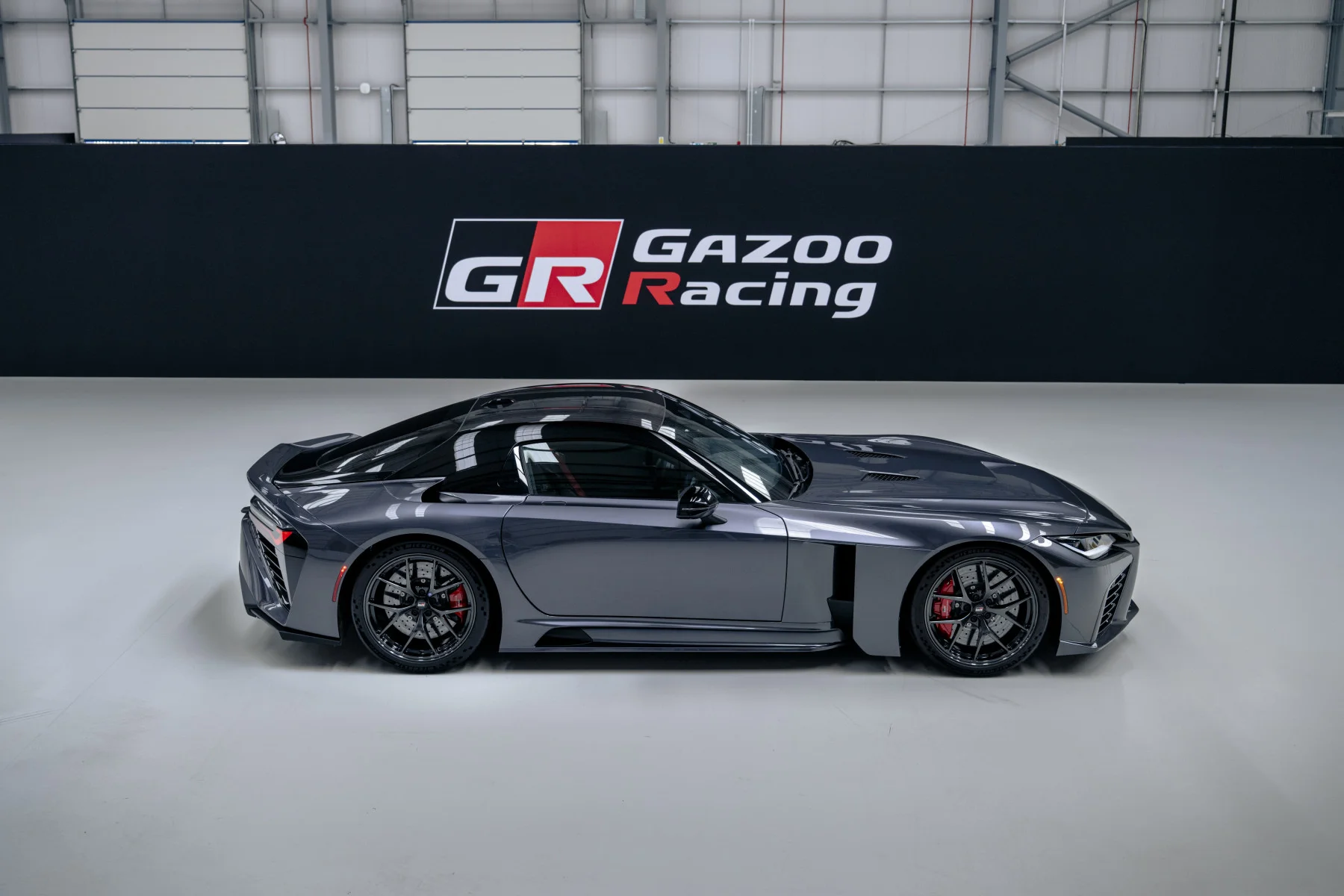
Preview — Toyota
Toyota Built a V8 Supercar. Then It Started Interviewing Its Buyers.
641 hp V8 hybrid. 320+ km/h. Launch around 2027.
2027 Toyota GR GT · October 16, 2026 · Updated November 7, 2026 · The Torque Wrench · Preview
4.0L
Powertrain
650PS
Power (641 hp) or greater (Toyota target)
850Nm
Torque (627 lb-ft) or greater (Toyota target)
8-speed auto
Transmission
320km/h
Top Speed (199 mph) or greater (Toyota target)
1,750kg
Kerb Weight (3,858 lb) or lower (Toyota target)
Full disclosure: The Torque Wrench hasn’t driven it — nobody outside Toyota has. What exists today is a running prototype, a table of development targets, and a world premiere. This is the verified breakdown, not a road test.
Toyota is the company that spent the 2010s telling you the future was a hybrid crossover. It is also the company that has now built a front-engine, rear-drive supercar around a brand-new twin-turbo V8, developed a GT3 racer from the same bones, and — if reports of ~$225,000 prove right — priced the result in 911 GT3 territory. One of those Toyotas is lying. It is not the one with the V8.
The GR GT is the most interesting car Toyota has built since the LFA, and the most revealing. Not because of what it promises, but because of how Toyota is selling it: first allocation oversubscribed, buyers vetted, flippers told to get lost. Toyota didn’t just build a supercar. It built a velvet rope.
R03Chapter 01
The Engine Toyota Swore It Would Never Build
Start with the hardware, because the hardware is the heresy. The GR GT’s 4.0-litre twin-turbo V8 (engine code G40E, per Wikipedia — Toyota’s release doesn’t name it) is newly developed, a clean-sheet design. Hot-V turbos, one in each bank. Dry-sump lubrication. A short-stroke 87.5 by 83.1 mm bore and stroke chosen to keep the engine low and the bonnet lower. Toyota, the patron saint of the sensible hybrid, just engineered a clean-sheet V8 designed to survive future emissions rules for years. The spreadsheet people lost. Beautifully.
The hybrid half is a single motor-generator integrated into the rear transaxle, ahead of a new eight-speed automatic with a wet starting clutch instead of a torque converter. Power travels from the front-mounted V8 through a carbon-fibre torque tube to that transaxle, which also houses a mechanical limited-slip differential. The motor fills torque during shifts and turbo lag, smoothing, not replacing. Combined target: 650 PS (641 hp) or greater, 850 Nm (627 lb-ft) or greater.
Read that word again: target. Toyota’s own December 2025 release labels every figure in the GR GT’s spec table a “prototype development target, in-house measurement,” and warns that details are subject to change. The 650 PS, the 1,750 kg, the 320 km/h, all of them are Toyota’s aims, not homologated facts. That honesty is rare. It also means this preview treats every number as a promise, not a result.
One more thing Toyota will tell you: it tuned the exhaust. The brief was a sharp, race-inspired V8 note that responds to how the car is being driven. In an era when most flagships pipe in synthesized noise, Toyota spent engineering hours on the sound of actual combustion leaving actual pipes. The priorities here are correct.
641 hp
From a brand-new twin-turbo V8.
It's a Toyota. It's got a V8. And you have to apply to buy one.
— The Torque Wrench
R04The Outlook
Preview
2027 Toyota GR GT — November 7, 2026
Full verdict after debut and independent testing
The Bottom Line
The GR GT is the most interesting car Toyota has built since the LFA, and the easiest to root for. A clean-sheet V8, a race car developed in parallel, a cockpit full of real buttons, and a company that tuned the exhaust before it tuned the marketing. The targets are ambitious but credible, Toyota showed a running prototype, named its caveats, and put its chairman’s philosophy on the spec sheet. That is not how companies launch vaporware.
The caveats are real, and they are all the same caveat: nothing here is final. The power, the weight, the top speed, the price, every one of them is a target or a report, and the car you apply to buy is not the car that will arrive in 2027. If Toyota hits its own numbers, the GR GT won’t just be the best Toyota ever built. It’ll be the car that made Stuttgart look over its shoulder.
And if it doesn’t? Then the interview was the product all along, and the velvet rope was the point. We don’t think so. Toyota has been rebuilding this shrine for four years. Our money’s on the car, but we’re waiting for the homologation sheet before we judge it.
What we love
- A brand-new Toyota V8 in 2026. The spreadsheet people lost.
- Race car first, road car second: the GR GT exists because the GT3 car needed homologation. That is the correct order.
- Proper supercar architecture: front-mid-engine, rear transaxle, carbon torque tube, 45:55 distribution, mechanical LSD.
- Physical buttons, toggles, and a shift-light cluster in the cockpit: no touchscreen maze, no menu diving at 200 km/h.
- Toyota tuned the exhaust for a real V8 note instead of synthesizing one. Priorities: correct.
What could be better
- Every figure is a Toyota development target: nothing homologated, nothing independently verified yet.
- Around $225,000 reported, unconfirmed by Toyota: 911 GT3 money for a first-generation flagship.
- First allocation oversubscribed, and Toyota vets buyers. Most readers will never get the chance to say no.
- Toyota has published no 0–100 km/h time, no battery capacity, no electric-only capability: the hybrid half of the story is untold.
- The 1,750 kg weight target is heavy for a car whose brief is “low weight with high rigidity”, the hybrid hardware has a cost.
Technical specifications
- Powertrain
- 4.0L twin-turbo V8 + transaxle-integrated hybrid motor · RWD
- Power
- 650 PS (641 hp) or greater (Toyota target)
- Torque
- 850 Nm (627 lb-ft) or greater (Toyota target)
- Transmission
- 8-speed auto, wet starting clutch, rear transaxle, mechanical LSD
- Top Speed
- 320 km/h (199 mph) or greater (Toyota target)
- Kerb Weight
- 1,750 kg (3,858 lb) or lower (Toyota target)
- Chassis
- Aluminium space frame · CFRP + aluminium panels · double-wishbone all round
- Brakes & Tyres
- Brembo carbon-ceramic · Michelin Pilot Sport Cup 2 (265/35ZR20 F, 325/30ZR20 R)
- Dimensions
- 4,820 × 2,000 × 1,195 mm · wheelbase 2,725 mm · 45:55 distribution
- Price & Sales
- ~$225,000 (reported, unconfirmed) · from 2027 · US via select Lexus dealers
R05Chapter 02
A Race Car With Number Plates
The GR GT did not start life as a road car. It started in January 2022 as the GR GT3 Concept at the Tokyo Auto Salon, a racing-dedicated concept with a long bonnet, a huge rear wing, and no production car underneath it. The logic was backwards from the usual: build the racer first, then earn the right to sell the road car by homologation. GT3 rules demand a production-based car, so the GR GT exists because the GT3 car needed it to.
The road car and the racer were developed in parallel. Camouflaged prototypes ran at the Goodwood Festival of Speed in July 2025, and the finished pair premiered on December 5, 2025, alongside the electric Lexus LFA Concept. The GT3 version keeps the 4.0-litre biturbo V8 and drops the hybrid entirely (GT3 regulations don’t allow it) riding on Rays centre-lock wheels with a side-exit exhaust and far more aggressive aero. The road car keeps the motor. That split tells you exactly what the hybrid is: a road-car compromise for drivability and emissions, not racing hardware.
Underneath, Toyota claims its first all-aluminium space frame (large cast and extruded sections bonded together) wrapped in aluminium fenders and doors with carbon-fibre-reinforced plastic for the bonnet, roof, and rear deck. Double wishbones at all four corners, forged aluminium arms mounted low. Brembo carbon-ceramic discs. Michelin Pilot Sport Cup 2s developed for the car: 265/35ZR20 front, 325/30ZR20 rear. Front-mid-engine layout, 45:55 weight distribution, stability control adapted from Toyota’s Le Mans programme. The spec sheet reads like a GT3 car’s CV because it is one.
And the shape follows: a long bonnet, NACA ducts in it, vents behind the wheels to manage brake heat, a deployable ducktail spoiler that adds downforce without piling on drag, and quad exhausts placed to help thermal management. Every surface serves a purpose, which is the polite way of saying the GR GT was designed in a wind tunnel with a styling department allowed to watch.
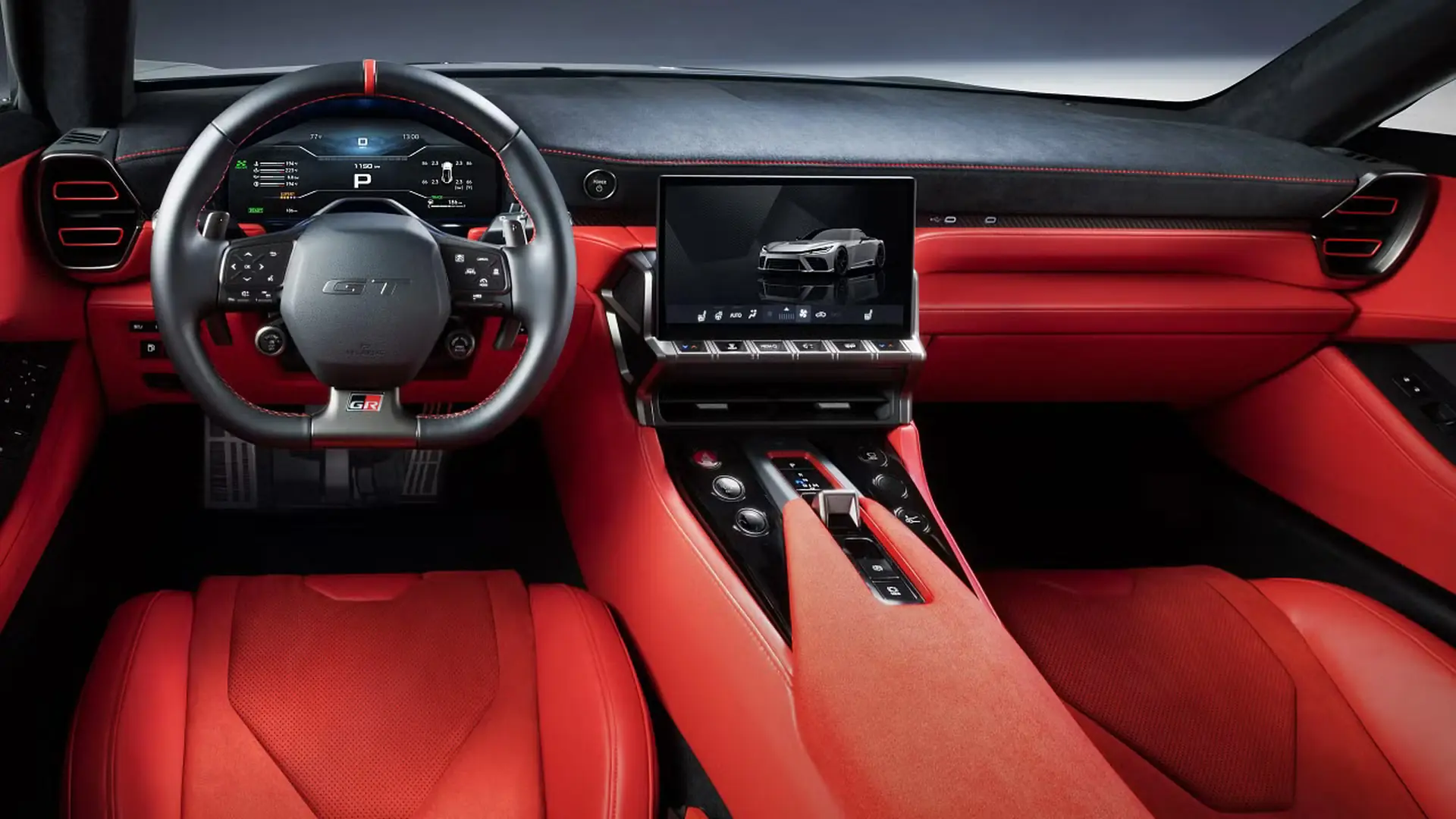
“The GR GT isn’t Toyota going upmarket. It’s Toyota admitting the race car was the point all along.”
R06Chapter 03
The Ghosts in the Room
Toyota premiered the GR GT with two ghosts on stage. The first is the 2000GT, the 1967 halo that proved Japan could build a world-class sports car. The second is the Lexus LFA, the V10 masterpiece built from 2010 to 2012 in a run of 500 cars at $375,000 each, a car Toyota lost money on and gained immortality from. Toyota’s framing was explicit: the GR GT, the GR GT3, and the LFA Concept are flagships in the manner of those two cars.
The LFA connection is more than framing. Engineers from the original LFA programme were brought back to pass on their experience, and chairman Akio Toyoda (the man who drove the company back toward cars people actually want) worked closely with the team. Toyota even gave the project a philosophy: “Shikinen Sengu,” the Shinto ritual of periodically rebuilding a shrine to pass craft to the next generation. The GR GT is, in Toyota’s telling, a shrine rebuilt, a way to hand the secret sauce of car-making to engineers who never got to build a V10.
The details back up the theatre. The GR GT carries no Toyota badges, inside or out. It is a GR car, full stop, the clearest statement yet that Gazoo Racing is becoming its own performance brand. And in the United States it won’t even be sold in Toyota showrooms: it goes through select Lexus dealers, the same channel that once sold the LFA. Toyota is asking you to think of this car as an heir, not a trim level.
R07Chapter 04
The Interview
Here is where the GR GT story gets properly strange. Toyota has not confirmed a price. Reports point to around $225,000 in the US, several times the price of a Supra, in 911 GT3 territory, and the most expensive production Toyota ever built, above even the Century SUV. Toyota’s own project manager reportedly pointed to today’s GT3-class cars as the pricing reference. For a first-generation flagship from a brand new to this price class, that is a lot of confidence to ask of a buyer.
And Toyota is not asking just anyone. Senior vice president Andrew Gilleland told The Drive that the first allocation is already sold, and that Toyota won’t have enough to meet demand “by design.” Toyota later clarified that nothing was actually pre-sold — only that interest exceeded the first allocation — and no names are tied to cars. The company is vetting buyers, matching them with “GR Meisters,” and filtering out flippers. As one executive put it: it’s going to feel like an interview process for a customer. The GR GT is a car you apply for.
What would change the read? Two things to watch. First, the rumored variants: Japanese media reports suggest an open-air targa reviving the Mk IV Supra’s “Aero Top” name, and a spied track-focused prototype has been photographed chasing a 911 GT3 RS, but both are unconfirmed, and Toyota has said nothing on the record. Second, the numbers: until Toyota homologates the car, every figure in this preview is a target. If production cars land in 2027 at 650 PS and 1,750 kg, the GR GT is the real thing. If they don’t, the interview will look like theatre.