Issue Nº 02 — Autumn 2026
R01Verified — Tesla
Tesla Says the Roadster Flies. The Honest Answer Is Shorter: It Hops.
Tesla Roadster: The Flight Claims · November 6, 2026 · Preview
Explainer, no score. It hops, flips, and jumps — on ten cold-gas thrusters, for about five seconds a charge. Sustained flight is unproven.
0–60 mph — claim vs demonstration
0.59
s
Rocket claim, Tesla target
vs
0.81
s
Demo run, Tesla’s own timer
The 0.59-second figure belongs to the one-seat, invite-only Rocket trim. The 0.81-second run came from a driverless prototype at McGregor, Texas, and has not been independently timed.
0.59s
Rocket 0–60 claim
0.81s
Demo 0–60 run
10
Cold-gas thrusters
600L
Compressed air
80kN
Rear thrust, reported
2028
Production target
Full disclosure: The Torque Wrench hasn’t driven it — nobody has. The car that performed in Texas drove itself, with a mannequin in a SpaceX spacesuit at the wheel, and the version that flies cannot legally use a public road. This is the verified explainer, not a road test. The full breakdown of the car itself lives in our Tesla Roadster preview.
Three weeks after the stunt, the argument is not about what happened. The footage is real — Snopes rated it true — and the car really did leave the ground. The argument is about the verb. Tesla says the Roadster flies. The Smithsonian’s curator of vertical flight, asked before the event, said: “We are literally talking about hopping.” One charge of the thrusters lasts about five to six seconds. That is the whole flight envelope, and everything else is marketing.
Then there is the number. Under 0.59 seconds to 60 mph, attached to the one-seat Rocket trim — a car you cannot buy, cannot drive on a road, and cannot sit in with a passenger. The number Tesla actually demonstrated, on its own timer, was 0.81 seconds. Top Gear’s take, published November 2, put the gap between those two numbers at the centre of the story. This explainer takes the claim apart, piece by piece, and tells you exactly which parts are shown, which are promised, and which are just physics homework.
R03Chapter 01
What Tesla Actually Showed in Texas
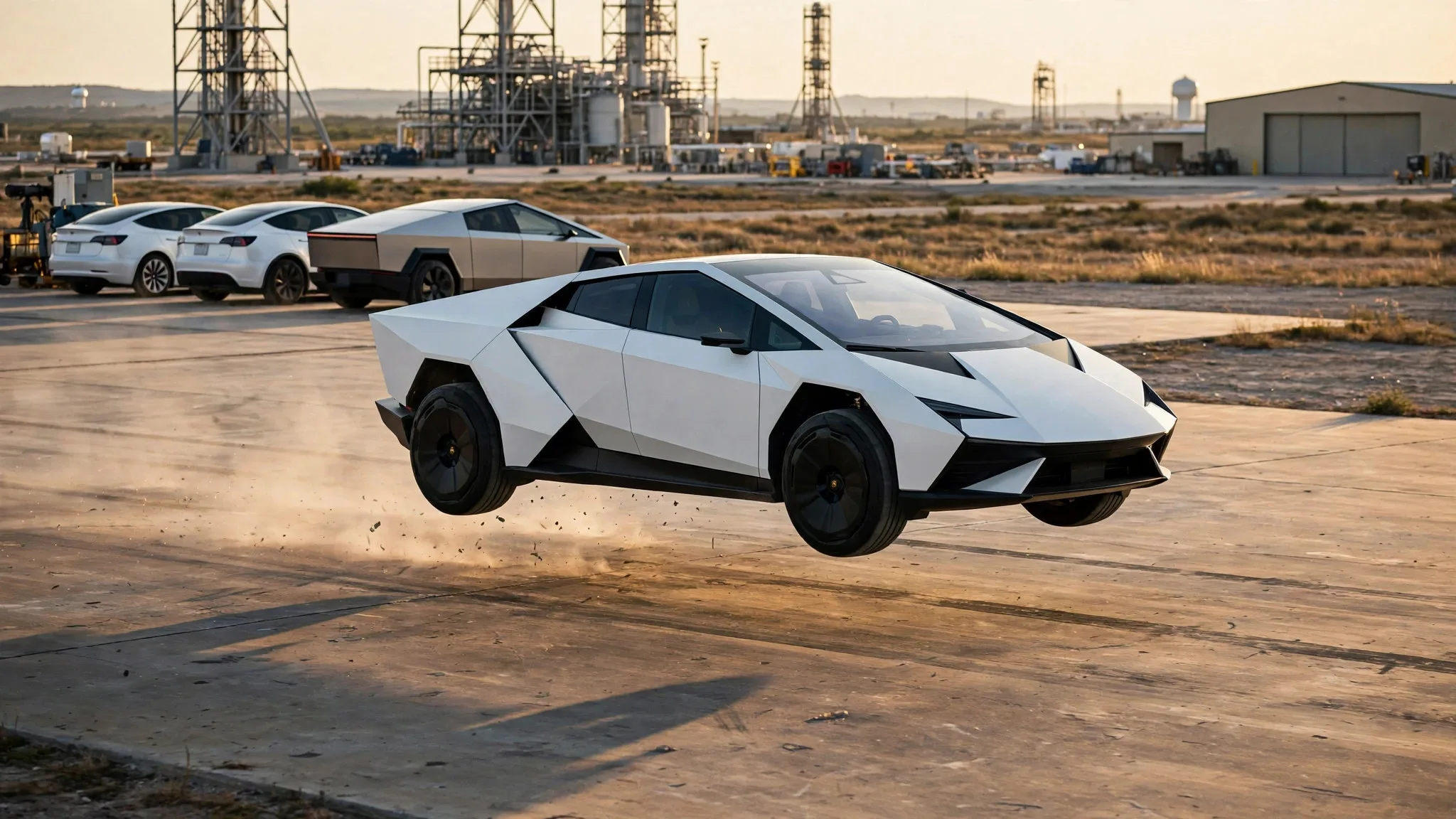
Start with the night itself, because the footage looks fake and Tesla knew it. October 15, 2026, 7:55 pm Central, at SpaceX’s rocket test facility in McGregor, Texas — an event already postponed once from October 1, when severe weather made the outdoor venue unusable. The car drove up a curved ramp until it was upside down, held to the surface by fan suction. It flipped in mid-air on bursts of compressed gas and landed back on the tarmac. Then the kickflip: a driverless jump clean over a lineup of Teslas — a Model 3, a Model Y, a Cybertruck, a Semi, and a Cybercab — with a mid-air roll on the way down. Engineering vice president Lars Moravy called it a kickflip. Musk told the crowd the car was uncrewed “to make sure we don’t kill anyone.”
Two facts keep the stunt honest. First, it was real. Snopes rated the videos true: the demo was livestreamed, filmed by attendees, and shows no sign of AI or editing. Aviation Week, reporting the day after, described a multimode suction system plus cold-gas thrusters developed with SpaceX, and a short hop flown without a human passenger, including an axial roll. Second, it was a stunt, not a test. The car performed driverless, with a mannequin in a SpaceX spacesuit in the driver’s seat, on a closed test site, in front of a friendly crowd. Nobody outside Tesla has timed, weighed, or measured anything about it. What was shown is spectacular. What was proven is narrow: the hardware works once, on a stage.
The third fact is the one Tesla would rather you skip. The car that flew is not the car you can buy. The flying version is the Rocket: one seat, ten perimeter thrusters, invite-only, and — per Tesla’s own site — not approved for public road use. The road car is the Performance trim, two seats, no thrusters, 0–60 claimed under 1.6 seconds. The demo merged all three trims into one image in the public mind, and that merge is doing most of the marketing work.
5–6 s
One charge of the thrusters lasts about five to six seconds, per InsideEVs. That is the flight envelope.
A hop is not a flight. A 0.59-second claim is not a 0.59-second car.
— The Torque Wrench
R04The verdict
Preview
Tesla Roadster: The Flight Claims — November 6, 2026
No score yet — full verdict after debut
The Bottom Line
Start with what is real, because it is easy to lose it in the smoke. A car drove upside down on a ramp, flipped in mid-air, and jumped five other cars, in front of a crowd, with compressed air and fans. That is not a rendering. It is not AI. Snopes rated the footage true, Aviation Week confirmed the hardware, and the physics checks out: cold gas plus suction is a real engineering solution to a problem nobody asked to be solved. Tesla built the car that flies before building the car you can buy, and the flying part — the hop, the flip, the landing — actually happened.
Now the asterisks, because they are the story. The 0.59-second figure is a target for a trim you cannot buy, and Tesla’s own numbers disagree about it by a tenth and a half. The only timed run, 0.81 seconds, was measured by the seller. One charge of the thrusters lasts five seconds. The flying version cannot use a public road, has no FAA sign-off, and has no published height, distance, or duration. And the car underneath it all — the Performance, the one with a road and a reservation page — has never been driven in public by anyone, ever.
So the verdict is a line, drawn in the air, five seconds long. On one side of it: a hop, which is extraordinary. On the other: flight, which is still a promise. The Roadster does not need to fly to matter — a car that out-accelerates its own tyres and lands a backflip on stage has already earned its place in history. But words matter too, and “flies” is doing more work than five seconds of thrust can support. It hops. That is already extraordinary. Flying is a different promise, and it is still unkept.
What we love
- The stunt happened in front of a crowd, driverless, with no safety net. A backflip that fails in public is a disaster; Tesla did it anyway. That is the kind of nerve the car business runs on.
- The suction fan as real engineering. Downforce without wings, grip without drag — if 2G holds up, it is a genuine idea, not a gimmick, and it works in a parking lot.
- Cold gas, not combustion. No fuel, no flame, no explosion risk — the thruster system is the sane version of a mad idea, and the tank refills between runs.
- Top Gear asking the right question. The 0.59-second figure is a target for a car almost nobody can buy; saying so out loud is what journalism is for.
- The Snake River Canyon dare. Evel Knievel’s gorge, a car with thrusters, and a CEO willing to say it on stage: the showmanship is the point, and the point is glorious.
What could be better
- No independent timing. The 0.81-second run was timed by the company selling the car. Nothing in this story has been measured by anyone else.
- Three numbers for one claim. 0.59, 0.55, 0.67 — Tesla’s own figures do not agree with each other, and nobody at Tesla has explained the spread.
- Five seconds a charge. One thruster fill buys a hop, a flip, and a landing. After that the flying car is a heavy EV waiting for a refill.
- The Rocket cannot be bought or driven on a road. The version that flies is invite-only, single-seat, and not road-approved: the headline act is not a product.
- No flight data published. No height, no distance, no duration — Tesla has shown a hop and called it flight, and the regulators have not signed off on either word.
Technical specifications
- Reveal / demo
- October 15, 2026, 7:55 pm CDT · SpaceX rocket test facility, McGregor, Texas (postponed from October 1 due to severe weather)
- Demo 0–60 mph
- 0.81 s on Tesla’s own timer, thrusters firing, driverless prototype · 0.67 s with rollout subtracted (one report) · not independently timed
- Rocket claim
- Under 0.59 s (Tesla target) · Electrek lists 0.55 s — outlets disagree, Tesla has not reconciled the figures
- Trim claims
- Performance under 1.6 s · Thrust under 0.9 s · Rocket under 0.59 s (all Tesla claims, unverified)
- Thrusters
- 10 cold-gas nozzles · ~600 litres compressed air in carbon-fibre overwrapped pressure vessels (COPVs) · reported working pressure 10,000 psi · tank rechargeable
- Rear thrust
- Over 80 kN from the four rear thrusters (Moravy, October 21 — reported)
- Flight envelope
- One thruster charge ≈ 5–6 seconds (InsideEVs, reported) · Tesla has published no height, distance or duration
- Suction downforce
- Fan-based underbody system, up to 2G (reported)
- Road legality
- Rocket invite-only, single seat, NOT approved for public road use (Tesla) · no FAA sign-off reported
- Production / money
- 2028 target (Musk) · no final price announced · deposits $50,000 Performance / $250,000 Thrust
R05Chapter 02
The 0.59-Second Number, Taken Apart
Here is the number, and here is the gap. Tesla attaches “under 0.59 seconds” to the Rocket trim. What Tesla demonstrated, on its own timer, in front of the crowd, was 0.81 seconds. One report puts the demo run at 0.67 seconds with rollout subtracted — the standard drag-strip fudge that deletes the first foot of motion — without saying which version made the run. Electrek lists 0.55 seconds for the Rocket. So the claim is 0.59, the reported variants are 0.55 and 0.67, and the only timed run anyone has seen is 0.81. Tesla has not reconciled its own numbers, and until it does, “0.59” is a target with a fan club, not a figure.
Now the physics, because the number is only possible if you stop trusting the tyres. Sixty miles per hour in 0.59 seconds means an average of about 4.6g of acceleration. A road tyre on tarmac tops out around 1.3g of grip before it gives up; the independently verified benchmark, the Rimac Nevera at 1.74 seconds, is already near the edge of what rubber can do. The Roadster cheats, legitimately: the thrusters push the car forward with gas, not grip, so the tyre limit stops applying. That is the whole trick, and it is a real one — a car that accelerates partly like a rocket is allowed to post rocket numbers. But it also means the 0.59 figure is a thruster number, not a car number, and it only exists while the tanks have air in them.
Top Gear’s November 2 take is the clearest framing of the gap so far: the 0.59-second figure is a target for a trim most buyers will never be offered, and even Tesla is not sure how fast the car can ultimately go. Read that again. The company selling the number does not know the number. The 0.81-second run is the only measurement in the story, and it was timed by the seller, on the seller’s equipment, at the seller’s event. That does not make it false. It makes it unverified — and in this business, unverified and false share a waiting room.
“It can hop, flip, and jump. It cannot fly — yet. There is a difference, and the difference is the story.”
R06Chapter 03
Cold Gas, Not Rockets: How the Hop Works
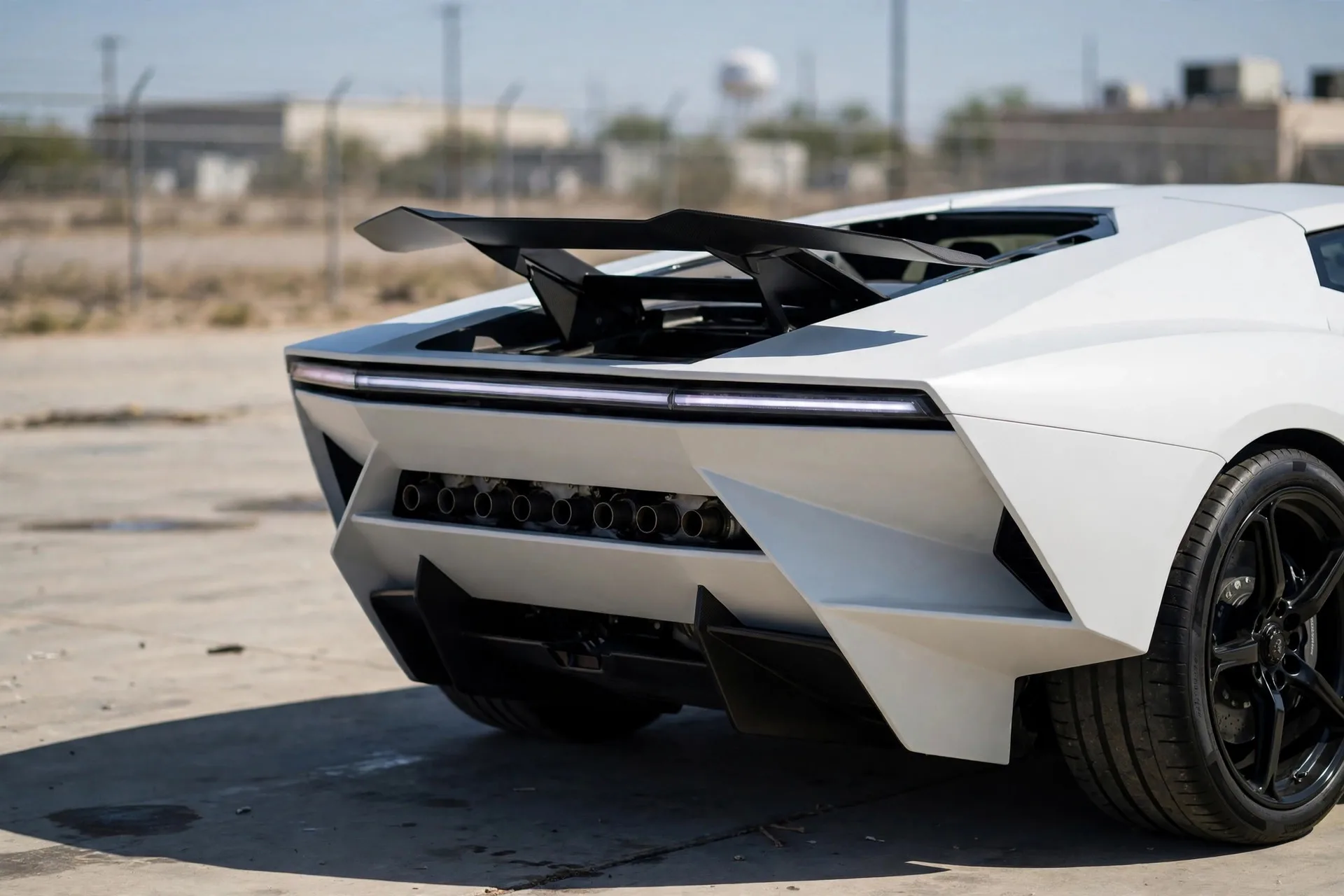
First, the correction that matters most: these are not rocket engines. A cold-gas thruster is a nozzle that releases highly pressurised gas — in this case, plain compressed air — without burning anything. No combustion, no fuel, no flame. The system is SpaceX-derived, the same attitude-control idea that steers Dragon capsules, scaled up from nudging a spacecraft to shoving a car. Ten nozzles around the body: four at the rear for forward thrust, six more for altitude, attitude, and rotation. The air lives in carbon-fibre overwrapped pressure vessels — COPVs — packed into every usable void in the car, about 600 litres of it, at a reported working pressure of 10,000 psi. The tank can be refilled between runs. Nothing explodes. That is the point.
The numbers around the system are specific enough to respect. The four rear thrusters produce over 80 kN of thrust, per engineering chief Lars Moravy — roughly eight tonnes of push, several times what the tyres can transmit, which is why the car can out-accelerate its own grip. Alongside the thrusters sits the fan-based suction system under the floor, which Tesla says generates up to 2G of downforce, enough to hold the car to an inverted ramp. Steer-by-wire, an active rear wing, and a shape borrowed from the SR-71 and the F-35 complete the package. This is not a concept sketch. It is hardware, built by two companies that know how to build hardware, and it worked in front of witnesses.
But every system has a budget, and this one is measured in seconds. One charge of the thrusters lasts about five to six seconds, per InsideEVs. Five seconds of thrust buys a hop, a flip, and a landing — the exact sequence Tesla showed. It does not buy a flight. After the tanks empty, the Roadster is a heavy electric car with a fan underneath, waiting for a refill. Tesla has published no height, no distance, and no duration for the Rocket’s flight, because there is no flight to publish yet. Musk floated the next stunt at the reveal — jumping the Snake River Canyon, where Evel Knievel tried to cross in a steam rocket — which tells you where this story is headed: bigger stages, same five seconds.
R07Chapter 04
Hop vs Flight: The Line That Matters
So: can it fly? The honest answer depends on the verb. If “fly” means “leave the ground under its own power, move through the air, and land under control,” then yes — for about five seconds, a few feet up, in a straight line, with nobody aboard. If “fly” means what the word means to everyone else — sustained, controlled, useful flight, the kind you could repeat, steer somewhere, and come back from — then no, and nothing Tesla has shown suggests it is close. The Smithsonian’s curator of vertical flight said it before the event, plainly: “We are literally talking about hopping.” Hopping is not a lesser achievement. It is a different one. Conflating the two is how a stunt becomes a lie.
The regulators agree, which is why the Rocket is invite-only and not approved for public roads. A car with perimeter nozzles has no homologation path: pedestrian safety rules do not have a chapter for 10,000-psi air jets, crash testing does not cover COPV tanks packed into the body, and no FAA sign-off for powered lift has been reported. Tesla has not published a regulatory pathway for a road-legal car with rocket thrusters, and the fine print says the Rocket feature is not approved for public-road use. The flying car is, legally, a closed-circuit experimental vehicle. You cannot buy it, you cannot register it, and you cannot fly it to work. You can watch it, on a stage, for five seconds.
What would change the verdict? Three things, in order. An independent test: a production car, timed by a third party, posting a number nobody at Tesla touched. A production date that holds: 2028, from a company that has moved this car’s date at least eight times since 2017. And a flight that lasts: not a hop over five parked cars, but a sustained, steered, repeatable flight with a human aboard and a regulator watching. Until then, the Roadster is the most spectacular five seconds in car history — and five seconds is exactly what it is.