Preview — Ferrari
Ferrari Deleted the Hybrid. The 296 Got Faster.
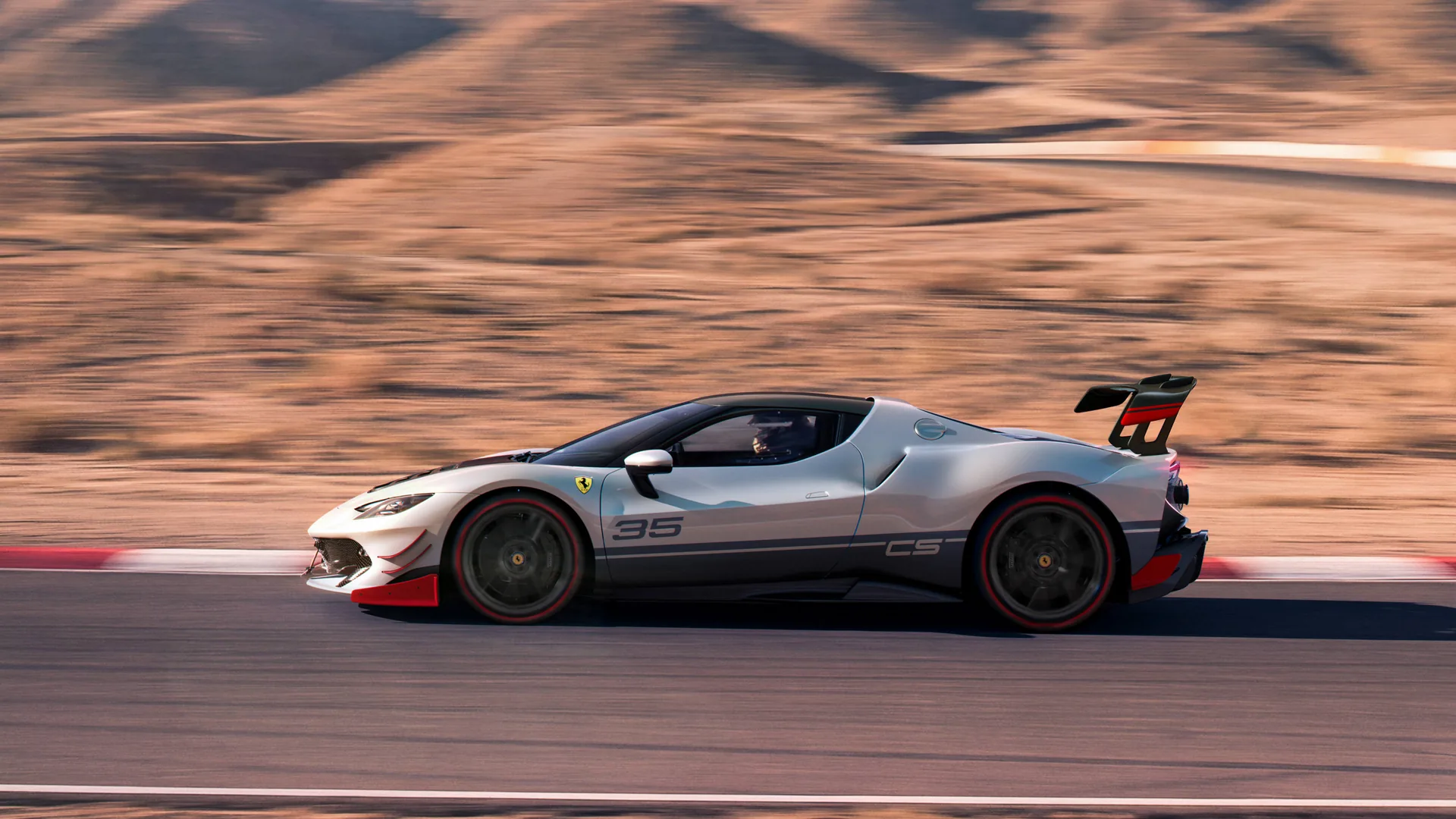
670 hp. 1,330 kg. A fixed wing and no battery. The race car, with plates.
Ferrari 296 Challenge Stradale · November 23, 2026 · The Torque Wrench · Preview
670 CV
Twin-turbo V6, no hybrid (661 hp)
1,330 kg
Dry — same as the race car
2.8 s
0–100 km/h, Ferrari
617 kg
Downforce at 250 km/h
1:18.5
Fiorano, Ferrari's claim
€291,000
Italy price — US not yet announced
Full disclosure: The Torque Wrench hasn't driven it — nobody outside Ferrari has. The car was revealed on November 21, 2026, at the Finali Mondiali in Barcelona, and the first customer cars don't arrive until the second quarter of 2027. What follows is the verified breakdown: which numbers are Ferrari's word, which are reported, and which are still just estimates.
The news, straight: Ferrari has built a 296 with no hybrid system at all. The 2,992 cc twin-turbo V6 works alone, making 670 CV (661 hp) — 160 CV less than the 296 GTB's hybrid-assisted total. The battery, the motor and the wiring are gone, and with them 140 kg: the Challenge Stradale weighs 1,330 kg dry, the same as the 296 Challenge Evo race car it was developed alongside. Then Ferrari bolted on the race car's fixed wing and lapped Fiorano in 1:18.5 — half a second quicker than the 880-CV 296 Speciale, three seconds quicker than the GTB. Less power. Faster car. Ferrari spent five years telling us the future was electric, then built the car that deletes the electricity.
And the question that makes this car worth a whole story: is this a one-off act of nostalgia, or is it the direction? The answer is in the price list. The Challenge Stradale is not a limited edition. It is not allocation-only. It is a standard range model, open to any customer who walks into a dealer — the opposite of the Speciale, which you can only buy if Ferrari already likes you. Ferrari didn't build a collector's piece. It built a car anyone can order, with the hybrid deleted and a wing bolted on. That is either the bravest thing Maranello has done in a decade, or the most honest.
R03Chapter 01
The Deletion That Made It Faster
Start with the subtraction, because it is the whole car. The 296 GTB is a plug-in hybrid: a 663-CV V6 plus an electric motor, 830 CV combined, a 7.45 kWh battery, and 25 km of silent running nobody asked a Ferrari for. The Challenge Stradale throws all of it away. The V6 — the same one from the 296 Speciale, retuned for combustion-only duty — makes 670 CV (661 hp) on its own, and that is the entire powertrain. No motor. No battery. No eManettino Qualify mode. No silent mode. The car lost 160 CV and 140 kg in the same operation, and Ferrari's own stopwatch says it got faster.
The number that proves it is 1:18.5. That is Ferrari's claimed Fiorano lap for the Challenge Stradale — half a second quicker than the 296 Speciale, which has 210 CV more, and three seconds quicker than the GTB it replaces in the affections of anyone who cares about lap times. The Speciale is still the quicker car at a high-speed circuit like Monza, where its extra power and lower drag count for more than the Stradale's aero — Ferrari says so itself. But at Fiorano, a tight, technical track, weight and downforce beat power. The Challenge Stradale is 80 kg lighter than the Speciale and makes 617 kg of downforce against the Speciale's 435 kg. Physics did the rest.
One asterisk, because Ferrari's own spec sheet carries it: the 1,330 kg dry weight and the 1.98 kg/hp ratio are quoted with optional lightweight equipment installed. The base car, without the options, will weigh more — Ferrari hasn't said how much more. It is a small footnote on a big number, and it is exactly the kind of footnote this site exists to catch. The honest version: the Challenge Stradale is 140 kg lighter than the GTB as Ferrari configures it for the brochure, and the same weight as the race car it was developed alongside. Even with the footnote, that is a serious diet.
Ferrari test driver Marc Gené drove the finished car at Mugello before the reveal, and Ferrari's magazine quotes his verdict: 'Guys, it's exactly like driving an actual racecar!' Test drivers say things like that about every new car. The difference here is that the claim is checkable: same dry weight as the Challenge Evo, same wing, same aero philosophy, same tyres. The Challenge Stradale is not a GTB with a bodykit. It is the race car with number plates, and the name on the back says so — Challenge Stradale, the same name Ferrari put on the 360 in 2003, when it did exactly this for the first time.
1,330 kg
Dry — the same as the Challenge Evo race car it was developed alongside, and 140 kg less than the 296 GTB.
Ferrari deleted the hybrid. The car got faster. The argument is over.
— The Torque Wrench
R04The Outlook
Preview
Ferrari 296 Challenge Stradale — November 23, 2026
Full verdict after independent testing
The Verdict Before the Verdict
So what would make the Challenge Stradale a success? Three things, and they are all still unproven. First, the lap time: Ferrari's 1:18.5 has to survive an independent test, on a track that isn't Fiorano, against a stopwatch Ferrari doesn't own. Second, the price: €291,000 in Italy is fair for a car this focused; a US price that creeps past $350,000 with options puts it against cars that were never meant to be this compromised. Third, the road: a fixed wing, a stripped interior and a race car's setup have to be liveable somewhere other than a circuit, or the Challenge Stradale becomes a garage queen with a great spec sheet — the fate of every hardcore special that forgot people drive to the track.
And what would sink it? The same list, read backwards. A Fiorano time that doesn't repeat. A US price that makes the Speciale look like value. A ride so stiff and a cabin so bare that owners trailer it everywhere and never learn what the V6 sounds like at 8,500 rpm. And the quietest risk of all: that Ferrari built the car its engineers wanted and its customers only admire. The 360 Challenge Stradale worked because people drove it. The 296 has to do the same, or the name becomes a museum piece.
What Torque Authority will track, in order: the first independent test, Ferrari's official US price, and the first customer delivery in the second quarter of 2027. Until then, this is a preview of a promise — a 296 with the hybrid deleted, a wing bolted on, and a lap time that embarrasses the flagship. Ferrari spent five years telling us the future was electric. Then it built a car that deletes the electricity and goes faster. Tighten it 'til it sings.
What we love
- The deletion itself. No battery, no motor, no 140 kg of apology — the hybrid is gone and the car is faster for it. Ferrari's own Hybrid Fight-Back, built in Maranello.
- The Fiorano number. 1:18.5 — half a second quicker than the 880-CV Speciale, three quicker than the GTB. Less power, faster car. The stopwatch doesn't care about your press release.
- The wing. A fixed rear wing on a road Ferrari, straight off the Challenge Evo, making 617 kg of downforce at 250 km/h. It looks like a race car because it nearly is one.
- Anyone can buy one. Not limited, not allocation-only, no 'existing relationship' gate like the Speciale — a standard range model any customer can order.
- The name, earned. Twenty-three years after the 360 Challenge Stradale, the recipe is identical: take the race car, make it road-legal, delete everything that isn't speed.
What could be better
- Slower in a straight line. 0–200 km/h in 7.9 s against the GTB's 7.3, top speed over 300 km/h against the GTB's 330. The wing and the missing motor both take their cut — the CS wins on track, not on the autobahn.
- No independent test exists. Every performance number on this page is Ferrari's word, and nobody outside Maranello has driven the car.
- The price is a report, not a number. €291,000 in Italy is solid; the ~$320,000 US figure is a conversion, and Ferrari hasn't announced US pricing.
- The stripped interior is a gamble. Ferrari says the cockpit can be optioned without 'superfluous trim' for further weight savings — read: the car you actually want to live with costs more than the car on the poster.
- The Speciale still exists. For the money, the 880-CV hybrid is faster at Monza and faster to 200 km/h — the CS is the purist's car, not the fastest 296. Ferrari will sell you either, and that is the awkward part.
Technical specifications
- Powertrain
- 2,992 cc 120° twin-turbo V6, no hybrid — 670 CV (661 hp) @ 8,000 rpm (Ferrari)
- Torque
- 740 Nm (546 lb-ft) @ 6,250 rpm (Ferrari, via Autocar India)
- Gearbox
- 8-speed dual-clutch F1, rear-wheel drive (Ferrari)
- Performance
- 0–100 km/h 2.8 s, 0–200 km/h 7.9 s, top speed over 300 km/h (186 mph) (Ferrari, via Autocar India)
- Fiorano lap
- 1:18.5 claimed — 0.5 s quicker than the 296 Speciale (1:19.0), 3.0 s quicker than the 296 GTB (1:21.5, derived from Ferrari's Speciale comparison) (Ferrari, via MotorBiscuit)
- Weight
- 1,330 kg dry — 140 kg less than the 296 GTB, same as the 296 Challenge Evo race car; figure quoted with optional lightweight equipment (Ferrari)
- Downforce
- 617 kg @ 250 km/h — 72% more than the 296 GTB (Ferrari)
- Tyres & brakes
- Pirelli P Zero R / P Zero Trofeo RS; carbon-ceramic brakes, 398 mm front / 380 mm rear (Ferrari)
- Price
- €291,000 in Italy incl. VAT (~$320,000); US price not yet announced — Car and Driver reports ~$307,000 (Hypebeast; Car and Driver via AutoNewsX)
- Availability
- Standard range model, not limited, open to any customer; European deliveries from Q2 2027, US deliveries expected Q3 / late 2027 (Ferrari execs via Daily Fox News; Hypebeast)
R05Chapter 02
The Wing Is the Point
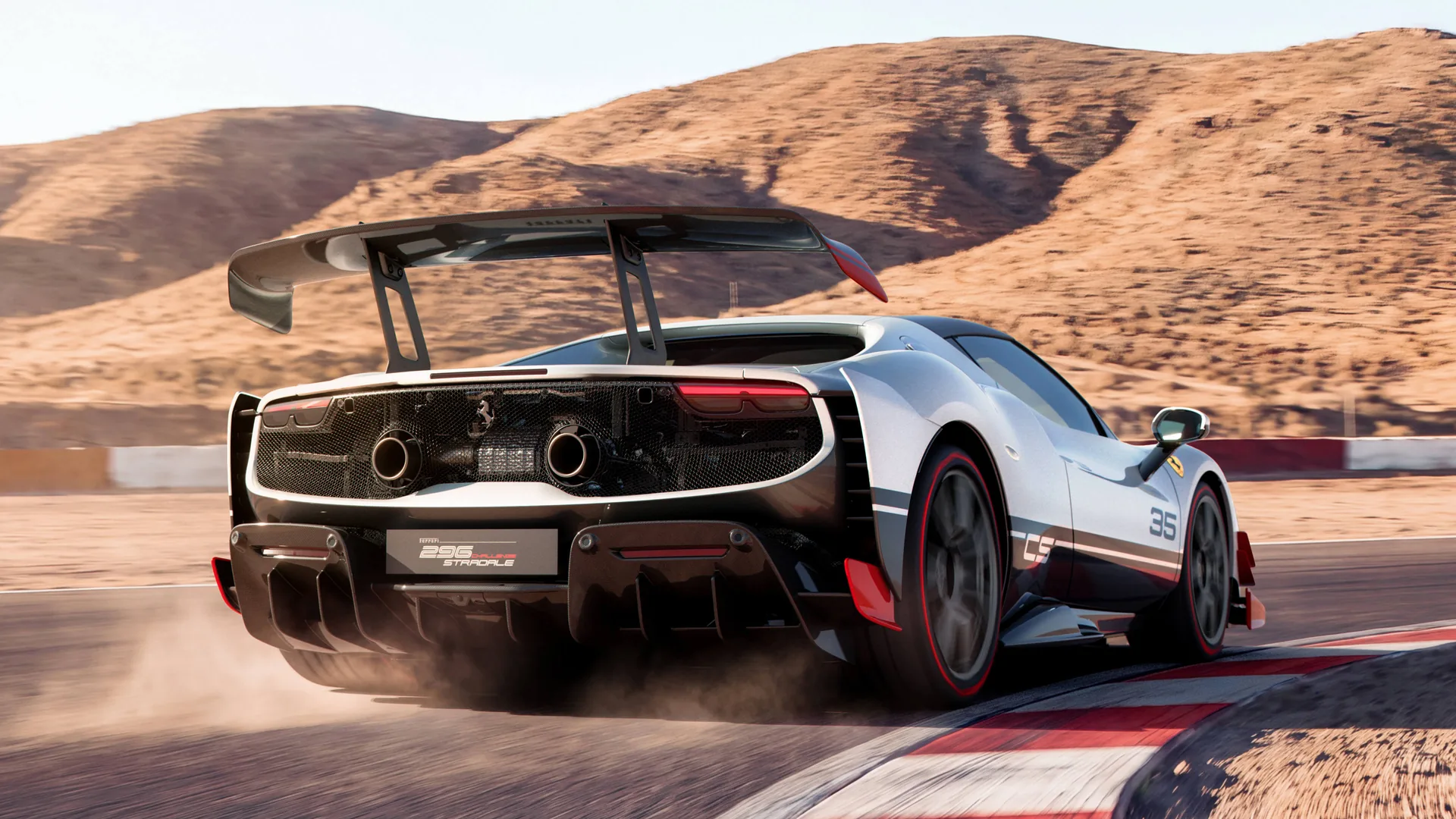
Look at the back of the car and the argument is over. A fixed rear wing, on a road Ferrari, big enough to see from the next county. It is the Challenge Evo's wing, carried over with the splitter, the flick, the aero damper, the vortex generators and a fully enclosed underbody — an integrated system, not a styling exercise. Together they make 617 kg of downforce at 250 km/h. That is 72% more than the GTB, and it is the difference between a car that leans on its tyres and a car that leans on the air.
The wing is also the reason the Challenge Stradale is slower in a straight line than the car it replaces, and Ferrari doesn't hide it. The GTB does 0–200 km/h in 7.3 seconds and tops out at 330 km/h. The Challenge Stradale needs 7.9 seconds to 200 km/h and tops out at over 300 km/h — the motor is gone, the drag is up, and the wing is doing exactly what wings do. On a motorway, the GTB wins. On a circuit, the Stradale wins by three seconds a lap at Fiorano. Ferrari has chosen its battlefield, and it is not the autobahn.
That choice is the whole point of the car, and it is why the Challenge Stradale matters more than its spec sheet. Every other manufacturer in this segment is adding power and adding weight and calling it progress. Ferrari just did the opposite: less power, less weight, more downforce, and a lap time that embarrasses the flagship. The wing is not decoration. It is the argument, bolted to the back of the car in carbon fibre.
“Ferrari took power away and made the car faster. That is not a contradiction. That is the whole point.”
R06Chapter 03
The Engine, Alone at Last
Now the engine, because for the first time in the 296's life it gets to work alone. The 2,992 cc 120-degree twin-turbo V6 is the Speciale's unit, minus the electricity: 670 CV (661 hp) at 8,000 rpm, 740 Nm (546 lb-ft) at 6,250 rpm, and an 8,500-rpm redline, driving the rear wheels through an eight-speed dual-clutch gearbox. No electric motor filling the torque hole at low revs, no battery behind the seats, no hybrid hardware between the driver and the throttle. Ferrari says the absence of a hybrid component 'underscores the direct connection between driver and accelerator, engine, and rear wheels' — which is corporate language for: the thing you feel through the pedal is now the engine, and only the engine.
The chassis got the same treatment as the powertrain. ABS Evo works in all driving conditions and in every Manettino setting — Ferrari's way of saying the electronics are there to save you, not to manage you. The tyres are Pirelli P Zero R and P Zero Trofeo RS, the brakes are carbon-ceramic, 398 mm at the front and 380 mm at the rear. The suspension is a dedicated setup with specific control systems, developed alongside the race car. Nothing here is shared with the GTB's comfort settings, because the Challenge Stradale doesn't have comfort settings. It has a race car's setup, tuned for a road car's tyres.
And the sound. Nobody has recorded it yet, and Ferrari hasn't published a decibel figure, so this is the one place the copy has to be honest about what it doesn't know. But the physics is simple: a twin-turbo V6 with no electric motor smoothing the gaps, no battery muting the exhaust, and a fixed wing shouting about its intentions. The GTB's V6 is a good engine wearing a hybrid's manners. The Challenge Stradale's V6 is the same engine with the manners removed. Spring 2027 will tell us what that sounds like. The spec sheet already tells us what it means.
R07Chapter 04
Twenty-Three Years Later, the Name Means the Same Thing
The name is the oldest thing on the car. Challenge Stradale last appeared in 2003, on the 360 — a Modena lightened and stiffened into a road-legal version of the Challenge race car, and the car that made the whole formula famous. Twenty-three years later, the recipe hasn't changed: take the race car, make it road-legal, delete everything that isn't speed. The 296 Challenge Stradale is the 360's direct descendant, and Ferrari knows it — the reveal put the road car and the Challenge Evo race car on stage together, the same weight, the same wing, the same aero, one with plates and one without.
The price is where the story gets interesting, and where it gets careful. In Italy, the Challenge Stradale costs €291,000 including VAT — roughly $320,000. Ferrari has not announced a US price. Car and Driver reports about $307,000, with US sales from the third quarter of 2027; European deliveries start in the second quarter. Until Ferrari publishes a US number, every dollar figure on this page is a report, and it stays labelled as one. What is not a report: the car is a standard range model, not a limited edition, and it is open to any customer. The Speciale, by contrast, requires an existing relationship with the brand — Ferrari decides whether you may buy one. The Challenge Stradale is the car Ferrari will sell to anyone. That is a bigger statement than the wing.
The Evo, meanwhile, is the race car the Stradale is based on: 700 hp at 7,500 rpm, a seven-speed gearbox, and a debut in the 2027 Ferrari Challenge season, which adds 40-minute endurance races from the second round at Mugello. The Stradale is the road car that shares its weight, its wing and its aero. The Evo is the race car that shares its engine. Between them, they are Ferrari's answer to the question Hybrid Fight-Back asked: what happens when the hybrid stops being the point? The answer, it turns out, is a car with less power, less weight, a bigger wing, and a faster lap time. Ferrari deleted the hybrid. The 296 got faster. The argument is over — until the first independent test, the first official US price, and the first customer delivery in 2027. This page will track all three.